
Brownie’s Marine Group: Innovation, Financial Strain, and the Challenge of Scaling Battery-Powered Diving Systems
Brownie’s Marine Group is repositioning itself with battery-powered, software-driven marine technologies and a portfolio of patented products, but persistent financial instability and competitive market pressures raise questions about its ability to convert innovation into lasting profitability.
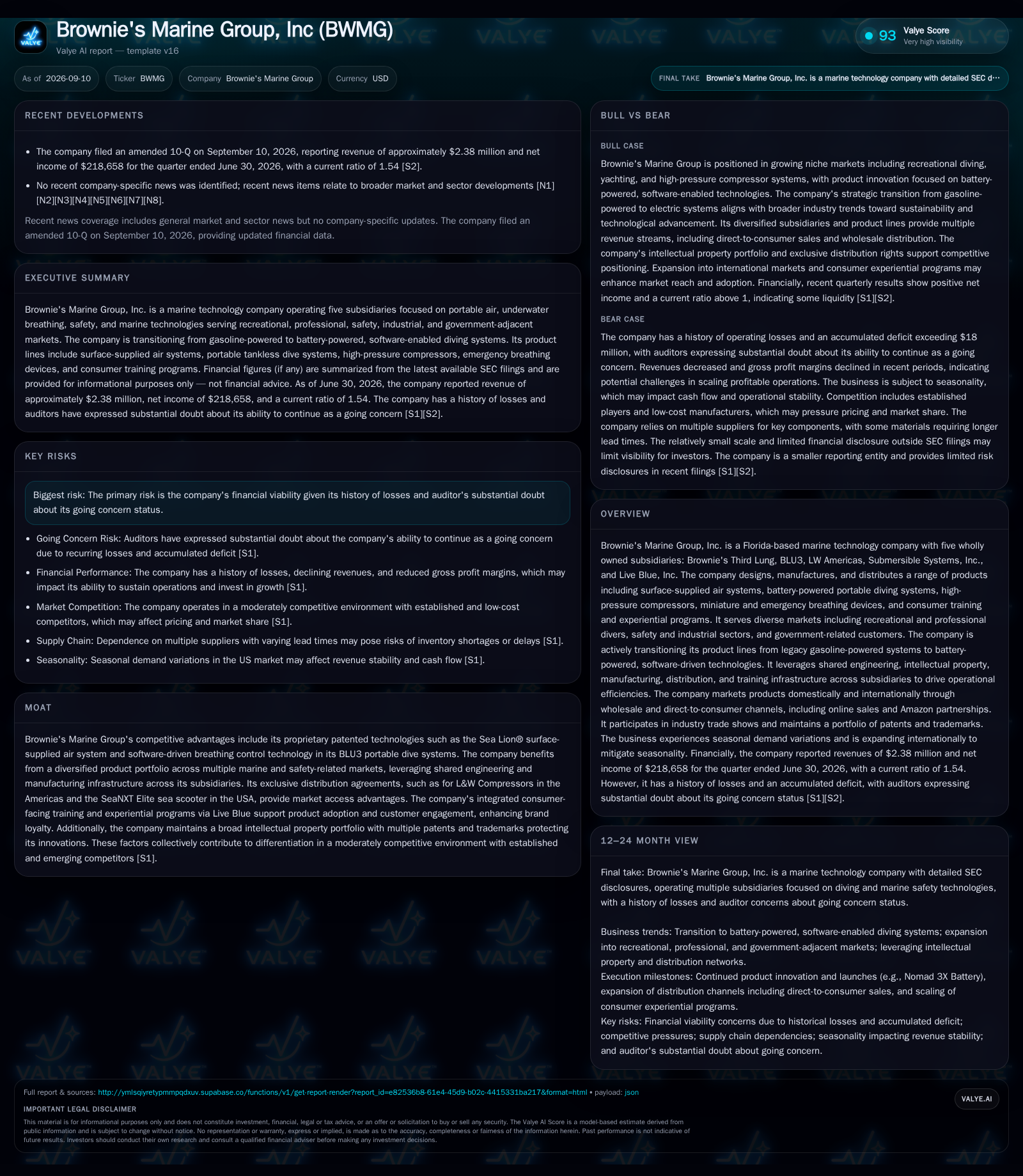
Brownie’s Marine Group is shifting from legacy gas-powered systems to battery-powered, software-enabled marine products, targeting recreational, safety, and industrial markets. Despite recent profitability in Q2 2026, the company faces a history of losses, declining revenue, eroding margins, and a substantial accumulated deficit, with auditors expressing doubt about its ability to continue as a going concern. Success hinges on scaling new product lines and international expansion, but competition, seasonality, and capital constraints present significant hurdles. The next year will test whether technological innovation can drive durable operating leverage and reverse a decade-long pattern of underperformance. [S1] [S2]
Brownie’s Marine Group, a Florida-based marine technology company, is in the midst of a strategic transition from gasoline-powered to battery-powered, software-enabled diving and marine safety systems. With five subsidiaries spanning portable air systems, emergency breathing devices, compressor distribution, and consumer training programs, the company is attempting to leverage innovation and intellectual property to expand in both recreational and professional markets. Recent quarterly profitability offers a glimmer of hope, but a long track record of operating losses, declining revenue, and auditor warnings about financial viability underscore the risks. The central question is whether product innovation and international expansion can overcome entrenched financial and operational headwinds.
Recent Profitability Masks Persistent Financial Uncertainty
Brownie’s Marine Group reported revenue of $2.38 million and net income of $218,658 for the quarter ended June 30, 2026, achieving a current ratio of 1.54 [S2]. While this marks a rare instance of quarterly profitability, it comes against a backdrop of chronic financial underperformance: the company posted a net loss of $105,149 in 2025, and its accumulated deficit stood at $18.03 million at year-end 2025 [S1]. Auditors have expressly stated substantial doubt about the company’s ability to continue as a going concern, citing recurring losses and cash depletion [S1] [S2]. Revenues declined by 8% in 2025, with gross profit margin contracting from 40.4% to 37.4% [S1]. These facts highlight a business at a crossroads, with short-term operational improvement overshadowed by long-term structural fragility.
Can Battery-Powered Systems Drive Margin Recovery?
Brownie’s economic engine is built on the design, manufacture, and distribution of marine breathing and safety systems, with a growing emphasis on battery-powered, software-enabled devices across both recreational and professional markets [S1]. The company’s economics are shaped by a blend of wholesale and direct-to-consumer sales, with wholesale channels historically dominant but e-commerce and Amazon sales increasing. The battery-powered product transition—epitomized by BLU3’s Nomad 3X Battery, which triples run time—offers the potential for premium pricing and expanded addressable markets if reliability and performance are proven in the field.
Variable costs include raw materials (machined parts, hoses, compressors, electronics) and outsourced manufacturing, while fixed costs are driven by engineering, regulatory compliance, and a relatively small workforce of 36 full-time employees [S1]. Operating leverage could be unlocked if new products achieve scale, but the company’s modest cash position ($238,754 as of June 30, 2026) and a low cash ratio (0.09) severely limit the ability to invest in inventory, marketing, or R&D without external funding [S2]. The question is whether the company can generate sufficient volume and pricing power from new platforms before liquidity constraints force retrenchment or dilution.
Defensible Niche or Margin Squeeze? Brownie’s Place in a Shifting Marine Market
Brownie’s operates in moderately competitive markets, facing established brands like Aqua Lung America and Bauer Compressors as well as low-cost Chinese manufacturers [S1]. The company’s competitive toolkit includes patented products such as the Sea Lion® surface-supplied air system and exclusive distribution rights for certain high-profile devices (e.g., SeaNXT Elite sea scooter in the USA) [S1]. These IP assets and exclusive agreements may provide some pricing insulation and customer stickiness, especially in specialized or regulated segments (e.g., emergency breathing devices for safety and government-adjacent markets).
However, the broader recreational diving and compressor segments are price-sensitive and exposed to import competition, limiting the potential for sustained premium margins. Direct-to-consumer channels could improve gross margin if customer acquisition costs are contained, but scale and brand awareness remain hurdles. Brownie’s expansion into guided tour programs and training experiences may foster adoption, but such initiatives tend to be capital- and labor-intensive, with uncertain scalability.
Switching frictions in this industry are moderate: while professional and institutional buyers value reliability and service networks, recreational customers may be price-driven and less loyal. Ultimately, Brownie’s niche positioning relies on ongoing product innovation and the ability to maintain differentiated features as battery-powered systems become mainstream.
Pathway to Scale: When Innovation Unlocks Broader Adoption
The most favorable outcome for Brownie’s would see its battery-powered, software-driven platforms—like the Sea Lion® and BLU3 lines—gain rapid adoption among recreational and professional divers, as well as yachting and safety customers. If the Nomad 3X Battery delivers as promised, it could extend usage scenarios, drive repeat purchases, and justify premium pricing, especially as regulators and consumers move away from gas-powered systems.
Expansion into international markets and the successful rollout of scalable franchise models for experiential programs could diversify revenue streams and smooth seasonality. Higher-margin direct-to-consumer sales, coupled with operational efficiencies from shared engineering and manufacturing, could lift gross margins back above 40%.
Evidence to confirm this scenario would include sustained revenue growth (return to double-digit annual increases), improvement in gross margin to prior levels or above, positive operating cash flow, and the launch of additional software-enabled or connected products that demonstrate market traction.
Incremental Progress Amid Ongoing Constraints
The most plausible trajectory is one of incremental improvement, where Brownie’s continues to introduce new battery-powered products and gradually expands its direct-to-consumer and experiential offerings, but struggles to achieve scale sufficient to dramatically alter its financial profile. Revenue may recover modestly as international sales offset US seasonality, and gross margins could stabilize if supply chain disruptions are managed and the product mix shifts toward proprietary platforms.
However, persistent capital constraints and competitive pricing pressure may prevent the company from funding aggressive marketing, R&D, or inventory builds. Operating leverage remains elusive unless volume meaningfully increases, and any gains in profitability are vulnerable to adverse macro or industry shocks.
This scenario would be confirmed by mid-single-digit annual revenue growth, gross margins stabilizing in the high-30s, and continued reliance on small-scale financing or working capital management to sustain operations.
Liquidity Crunch and Strategic Retrenchment
In the adverse case, Brownie’s fails to generate sufficient traction with new products, facing ongoing revenue declines, intensifying competition, and margin compression. Seasonality and supply chain delays could exacerbate cash flow volatility, while the low cash ratio and recurring losses heighten the risk of insolvency or forced asset sales.
If auditors’ going concern warnings materialize, the company may have to pursue dilutive financing, divest subsidiaries, or sharply curtail R&D and marketing, further eroding competitive position. In this scenario, the business is forced into retrenchment, with the possibility of bankruptcy or liquidation if external capital is unavailable.
Confirmation would come from consecutive quarters of operating losses, deteriorating gross margins, further declines in revenue, and negative operating cash flow, accompanied by emergency capital raises or asset sales under distress.
What Will Determine Whether Brownie’s Innovation Can Reverse Its Financial Trajectory?
Quarterly revenue growth rates—especially the mix of wholesale versus direct-to-consumer channels—would indicate whether new product lines are gaining traction.
Gross margin trends, particularly as battery-powered and software-enabled products scale, will reveal whether the company can offset input cost pressures and competition.
Operating cash flow (if disclosed) is a critical indicator of whether product innovation is translating into sustainable economics rather than just inventory build or receivables growth.
International sales as a percentage of total revenue, which would help test whether expansion is reducing seasonality and broadening market reach.
Adoption rates and repeat sales for flagship products like the Nomad 3X Battery and Sea Lion® battery-powered platform.
Evidence of franchise or recurring revenue models emerging from Live Blue’s experiential programs.
Changes in liquidity position (cash, current ratio) and any new financing or capital raises.
Any disclosures on customer concentration, recurring contracts, or major channel partnerships, which could impact revenue visibility and risk.
Disclaimer: This is research-only, informational analysis and not investment advice. It may include AI-generated interpretation and general industry context. Always verify important details using primary sources.

Comments