
Photronics and the Next Wave of Semiconductor Fabrication: Opportunity, Cyclicality, and Competitive Pressures
Photronics’ Q3 2026 results underscore its strategic positioning at the intersection of advanced semiconductor manufacturing and AI-driven demand, but the company’s capital intensity, customer concentration, and industry cyclicality remain central to its risk/reward profile.
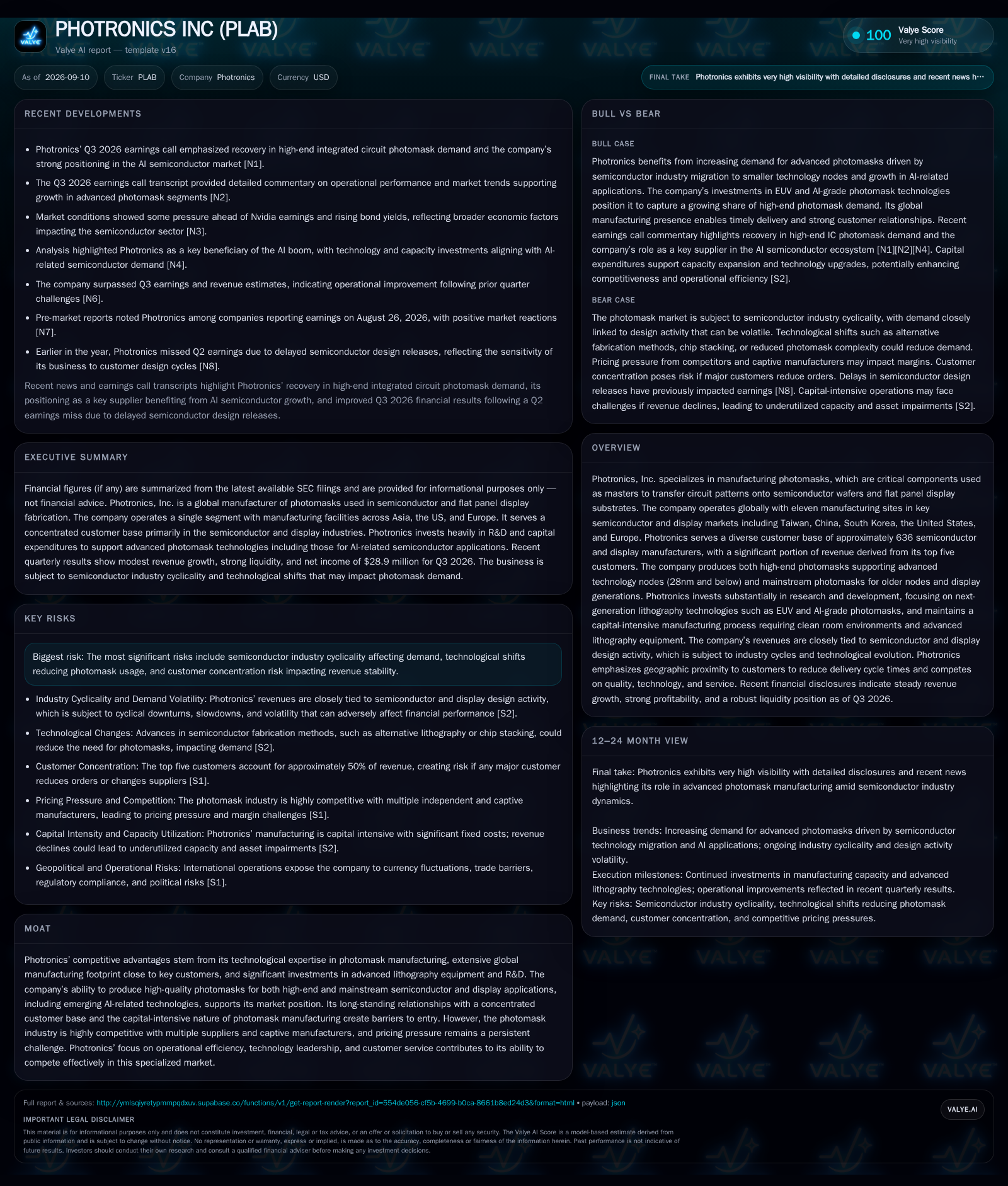
Photronics, Inc. reported Q3 2026 revenue of $216 million (up 2.9% YoY) and net income of $28.9 million, reflecting improved demand for high-end photomasks—especially those supporting AI chip designs. Its $549.5 million cash position and robust current ratio highlight balance sheet strength, while ongoing capital expenditures target leading-edge lithography and capacity expansion. However, customer concentration (top five account for ~50% of revenue), exposure to semiconductor industry cycles, and the threat of alternative chip fabrication technologies are persistent risks. The company’s fortunes hinge on continued momentum in advanced node adoption and the durability of AI-driven semiconductor growth [S1] [S2] [N1] [N2] [N4] [N6] [N8].
Photronics, Inc. sits at a critical junction in the semiconductor value chain, supplying photomasks essential for both the most advanced integrated circuits and mainstream chips. Its recent Q3 2026 results signal a recovery in high-end photomask demand, fueled by AI-driven semiconductor growth and technology migration toward smaller nodes. With a substantial cash reserve and active investment in next-generation fabrication capabilities, Photronics is positioning for continued relevance. Yet the company’s reliance on a concentrated customer base, exposure to industry cyclicality, and the constant threat of disruptive manufacturing technologies make its long-term trajectory tightly linked to the pace and direction of semiconductor innovation.
Recent Results Reflect Recovery in High-End Demand and Continued Capital Commitment
Photronics reported Q3 2026 revenue of $216 million, a 2.9% increase over the prior year, with growth concentrated in high-end integrated circuit photomasks—particularly those supporting advanced nodes and AI-related applications [S2] [N1] [N4]. Net income for the quarter reached $28.9 million, while the company’s cash and equivalents stood at $549.5 million, yielding a current ratio of 4.94 [S2]. This financial strength underpins ongoing capital expenditures, which totaled $130.4 million for the first nine months of 2026 and are projected at $255–305 million for the full year, focused on expanding technology and manufacturing capacity [S2]. Notably, the company’s Q2 miss—attributed to delayed customer design releases—underscores the volatility inherent in its end-markets [N8]. The recovery in high-end demand and operational improvement in Q3 suggest that Photronics is benefiting from renewed semiconductor design activity and the AI boom, but the durability of this rebound remains a central question.
The Economics of Photomask Manufacturing: Fixed Costs, Volume Sensitivity, and the Race for Technological Edge
Photronics’ business model is defined by the capital-intensive nature of photomask manufacturing: clean room environments, advanced lithography equipment, and rigorous inspection protocols drive significant fixed costs [S1]. Variable costs are relatively modest compared to the upfront investment in facilities and technology. As a result, operating leverage is high—incremental revenue from increased capacity utilization can flow disproportionately to the bottom line when demand is robust.
Revenue mix is split between high-end photomasks (for advanced nodes such as 28nm and below, including EUV and AI-grade masks) and mainstream products (older nodes and legacy display applications) [S1] [S2]. High-end masks command premium pricing due to technical complexity and performance requirements, but also require continual R&D and capex to remain competitive. Mainstream masks offer lower margins but provide volume stability, especially in display end-markets.
Photronics’ planned $255–305 million in 2026 capex reflects the need to stay at the technological frontier, but also increases the risk of underutilized assets if demand softens.Cash reserves; these figures do not by themselves establish operating, investment, or financing capacity, yet the business is exposed to swings in semiconductor design activity—periods of strong order flow can drive margin expansion, while downturns can rapidly erode profitability due to the fixed-cost base.
Competing on Proximity, Technology, and Service—But Facing Captive and Independent Rivals
Photronics operates in a highly specialized, globally competitive market. Its main rivals include other independent photomask manufacturers and captive mask shops run by major semiconductor and display companies [S1]. Barriers to entry are high due to capital requirements, technical expertise, and the need for close geographic proximity to customer fabs to minimize delivery times and support rapid design iteration.
Competitive differentiation hinges on product quality, technological capability (especially at advanced nodes), delivery reliability, and customer service. Photronics’ global footprint—eleven manufacturing sites across Asia, the U.S., and Europe—enables it to serve leading-edge customers directly and quickly [S1]. However, pricing pressure remains endemic, particularly from captive suppliers who may operate on a cost-plus basis or use masks as part of a broader foundry service offering.
The risk landscape is further complicated by customer concentration: the top five customers represented about 50% of 2025 revenue, amplifying the impact if a major account shifts sourcing strategies or reduces orders [S1]. Technological substitution (such as maskless lithography or advanced chip stacking) could, over time, erode demand for traditional photomasks, though adoption curves for such technologies remain uncertain.
AI-Driven Semiconductor Design Cycle Extends, Fueling High-Margin Growth
A favorable scenario for Photronics would see ongoing momentum in AI-related semiconductor innovation, with sustained migration to smaller nodes (7nm and below) and increased adoption of EUV lithography. In this environment, customers would require more complex, higher-value photomasks at greater frequency, driving both volume and average selling price expansion. Photronics’ investments in advanced technology and geographic proximity could support share gains among fabless and foundry customers, especially as time-to-market pressures intensify.
Confirmation of this scenario would include multiple quarters of accelerating high-end photomask revenue growth, rising gross margins, and evidence of new customer wins or expanded share at leading semiconductor manufacturers. Disclosures of multiyear supply agreements for advanced nodes, if provided, would further support the bull thesis. Conversely, a flattening of high-end mask demand or signals that AI-driven design cycles are peaking would challenge this view.
Cyclic Recovery with Persistent Volatility and Margin Compression Risk
The most plausible outlook is for Photronics to participate in the current upcycle, benefiting from AI and advanced node adoption, while continuing to navigate the inherent volatility of the semiconductor and display industries. Revenue would grow in line with industry design activity, with periods of strong order flow offset by occasional slowdowns tied to customer delays or macroeconomic headwinds.
Margins may see incremental improvement as high-end mix increases, but pricing pressure and the need for ongoing R&D/capex could limit operating leverage. Customer concentration remains a persistent risk, and any major customer shift would materially impact results. The base case would be confirmed by steady—if not spectacular—top-line growth, stable or modestly improving margins, and continued investment in technology and capacity. Signs of margin erosion, persistent order delays, or a reversal in advanced node demand would challenge the base scenario.
Technological Disruption or Design Slowdown Triggers Asset Underutilization
A bearish outcome would be driven by either a sharp downturn in semiconductor design activity (for example, a cyclical bust, inventory correction, or AI demand plateau) or by the accelerated adoption of alternative manufacturing techniques that reduce photomask intensity (e.g., maskless lithography or 3D chip stacking). In this scenario, Photronics’ fixed-cost infrastructure would become a liability, leading to underutilized capacity, margin compression, and possible asset impairment.
This scenario would be evidenced by sequential revenue declines, negative operating leverage, and shrinking gross margins. Capex plans might be curtailed or postponed, and commentary would likely shift to cost-cutting and restructuring. Early warning signs could include a sudden drop in orders from major customers, public announcements about alternative fabrication methods being adopted by key industry players, or a reversal in advanced node investments by leading foundries.
Testing the Photronics Thesis: Metrics and External Forces to Track
Quarterly revenue growth rates for high-end photomasks, especially those supporting 7nm and below nodes, would help test the durability of advanced node demand.
Gross and operating margin trends—particularly in relation to high-end versus mainstream product mix—would signal whether pricing power and cost absorption are improving or eroding.
Capital expenditure levels and project disclosures: Are investments keeping pace with technological change, and are they translating into higher capacity utilization?
Customer concentration metrics (if disclosed): Any change in the proportion of revenue from top customers would indicate shifting customer risk.
Order backlog or forward visibility statements (if disclosed) would provide insight into demand stability and revenue pipeline.
Industry commentary from major semiconductor manufacturers about lithography roadmaps, mask requirements, and adoption of alternative fabrication technologies could impact Photronics’ addressable market.
Any evidence of major customer insourcing, switching to captive suppliers, or adopting maskless/alternative approaches would be an early risk indicator.
Geopolitical or regulatory developments affecting cross-border semiconductor supply chains, especially in Asia, could influence operations and demand patterns.
Disclaimer: This is research-only, informational analysis and not investment advice. It may include AI-generated interpretation and general industry context. Always verify important details using primary sources.

Comments