
Showroom Expansion, Margin Pressures, and the Economics of Lovesac’s Omni-Channel Furniture Model
Lovesac’s recent results highlight a business at the intersection of physical retail investment and omni-channel strategy, as showroom-driven revenue offsets e-commerce softness. The challenge: sustaining growth and margins amid capital-intense expansion, competitive threats, and mounting cost pressures.
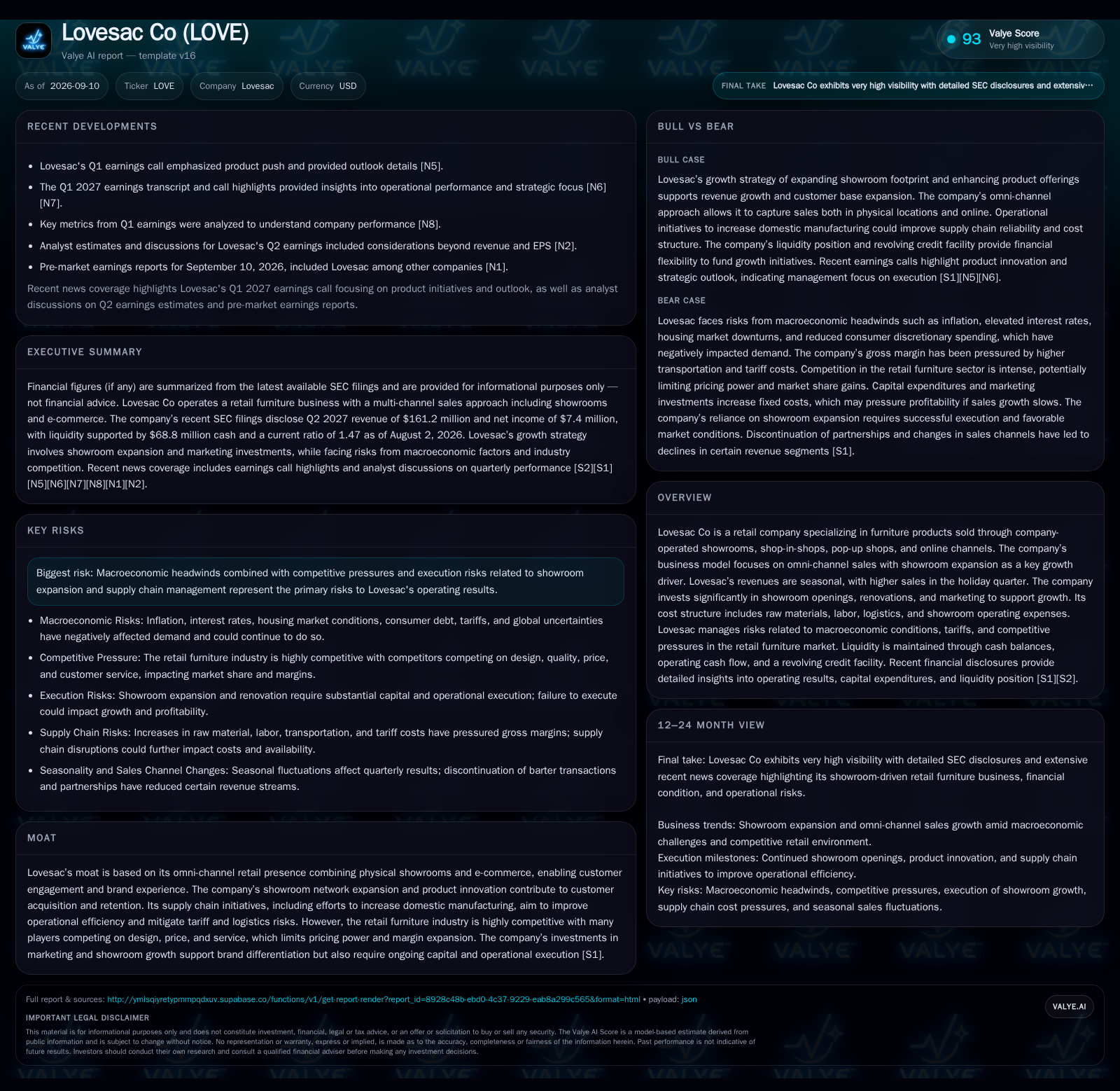
Lovesac reported $161.2 million in net sales and $7.4 million in net income for Q2 2027, driven by showroom expansion but pressured by higher costs and declining online sales. With 278 showrooms now open, the company’s strategy leans heavily on capital investment and in-person retail experience. Gross margins fell year-over-year due to transportation and tariff costs, while liquidity remains supported by $68.8 million in cash and a revolving credit line. The key questions are whether showroom-led growth can outpace rising expenses and if omni-channel execution can fend off competitors in a volatile discretionary spending environment. [S1] [S2]
Lovesac’s latest financials reflect a business doubling down on brick-and-mortar growth just as macroeconomic and cost headwinds intensify. With nearly 10% showroom sales growth offsetting online softness, the company’s strategy pivots on physical presence and experiential retail, even as gross margins narrow and capital needs rise. This creates a high-stakes operating environment: Lovesac must prove that investing in showrooms delivers sustainable revenue and margin expansion in a market where consumers are price-sensitive, competitors are aggressive, and supply chain volatility remains a threat. The next leg of the story will depend on whether in-person retail can consistently deliver growth and justify the fixed costs.
Recent Results: Showroom Growth and Margin Compression Define the Quarter
Lovesac reported net sales of $161.2 million and net income of $7.4 million for the quarter ended August 2, 2026 [S2]. The company ended the period with 278 showrooms, having opened 28 and closed 7 over the fiscal year [S1]. Showroom sales rose 9.9%, while internet sales fell 2.0% and other sales declined sharply due to discontinued partnerships and barter transactions [S1]. Gross margin dropped to 56.4% from 58.5% a year earlier, pressured by higher inbound transportation and tariff costs, only partially offset by price increases and vendor concessions [S1]. Liquidity remained stable, with $68.8 million in cash, a current ratio of 1.47, and access to a $40 million revolving credit facility [S2]. These facts set the stage for a business model that is growing its physical footprint, but at the cost of eroding margins and rising operational complexity.
How Lovesac’s Omni-Channel Model Translates to Profitability—And Where It’s Vulnerable
Lovesac’s economics are shaped by a blend of showroom-driven sales and e-commerce, with physical locations now the primary growth driver. Showroom expansion requires substantial upfront capital—$24 million in fiscal 2026 was spent on new openings and corporate investments [S1]—and ongoing fixed costs in rent, payroll, and marketing. This creates operating leverage: higher showroom sales can improve profitability, but if sales growth falters, fixed costs could quickly pressure margins.
Gross margin erosion in the latest period, despite price increases, signals the vulnerability of Lovesac’s model to supply chain shocks and rising tariffs. The company’s gross margin of 56.4% remains strong by retail standards, but the direction matters: a decline of over 200 basis points year-over-year reflects the challenge of passing higher costs onto consumers in a competitive environment [S1]. Meanwhile, marketing expenses are rising, now at 12.7% of net sales, and selling, general, and administrative (SG&A) costs are up due to higher payroll, rent, and impairment charges [S1].
The capital structure is typical for a retail growth company: funded by a mix of cash, operating cash flow, and a $40 million revolver [S1] [S2]. The risk is that working capital needs rise seasonally (especially pre-holiday), and any sales disappointment or cost overrun could stress liquidity. Lovesac’s business is thus a bet on volume growth outpacing cost inflation and capital outlays—a dynamic that can swing quickly in either direction.
Physical Experience as Differentiator—But Competitive Pressures Remain Relentless
Lovesac’s current approach leans heavily on the in-person retail experience—showrooms as both sales and brand engagement vehicles. This can create switching frictions for customers who value tactile product trials and design consultations, potentially building loyalty and reducing price sensitivity.
However, the retail furniture sector remains fiercely competitive, with rivals ranging from digitally native brands to large-scale home furnishing chains. Most compete on design, perceived quality, price, and customer service [S1]. The closure of shop-in-shops (notably at Best Buy) and declining online sales suggest that Lovesac’s omni-channel strategy may be more defensive than offensive: it is shoring up its strongest channel rather than expanding share across all fronts.
Product innovation and efforts to increase domestic manufacturing could help Lovesac lower supply chain risk and differentiate on quality or lead time, but these advantages are not yet proven at scale. The company’s moat—if it exists—rests on the effectiveness of its showroom network and brand, but neither is immune to aggressive discounting or new entrants with innovative business models.
When Showroom Investment Pays Off: The Path to Higher Sales and Margin Recovery
The most favorable outcome for Lovesac would see showroom expansion fueling sustained same-store sales growth, with each new location ramping efficiently and contributing to operating leverage. If the in-person experience proves uniquely valuable—driving higher average order values, improved customer retention, and stronger brand affinity—then the fixed costs of expansion could be more than offset by incremental gross profit.
A recovery or stabilization in gross margin, perhaps via further domestic sourcing, improved logistics, or successful price increases, would reinforce this dynamic. Evidence confirming this scenario would include: accelerating comparable showroom sales, gross margin expansion despite ongoing cost pressures, and positive operating cash flow even as the company invests in growth. If Lovesac can also reignite digital sales—perhaps through better integration of showroom and online experiences—it could further amplify the upside.
Balancing Growth and Margin: The Most Plausible Near-Term Trajectory
The most likely scenario is one of moderate revenue growth led by showroom expansion, but with continued margin pressure and operating cost inflation. Lovesac’s showroom investments are likely to deliver incremental sales, but the company may struggle to fully offset higher transportation, tariff, and labor costs in the short term.
Gross margin could stabilize at the lower 56–57% range if cost pressures ease or if further price increases stick, but a return to prior peaks may prove difficult unless supply chain conditions improve materially. Liquidity remains adequate, but working capital needs will rise in the pre-holiday build-up, keeping the company reliant on operating cash flow and its credit facility.
Confirmation of this scenario would be quarterly results showing steady but unspectacular showroom sales growth, flat or slightly declining internet sales, stable (but not expanding) gross margin, and SG&A growth tracking close to sales.
Fixed Cost Drag and Demand Weakness: How the Model Could Unravel
The adverse scenario centers on a slowdown in consumer discretionary spending—whether from macroeconomic shocks, housing market softness, or persistent inflation—which would erode showroom traffic and sales. In this case, Lovesac’s high fixed cost base (from rent, payroll, and marketing) would become a liability, compressing operating margins and straining cash flow.
If cost inflation persists (especially in transportation, labor, or tariffs) and the company is unable to raise prices or secure further vendor concessions, gross margins could fall further. A disappointing holiday season could accelerate inventory buildup and force discounting, further pressuring profitability. Any stumble in showroom ramp-up efficiency, or an inability to reignite digital sales, would compound the problem.
Evidence that this scenario is playing out would include declining same-store sales, further gross margin contraction, negative operating cash flow, and increased reliance on external financing or credit facilities to fund operations.
What Will Prove Whether Lovesac’s Showroom Strategy Can Deliver Sustainable Returns?
Quarterly comparable showroom sales growth—if disclosed—will be critical to assessing whether new locations are ramping successfully or cannibalizing existing stores.
Gross margin trends, especially in relation to input cost inflation and tariff exposure, will reveal whether the company can regain pricing power or improve supply chain efficiency.
The trajectory of internet sales: a return to growth would suggest omni-channel integration is working; continued decline would raise concerns about digital competitiveness.
Operating cash flow relative to capital expenditures, particularly during seasonal inventory builds, will test the sustainability of the expansion strategy.
SG&A leverage: whether overhead costs are rising in line with, or faster than, sales will indicate operating discipline.
Inventory levels and markdown activity in the holiday quarter could signal demand strength or weakness.
Updates on domestic manufacturing or supply chain initiatives would help gauge the company’s ability to mitigate cost pressures.
Any changes in credit facility utilization or liquidity position, especially following periods of high capital spending, would highlight potential financial stress.
Disclaimer: This is research-only, informational analysis and not investment advice. It may include AI-generated interpretation and general industry context. Always verify important details using primary sources.

Comments