
Caleres’ Multi-Channel Footwear Model: Earnings Momentum, Liquidity Limits, and What Could Shift the Narrative
Caleres delivered net income growth and beat Q2 2026 expectations, but its modest liquidity and competitive pressures highlight a delicate balance between capital returns, operational execution, and external risks. Examining brand leverage, channel strategies, and scenario drivers reveals where the next inflection point could emerge.
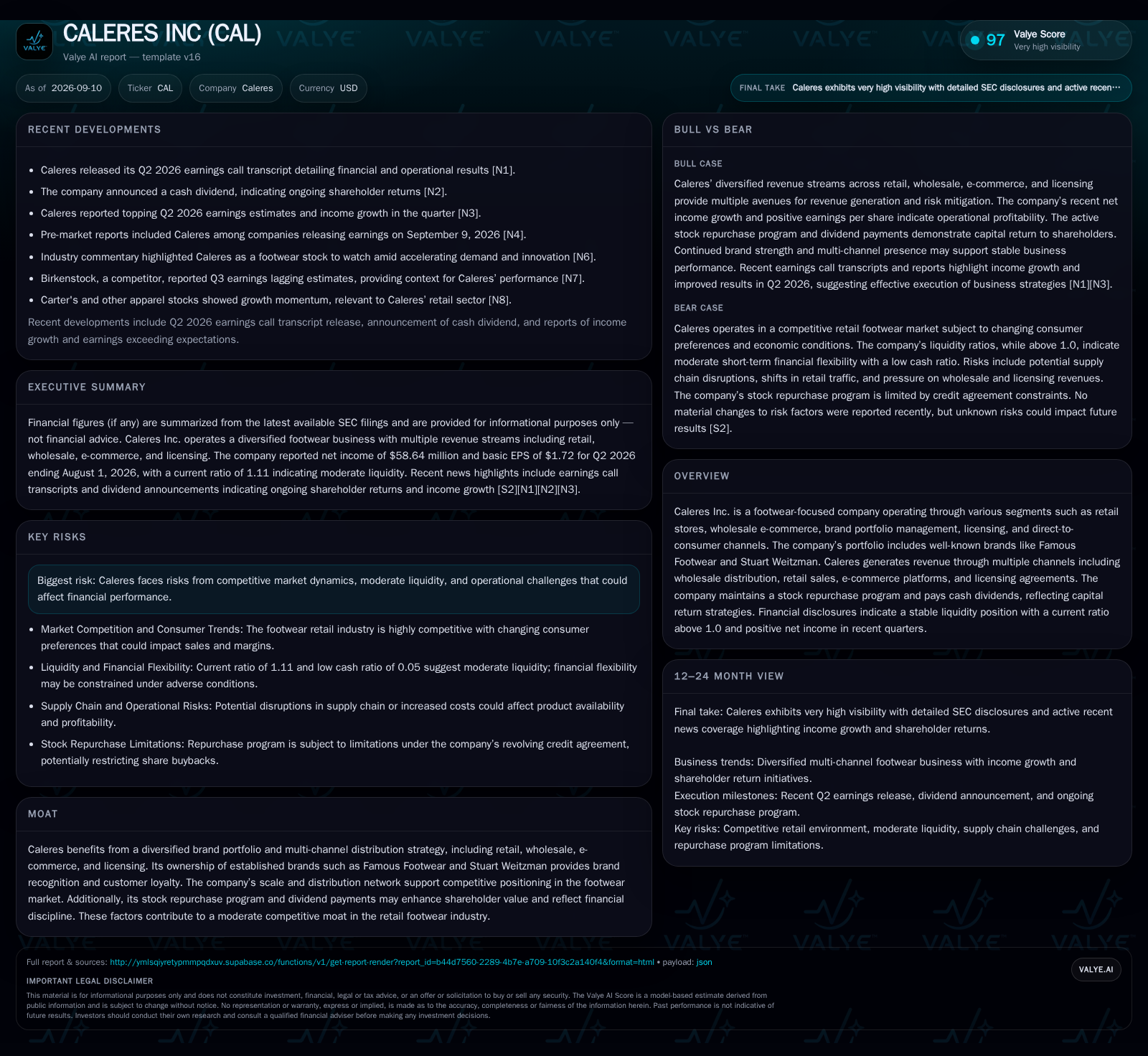
Caleres posted $58.64 million in net income and $1.72 in EPS for Q2 2026, exceeding expectations and supporting dividend payments and continued buybacks. While a diversified retail, wholesale, e-commerce, and licensing model underpins revenue resilience, a current ratio of 1.11 and a low cash ratio signal only moderate short-term flexibility. The core question is whether Caleres’ scale and brand assets can maintain earnings momentum amid shifting consumer demand, supply chain cost challenges, and ongoing capital allocation constraints. Watch for signs of sustained margin improvement, e-commerce mix gains, and inventory discipline as leading indicators of directional change. [S2] [N1] [N2] [N3]
Caleres Inc. stands at a crossroads typical of modern retail operators: it has demonstrated resilience through a multi-channel approach and posted robust Q2 2026 results, yet faces persistent questions about the sustainability of its earnings trajectory and balance sheet flexibility. The company’s ability to convert brand equity and channel diversity into durable profit growth will be tested by external volatility and internal capital constraints. As management continues to prioritize shareholder returns via dividends and buybacks, the real test is whether operational execution and channel mix can offset sector headwinds and liquidity limits. The coming quarters will reveal whether Caleres can strengthen its competitive position or if structural challenges will cap its upside.
Recent Earnings Beat and Capital Returns Define the Current Landscape
Caleres reported $58.64 million in net income and basic EPS of $1.72 for the quarter ended August 1, 2026, topping analyst estimates and signaling positive operational momentum. The company’s liquidity profile shows a current ratio of 1.11 and a cash ratio of just 0.05, indicating that while Caleres is covering near-term obligations, its cash reserves are slim relative to its liabilities. Active shareholder return policies are evident: during Q2, the company repurchased 544 shares at an average price of $14.14, and over 3.1 million shares remain authorized for buyback. Management also announced a cash dividend, further committing to ongoing capital returns. These facts define a company with recent earnings strength but limited financial slack, operating in a sector where flexibility and execution are critical. [S2] [N1] [N2] [N3]
How Caleres Makes Money: Channel Mix, Brand Leverage, and Margin Levers
Caleres generates revenue through a blend of retail stores, wholesale distribution, e-commerce platforms, and licensing agreements. This multi-channel structure offers some insulation against volatility in any one segment—if retail traffic softens, for example, e-commerce or wholesale could potentially absorb the slack. The company’s portfolio includes mass-market (Famous Footwear) and premium/luxury (Stuart Weitzman) brands, which may support tiered pricing and yield management. Gross margin dynamics in footwear retail are typically shaped by product mix, inventory discipline, and promotional cadence, with private-label and owned brands often delivering higher margins than third-party or wholesale lines.
On the cost side, variable expenses such as cost of goods sold, distribution, and store operating costs dominate, but there is potential for operating leverage if revenue per store or per digital transaction rises. Capital needs are moderate compared to asset-heavy retailers, but inventory investment and working capital management remain critical—especially with a current ratio just above 1.0. If Caleres can grow its direct-to-consumer (DTC) and e-commerce mix, margins may improve, but this depends on digital marketing efficiency and the ability to avoid excessive discounting.
Competitive Pressures and Differentiation in a Fragmented Footwear Market
The U.S. footwear market is highly fragmented, with competition from national chains, department stores, specialty boutiques, and online-first retailers. Caleres’ advantages stem from brand ownership, a broad distribution network, and the ability to target diverse consumer segments. Famous Footwear provides mass reach, while Stuart Weitzman gives access to higher-income demographics. However, these advantages are not absolute: private-label offerings from larger retailers, fast fashion, and direct-to-consumer digital brands are compressing margins and pressuring store traffic.
E-commerce has lowered switching costs for consumers, making brand and product differentiation even more crucial. Caleres’ ability to maintain customer loyalty through exclusive collections, loyalty programs, or differentiated in-store experiences could be a swing factor. The company’s moderate liquidity limits its ability to invest aggressively in technology or store refreshes compared to better-capitalized peers. Ultimately, Caleres’ moat is moderate, anchored in legacy brand equity and channel reach but challenged by digital disruptors and shifting consumer behaviors.
Unlocking Value Through Digital Acceleration and Brand Premiumization
If Caleres leverages its brand portfolio to drive a higher mix of DTC and e-commerce sales—particularly with premium or exclusive products—margin expansion could follow. Successful inventory management and targeted digital marketing may reduce markdown rates and enhance full-price sell-through, supporting both top-line growth and profitability. Shareholder returns through dividends and buybacks could further boost investor confidence, attracting new capital and potentially lowering the company’s cost of equity.
Confirmation of this scenario would come from sustained increases in e-commerce growth rates, higher gross margins, reduced inventory days, and repeated earnings beats. Accelerated store productivity or evidence of customer migration from wholesale to DTC channels would also validate the thesis. Conversely, stagnation in digital penetration or persistent promotional intensity would call the upside into question.
Multi-Channel Stability, Incremental Gains, and Persistent Margin Pressures
The most plausible trajectory for Caleres is one of incremental improvement: steady, if unspectacular, revenue growth across retail, wholesale, and e-commerce, with brand strength partially offsetting sector headwinds. Operating margins may remain pressured by competitive discounting and input cost volatility, but cost discipline and inventory management keep profitability positive. Capital returns continue, but at a measured pace, constrained by liquidity considerations and credit agreement limits.
Evidence for this scenario would include consistent, moderate earnings growth, stable or slightly improving liquidity ratios, and ongoing but modest share repurchases and dividend payments. Signs of severe margin compression, inventory build-up, or a breakdown in retail traffic would challenge the base case.
Liquidity Pinch and Margin Squeeze Could Force Strategic Retrenchment
Adverse conditions—such as a sharp decline in consumer footwear demand, supply chain cost spikes, or an inventory glut—could rapidly erode Caleres’ modest liquidity buffer. With a current ratio barely above 1.0 and low cash reserves, even a short-term sales shock or working capital squeeze could prompt reductions in store count, marketing investment, or capital returns. Intensified competition from larger retailers or digital-native brands could accelerate share loss, while persistent discounting would compress margins.
Downside confirmation would include a rapid deterioration in liquidity ratios, suspension or reduction of dividends/buybacks, significant inventory write-downs, or negative earnings surprises. Regulatory filings showing new risk disclosures or covenant breaches would also signal material stress.
Leading Indicators That Will Determine Caleres’ Next Chapter
Quarterly gross margin and operating margin trends—especially the mix between owned brands, wholesale, and DTC channels.
E-commerce and direct-to-consumer sales growth rates, if disclosed, as a sign of digital traction and margin potential.
Inventory turnover and days inventory outstanding, which would reveal discipline or risk in supply chain management.
Liquidity metrics (current ratio, cash ratio) and any changes in short-term borrowings or credit facility usage.
Pace and scale of share repurchases and dividend payments, which may signal management confidence or financial constraints.
Channel mix evolution—shifts between retail, wholesale, and e-commerce revenue, if disclosed.
Store productivity metrics such as sales per square foot or comparable store sales, if reported.
Any new risk factor disclosures or changes in credit agreement terms in future SEC filings.
Disclaimer: This is research-only, informational analysis and not investment advice. It may include AI-generated interpretation and general industry context. Always verify important details using primary sources.

Comments