
Consumers Bancorp: Profitability, Portfolio Risk, and Regional Banking Realities
Consumers Bancorp delivers solid earnings and maintains a diversified loan book, but faces classic regional bank exposures—credit risk, interest rate volatility, and limited visibility into operational levers. The critical question is whether prudent risk management and local-market strengths can offset cyclical and structural headwinds.
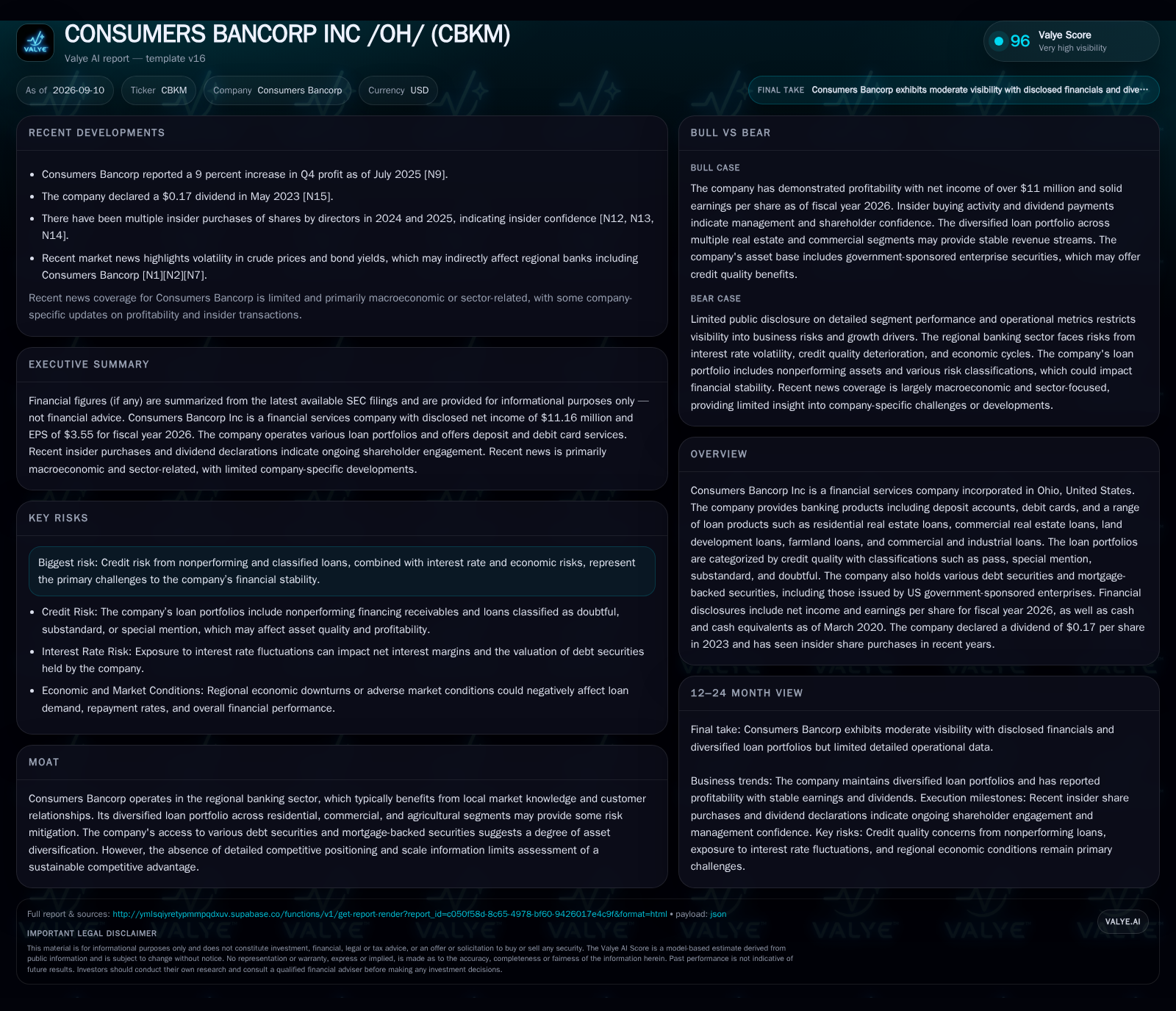
Consumers Bancorp reported $11.16 million in net income and $3.55 EPS for FY2026, reflecting ongoing profitability. The bank operates a broad portfolio of residential, commercial, and agricultural loans, but discloses the presence of nonperforming and higher-risk assets. Recent insider purchases suggest board confidence, yet limited public detail on segment performance and asset quality leaves questions about risk controls and growth levers in a challenging regional banking landscape. [S1]
Consumers Bancorp stands as a profitable, regionally focused bank with a diversified loan portfolio and visible insider support. Its $11.16 million net income for the fiscal year ended June 2026 underscores stable operations, but the bank’s exposure to nonperforming loans and lack of granular segment data leave open questions about its ability to navigate future credit cycles and interest rate shifts. With insider buying suggesting board-level optimism, the core issue is whether Consumers Bancorp’s risk management and local footprint can sustain returns amid sector-wide headwinds.
Recent Financial Results and Portfolio Composition Shape Near-Term Narrative
Consumers Bancorp reported net income of $11,164,000 and earnings per share of $3.55 for the fiscal year ended June 30, 2026, reflecting ongoing profitability in its core banking operations [S1]. The company’s loan book is diversified across residential and commercial real estate, land development, farmland, and commercial & industrial loans, with asset quality segmented into pass, special mention, substandard, and doubtful categories [S1]. Directors made insider purchases of shares in 2024 and 2025, which may be interpreted as a signal of internal confidence in the bank’s medium-term outlook. The loan portfolio includes both performing and nonperforming receivables, underscoring persistent credit risk as a central feature of its business model [S1]. These facts anchor the current thesis: Consumers Bancorp is profitable and diversified, yet faces the perennial risks of credit quality deterioration and limited transparency around operational drivers.
How Consumers Bancorp Makes—and Risks—Its Money
As a traditional regional bank, Consumers Bancorp’s revenue model is driven primarily by net interest income: the spread between interest earned on loans and securities versus interest paid on deposits and other funding sources. The company’s broad loan portfolio, spanning real estate (residential and commercial), land, agriculture, and commercial/industrial segments, provides multiple income streams and some diversification against sector-specific shocks. Mix and pricing depend heavily on local economic conditions and competitive dynamics, with loan yields and deposit costs shifting in response to broader interest rate movements.
Operating leverage is modest in banking: while fixed costs (branches, core systems, compliance) are meaningful, variable costs tied to loan growth and credit management scale with volume. Profitability can expand if loan growth outpaces cost inflation and credit losses remain contained. However, the presence of nonperforming loans and classified assets (doubtful, substandard, special mention) means credit losses can quickly erode margins if the local economy turns or underwriting proves aggressive. Funding needs are generally met through core deposits, but liquidity management and access to wholesale funding become critical if asset quality deteriorates or deposit competition intensifies.
The company’s investment in debt securities—including those from US government-sponsored enterprises and mortgage-backed securities—adds another revenue (and risk) layer, with valuation and income sensitive to interest rate changes. If rates rise sharply, Consumers Bancorp could face both margin compression (higher funding costs) and mark-to-market losses on securities portfolios.
Local Relationships and Diversification: Strengths and Structural Limits
Consumers Bancorp’s competitive position is typical of a regional bank: it likely leverages local market knowledge, established customer relationships, and community presence to attract and retain depositors and borrowers. The diversified loan portfolio—across residential, commercial, and agricultural segments—may reduce single-sector concentration risk and allow for some cross-selling of financial products.
However, the bank operates in a highly competitive landscape, facing not only other regional banks but also credit unions, national banks with digital reach, and increasingly, fintech lenders targeting niche segments. These competitors may offer lower-cost products, superior digital experiences, or more aggressive pricing—pressuring both loan yields and deposit costs. Furthermore, without significant scale, Consumers Bancorp may struggle to invest in technology, compliance, or product innovation at the pace of larger peers, potentially eroding its cost structure or customer relevance over time.
Switching costs for consumers and small businesses are typically low in banking, absent highly integrated commercial relationships or specialized loan products. Thus, retaining and growing the customer base depends on sustained service quality, pricing discipline, and local economic vitality.
If Credit Quality Holds and Local Lending Outpaces Peers
The most favorable trajectory for Consumers Bancorp would see stable or improving credit quality, with nonperforming and classified loans remaining a small fraction of the portfolio. This would preserve net interest margins and avoid costly loan loss provisions. If local economic conditions remain resilient, loan demand could grow across residential, commercial, and agricultural segments, supporting both volume and pricing power. Insider buying by directors could be an early signal of such optimism, especially if it coincides with positive credit trends and market share gains.
Confirmation of this scenario would require evidence of declining nonperforming asset ratios, expanding loan balances, and stable net interest margins—even as interest rates fluctuate. Additional upside could come from disciplined cost management and the ability to selectively grow higher-yielding loan segments without materially increasing risk. Falsification would occur if credit metrics deteriorate, loan growth stalls, or the bank is forced to increase provisions due to rising delinquencies.
Regional Bank Steady-State: Profitability with Persistent Risk
The most plausible medium-term outcome is that Consumers Bancorp continues to generate moderate profitability through its diversified loan book, but remains exposed to the classic risks of regional banking. Credit quality is likely to fluctuate within a normal range, with some quarters of elevated provisions offset by periods of benign credit performance. Loan growth may track broader regional economic trends, with limited ability to outpace the market absent new products or geographic expansion.
Operational leverage will remain contained by ongoing investments in compliance, technology, and customer service. Interest rate volatility—especially if rates remain elevated or rise further—could pressure both funding costs and securities valuations, impacting margins. Confirmation of this scenario would come from stable (but not accelerating) earnings, steady dividend payments, and credit ratios that move within historical bands. Falsification would require either a material credit event or a shift in competitive dynamics that erodes deposit or lending share.
Credit Deterioration or Funding Shocks Trigger Margin Compression
The most adverse scenario for Consumers Bancorp involves a sharp deterioration in asset quality—potentially triggered by a local economic downturn, sector-specific stress (e.g., commercial real estate), or poor underwriting discipline. Rising nonperforming loans would force the bank to increase provisions, compressing net income and potentially eroding capital buffers. In parallel, if deposit competition intensifies or wholesale funding becomes more expensive, net interest margins could be squeezed from both sides.
Additional downside risks include mark-to-market losses on securities portfolios if interest rates rise rapidly, or regulatory scrutiny if asset quality issues become pronounced. Confirmation of this scenario would be visible in spiking nonperforming asset ratios, sharply rising loan loss provisions, declining earnings, or regulatory disclosures of enforcement actions. The scenario is falsified if credit quality remains stable and funding costs are managed effectively.
Tracking What Could Shift Consumers Bancorp’s Outlook
Trends in nonperforming assets and the ratio of classified loans (doubtful, substandard, special mention) to total loans, if disclosed, would provide direct insight into credit risk and asset quality trajectory.
Quarterly net interest margin movements, especially in changing rate environments, will indicate the bank’s ability to manage funding costs and loan pricing.
Loan growth by segment (residential, commercial, agricultural) would help test whether portfolio diversification is translating into real market opportunity.
Changes in deposit mix and cost of funds, if available, would clarify how the bank competes for core funding and manages interest rate risk.
Provision expense trends and charge-offs over time would show whether credit risks are materializing or being effectively contained.
Updates on insider buying or selling could serve as a sentiment gauge for management’s forward outlook.
Any new disclosures on digital banking initiatives, technology investment, or branch rationalization would illuminate strategic responses to evolving competition.
Regulatory filings or commentary regarding capital ratios, stress test results, or enforcement actions would provide an external check on risk management effectiveness.
Disclaimer: This is research-only, informational analysis and not investment advice. It may include AI-generated interpretation and general industry context. Always verify important details using primary sources.

Comments