
Zumiez Inc: Private Label Growth and Store Integration in a Shifting Consumer Landscape
While Zumiez’s private label expansion and omnichannel integration offer margin and engagement opportunities, ongoing consumer headwinds and category-specific softness challenge the retailer’s ability to return to sustained profitability.
Zumiez reported a 2.5% year-over-year decline in Q2 2026 net sales, ongoing net losses, and softness in core categories like footwear and women’s apparel. However, private label products now represent over 30% of sales, supporting margin initiatives, and the company maintains a debt-free balance sheet with reported liquidity position. The business model relies on an integrated store and ecommerce approach and a distinctive customer experience, but competitive pressures and discretionary spending risks remain front and center. Watch for evidence of margin expansion, private label traction, and improvement in comparable sales as indicators of a potential turnaround or further pressure.
Zumiez Inc sits at a pivotal moment as it seeks to leverage its private label momentum and integrated omnichannel platform to offset mounting consumer pressures and category weakness. The specialty retailer, long known for its focus on youth-oriented action sports and streetwear, faces a complicated mix of opportunities and threats: sales are under pressure, but private label penetration is rising, and the business remains debt-free with reported liquidity position. The company’s ability to convert its merchandising and operational initiatives into a sustainable profit trajectory will be tested in the coming quarters, with margin expansion and comparable sales performance as critical swing factors.
Recent Results Highlight Margin and Category Challenges
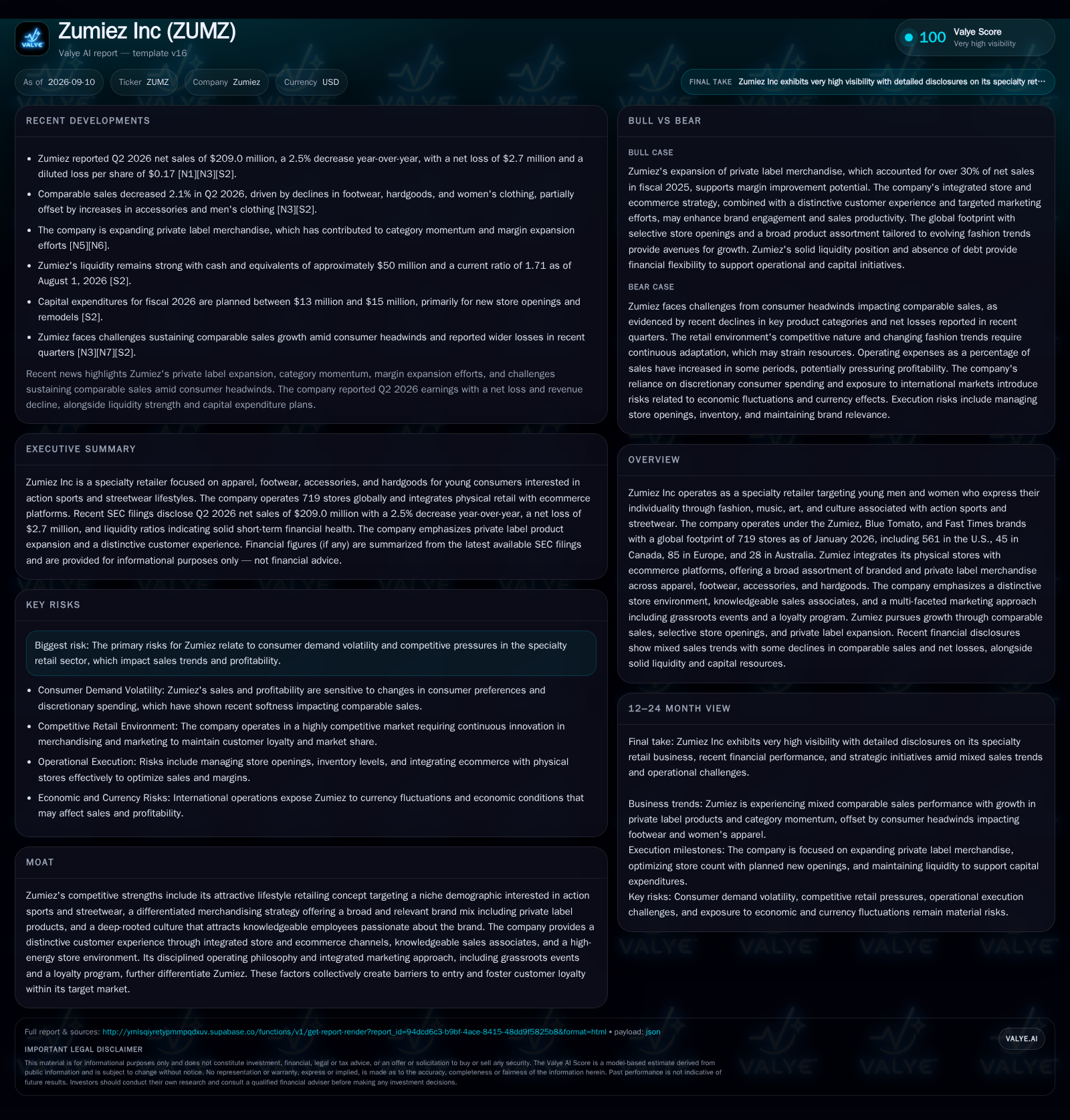
Zumiez reported Q2 2026 net sales of $209.0 million, representing a 2.5% decline versus the prior year period. Comparable sales dropped by 2.1%, with particular weakness in footwear, hardgoods, and women’s clothing, only partially offset by gains in accessories and men’s apparel. Gross margin fell slightly to 35.3%, and the company posted a net loss of $2.7 million, wider than the previous year’s loss. Despite these pressures, private label products now account for over 30% of net sales, and Zumiez maintains a reported liquidity position with $50.3 million in cash and no reported debt as of August 2026 [S2] [S1] [N5] [N6].
How Zumiez’s Model Could Drive Profitability—If Consumer Demand Cooperates
Zumiez’s economic engine fundamentally relies on a blend of branded and private label merchandise, with private label representing a key lever for gross margin improvement. Private label products typically offer higher gross margins due to design control and lower cost of goods, and Zumiez’s ability to scale this category to over 30% of sales is a positive development for margin potential [S1] [N6]. However, the company must balance this with continued investment in store experience, marketing, and omnichannel fulfillment, which drive SG&A expenses. The integration of ecommerce and physical stores—using localized store fulfillment for online orders—may help optimize inventory and reduce last-mile costs, but also adds operational complexity. Fixed costs from store leases and labor mean that positive comparable sales are critical for operating leverage; persistent sales declines risk deleveraging and continued net losses. Capital expenditures are moderate ($13–$15 million planned for fiscal 2026), suggesting Zumiez can fund growth and remodels without straining liquidity [S2].
Niche Differentiation vs. Mainstream Retail Pressures
Zumiez’s core advantage lies in its focused lifestyle positioning—serving young consumers interested in action sports, streetwear, and individual expression. The in-store environment, knowledgeable staff, and localized merchandising are designed to create an experience that is difficult for generic big-box or pure e-commerce competitors to replicate. However, the specialty retail segment is intensely competitive, with fast-fashion chains, digital-native brands, and mass merchandisers all targeting youth apparel and accessories. While private label growth can improve margins, it also exposes Zumiez to inventory risk if fashion trends shift rapidly. The STASH loyalty program and grassroots events are intended to build customer stickiness, but the effectiveness of these initiatives in driving traffic and retention is not yet fully established in the current environment. International expansion (Europe, Australia) adds diversification but also exposes the company to currency and execution risks as it builds brand awareness outside North America.
If Private Label Expansion and Store Integration Spark a Turnaround
A favorable scenario for Zumiez would see sustained growth in private label sales, supporting further gross margin expansion as design and sourcing efficiencies scale. If the company can reverse recent comparable sales declines—particularly in underperforming categories like footwear and women’s apparel—while maintaining cost discipline, operating leverage could drive a return to profitability. Evidence of success would include sequential improvement in comparable sales, continued gross margin gains, and declining net losses or a return to positive earnings. Robust performance from the loyalty program and increased ecommerce penetration, especially if digital growth is profitable and not purely promotional, would further bolster the case. Confirmation would come from management guidance raising margin or sales outlooks, and from reported improvements in store productivity metrics.
Stagnation: Incremental Progress Amid Volatile Demand
The most plausible outcome is that Zumiez experiences a choppy recovery, with private label margin benefits partially offsetting weak demand in certain categories. Comparable sales may stabilize or show low-single-digit growth as consumer headwinds persist, but not enough to meaningfully accelerate earnings. Gross margin could improve modestly if private label gains continue, but SG&A as a percentage of sales may remain elevated absent a stronger revenue rebound. Store rationalization and selective new openings may help optimize the footprint, but international markets are unlikely to be a major growth engine near-term. The company’s reported liquidity position and lack of debt; these figures do not by themselves establish operating, investment, or financing capacity, but persistent modest net losses or only marginal profitability are likely until consumer sentiment or category trends improve. Confirmation would be found in flat to slightly positive comparable sales, stable or improving gross margin, and steady liquidity metrics.
Escalating Losses if Consumer Weakness Persists and Category Trends Fail to Rebound
In a negative scenario, continued softness in footwear, hardgoods, and women’s apparel could lead to ongoing negative comparable sales, further gross margin erosion, and operating deleverage as fixed costs remain high. If consumer headwinds intensify—due to macroeconomic downturns or shifts in youth fashion preferences—Zumiez may be forced into deeper promotional activity, pressuring margins. Inventory overhang from failed private label bets could lead to markdowns, while ineffective marketing or loyalty efforts might fail to stem traffic declines. International markets could compound losses if currency or operational challenges mount. Evidence of this scenario would include accelerating net losses, declining cash balances, negative trends in inventory turnover, and management revisions to store opening or capex plans.
What Will Determine if Zumiez’s Private Label Bet Pays Off?
Comparable store sales growth or contraction by category—especially footwear and women’s apparel—will clarify whether the sales base is stabilizing or deteriorating further.
Gross margin progression, particularly the contribution from private label expansion, will indicate whether margin initiatives are gaining traction.
SG&A as a percentage of sales: monitoring whether expense discipline or deleveraging is driving changes in profitability.
Inventory turnover and markdown rates, if disclosed, would help assess the risk of over-assortment or fashion misses in both branded and private label lines.
Loyalty program participation and repeat purchase rates, if Zumiez discloses them, would provide insight into customer retention and engagement efficacy.
Ecommerce growth and profitability: separating revenue growth from margin dilution due to fulfillment or promotional costs would help test the omnichannel thesis.
Store productivity metrics (sales per square foot, traffic counts), if provided, would signal the health of the physical retail platform.
Liquidity and cash flow trends—especially if net losses persist—will be important for gauging the company’s ability to self-fund operations and capex without tapping external capital.
Disclaimer: This is research-only, informational analysis and not investment advice. It may include AI-generated interpretation and general industry context. Always verify important details using primary sources.

Comments