
Restaurant Brands International: Franchise Scale, Liquidity Friction, and the Stakes of Multi-Brand Execution
The company’s future will likely hinge on its ability to leverage brand scale, manage franchisee execution, and adapt to shifting consumer and cost dynamics.
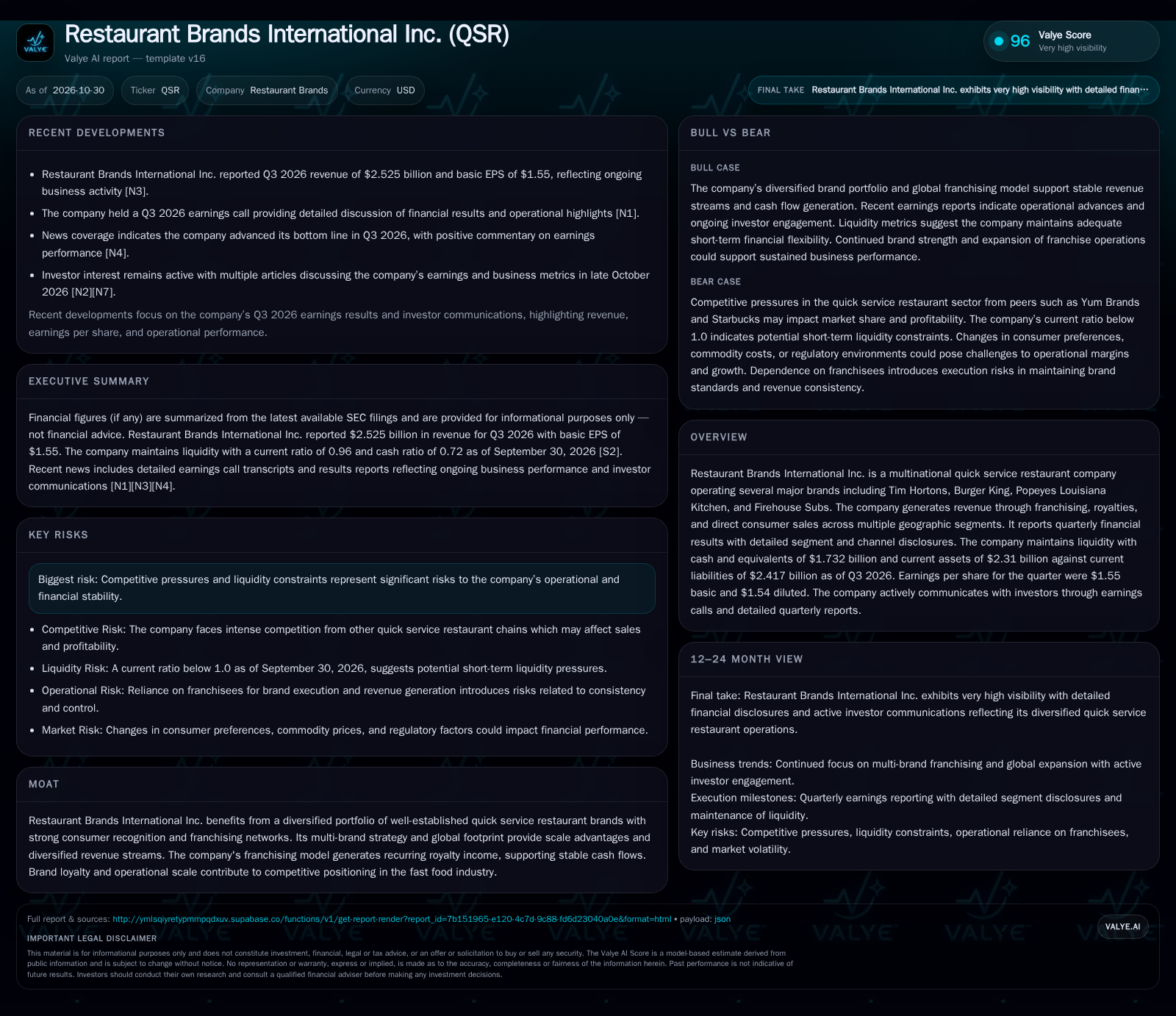
Restaurant Brands International (QSR) reported Q3 2026 revenues of $2.525B and continues to advance earnings, leveraging a global portfolio of leading quick service brands. Success will depend on maintaining franchisee alignment, optimizing operating leverage, and navigating cost and consumer shifts. [S2] [N4] [N6]
Restaurant Brands International (QSR), the parent of Burger King, Tim Hortons, Popeyes, and Firehouse Subs, continues to demonstrate the scale and earnings power of a diversified global franchisor. While Q3 2026 results show solid revenue and profit momentum, the company operates with a current ratio below 1.0 and faces intense competition from other quick service giants. This creates a dynamic where franchise growth and brand leverage must be balanced against liquidity management and the operational complexities of a multi-brand platform. The key question is whether QSR’s franchise-driven economics and global reach can offset sector headwinds and execution risk, particularly as consumer and commodity pressures evolve.
Earnings Growth and Liquidity Friction Define Recent Operating Landscape
Restaurant Brands International reported Q3 2026 revenues of $2.525 billion, with basic earnings per share of $1.55 and diluted EPS of $1.54, reflecting continued earnings advances and positive momentum in a competitive sector [S2] [N4]. Net income for 2025 was $1.075 billion, underscoring the company’s ability to generate profits at scale [S1]. The company reported cash and liquidity metrics for the period; these figures do not by themselves establish operating runway, investment capacity, financial flexibility, or financing capacity. [S2]
How Franchising Economics and Brand Mix Drive the P&L
Restaurant Brands International’s business model is anchored in franchising and royalty streams, which are structurally higher-margin and less capital intensive than direct restaurant operations. Royalties and franchise fees typically generate recurring revenue, with the company collecting a percentage of franchisee sales across its brand portfolio. This model enables QSR to scale revenue with relatively modest incremental capital, relying on franchisees for the bulk of store-level investment and operational risk.
Direct-to-consumer sales—where QSR operates company-owned stores—can provide higher gross revenue per unit but generally carry lower margins and greater exposure to labor and commodity cost volatility. The company’s multi-brand platform (Burger King, Tim Hortons, Popeyes, Firehouse Subs) allows both geographic and demographic diversification, with each brand targeting different consumption occasions and markets.
Operating leverage is achieved primarily through growth in system-wide sales and franchise unit expansion, as incremental royalty income falls quickly to the bottom line. However, royalty-driven models depend on franchisee health and store-level economics; if franchisees face cost pressures or sales declines, royalty streams can flatten or decline. Capital needs are concentrated in brand support, technology, and selective corporate store investment rather than large-scale asset deployment, giving QSR flexibility—but only if underlying cash flow is robust and working capital cycles are managed tightly.
Competitive Intensity and the Limits of Brand Scale
QSR operates in the highly competitive quick service restaurant (QSR) sector, facing global and regional peers such as Yum Brands (KFC, Taco Bell, Pizza Hut), McDonald’s, and Starbucks [N6]. Its multi-brand approach and international footprint provide scale advantages, diversified revenue streams, and leverage with suppliers and franchisees. Brand recognition and consumer loyalty are important, but the sector is vulnerable to shifts in consumer preferences, price sensitivity, and evolving food trends.
Competitive counterforces include aggressive promotion, menu innovation, and digital ordering platforms from both legacy giants and newer entrants. The company’s ability to maintain franchisee alignment and brand consistency across geographies is a differentiator, but also a source of execution risk. Switching costs for consumers are relatively low, making retention and frequency dependent on value, convenience, and brand relevance. Substitution risk is ever-present, with fast-casual, delivery aggregators, and even grocery retailers vying for dining occasions.
In this landscape, QSR’s moat is grounded in its franchise network density, global marketing reach, and the operational scale that supports national and international campaigns. However, these advantages are not insurmountable, and sustained outperformance will require ongoing investment in digital, menu, and operational innovation.
Unlocking Margin Expansion Through Franchise System Health and Digital Leverage
A favorable scenario for QSR involves robust same-store sales growth across its core brands, supported by successful menu innovation, digital ordering adoption, and effective marketing campaigns. If franchisees remain profitable and reinvest in store modernization, system-wide sales could accelerate, driving higher royalty income with minimal incremental corporate expense. Digital platforms could further increase order frequency and average ticket size, enhancing both franchisee and corporate economics.
Confirmation of this scenario would include consistent outperformance of sales and earnings versus peers, growing royalty margins, and evidence of franchisee investment in unit expansion or remodels. Analysts and investors would look for rising system-wide sales, higher franchisee profitability (if disclosed), and sustained positive operating leverage. Falsification would occur if same-store sales stall, digital adoption lags, or franchisee unit growth slows materially.
Sustained Growth Amid Competitive and Cost Headwinds
The most plausible trajectory is moderate revenue and profit growth, with QSR leveraging its brand scale and franchise model to offset ongoing cost and competitive pressures. In this scenario, global unit growth continues but at a measured pace, with menu innovation and digital initiatives helping to maintain relevance. Margin expansion is limited by wage, commodity, and promotional expense inflation, but stable royalty streams and disciplined capital allocation support steady earnings.
Supporting evidence would include stable or modestly rising system-wide sales, continued earnings advances in quarterly results, and franchisee sentiment that remains constructive. Signs of base-case risk would be persistent cost inflation outpacing pricing power, or notable franchisee distress leading to closures or slowed development.
Margin Compression and Franchisee Strain in a Disrupted Sector
A less favorable outcome would see competitive pressures and cost inflation eroding both franchisee and corporate margins. If consumer spending weakens or value propositions lag behind peers, same-store sales could stagnate or decline, reducing royalty revenue and exposing the company to fixed-cost deleverage in corporate-owned stores. Franchisee distress could increase, manifesting as unit closures, delayed remodels, or even litigation over contract terms.
Liquidity could become a more acute concern if working capital cycles tighten and cash generation lags obligations. Confirmation would come from declining system-wide sales, negative same-store comps, rising franchisee turnover, or any covenant-related disclosures about liquidity stress. Falsification would be indicated by stable or improving unit-level economics and the absence of significant franchisee attrition.
Milestones That Will Shape Restaurant Brands’ Franchise-Driven Thesis
Trends in system-wide same-store sales growth by brand and region, if disclosed, would clarify the health of the underlying franchise system.
Franchisee profitability and capital reinvestment rates (such as remodels or new unit openings) would help test the resilience of the royalty model.
Digital ordering penetration and average ticket size growth could signal success in driving higher-margin, higher-frequency transactions.
Gross and segment-level royalty margins, if disclosed, would be important for monitoring the scalability of the franchise model.
Competitive pricing moves or promotional intensity among major peers could affect QSR’s ability to sustain sales and margin growth.
Evidence of franchisee attrition, unit closures, or legal disputes would be early warning signs of strain in the system.
Disclaimer: This is research-only, informational analysis and not investment advice. It may include AI-generated interpretation and general industry context. Always verify important details using primary sources.

Comments