
Axos Financial’s Digital Banking Ambitions: Profitability, Scale, and the Stakes of Technology-Led Expansion
Axos Financial continues to post strong quarterly profits and EPS, underpinned by a digital-first banking strategy and targeted acquisitions. The company’s ability to leverage technology for operational efficiency and growth—while navigating the inherent risks of regional banking—will determine whether it can sustain its advantage in an increasingly competitive landscape.
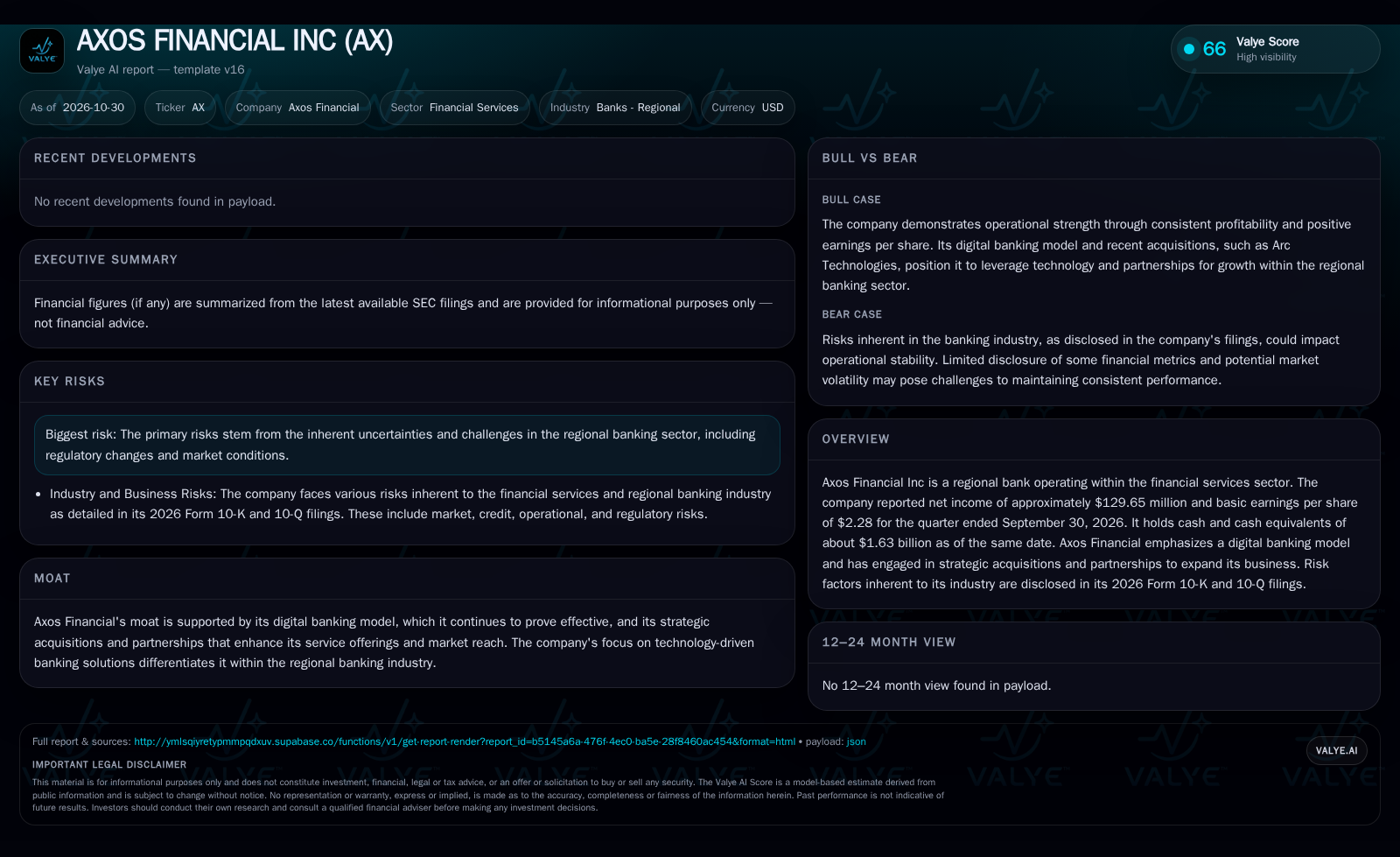
Axos Financial reported $129.65 million in net income and $2.28 basic EPS for the quarter ending September 30, 2026, with $1.63 billion in cash on hand. The company’s digital banking model and recent Arc Technologies acquisition signal a focus on technology-driven expansion. The challenge: translating digital operating leverage and new partnerships into durable, above-peer growth amid evolving industry risks and competition. [S2] [N1] [N2]
Axos Financial stands out among regional banks for its consistent profitability and explicit commitment to a technology-led, digital banking model. Its latest quarterly results—$129.65 million net income and $2.28 basic EPS—reflect both operational discipline and the early fruits of a digital strategy that aims to reduce costs and expand reach. With $1.63 billion in cash and a pattern of strategic acquisitions, Axos is positioning itself for scalable growth. The key question now is whether its digital-first approach and recent partnerships can deliver sustainable returns in a sector facing rising competition and regulatory scrutiny. [S2] [N1] [N2] [N7]
Profitability and Digital Expansion: Where Axos Stands Now
As of September 30, 2026, Axos Financial reported net income of $129.65 million and basic earnings per share of $2.28, with diluted EPS at $2.25. Cash and cash equivalents totaled approximately $1.63 billion. The company has publicly highlighted its digital banking model as a cornerstone of its strategy, aiming to differentiate itself from traditional regional banks through technology-driven efficiencies and customer acquisition. Recent earnings exceeded expectations, and Axos has moved to acquire Arc Technologies while expanding partnerships with credit unions, suggesting an intent to grow both technologically and through new customer channels. These developments are material because they reflect not just continued profitability, but also a willingness to invest in growth platforms that could alter Axos’s risk/reward profile in a consolidating sector. [S2] [N1] [N2] [N7]
Digital Model and Operating Leverage: How Axos Aims to Scale
Axos’s business model is built around digital banking, which can fundamentally alter the cost structure compared to branch-heavy peers. By leveraging technology, Axos may achieve lower operating expenses per customer, higher scalability, and the potential for better customer data analytics. The absence of a large physical branch network reduces fixed costs, and digital acquisition channels may allow for more efficient customer growth—if the company can balance marketing spend with lifetime value.
Revenue generation in this model remains tied to core banking activities: loan origination, net interest margin, and fee income. The digital approach could allow for product innovation (such as faster loan approvals or specialized deposit products) and may facilitate cross-selling at lower incremental cost. However, the sustainability of operating leverage depends on Axos’s ability to maintain strong underwriting standards and risk controls as it expands, especially through acquisitions like Arc Technologies. The company’s capital needs are typical of regulated banks, but the digital model may enable more flexible deployment of capital, provided regulatory requirements are met.
In sum, Axos’s economics hinge on whether digital efficiencies and acquisition-driven growth can compensate for the cyclical and regulatory risks inherent in regional banking.
Can Digital Banking Build a Defensible Edge in Regional Finance?
Axos’s digital-first strategy offers potential advantages over traditional regional banks, including lower overhead, scalable customer acquisition, and the ability to target niche or underserved segments through technology. However, the competitive landscape is intensifying: large national banks are investing heavily in digital transformation, while fintechs and neobanks are targeting the same digitally savvy customer base. For Axos, maintaining a defensible edge will depend on its ability to continuously innovate, integrate new acquisitions effectively, and deliver a differentiated customer experience.
Switching costs in banking tend to be moderate, especially for digitally native customers, so retention will depend on product breadth, pricing, user experience, and perceived security. The Arc Technologies acquisition and new credit union partnerships may allow Axos to access broader ecosystems and offer new services, but integrating these assets and cultures poses risks. To sustain its competitive position, Axos will need to demonstrate that digital scale translates into higher margins, better risk management, and defensible customer relationships relative to both incumbent banks and fintech upstarts.
If Digital Scale Delivers: What Sustained Outperformance Looks Like
In a favorable scenario, Axos leverages its digital banking infrastructure to achieve above-peer operating efficiency and customer growth. The integration of Arc Technologies and expansion into credit union partnerships could unlock new revenue streams and expand Axos’s addressable market. If the company can demonstrate that its technology stack enables superior risk management—e.g., through better credit analytics or fraud prevention—it may be able to grow its loan book without a commensurate increase in risk or expense.
Confirmation of this scenario would require evidence of continued outperformance on key metrics: improving efficiency ratio, widening net interest margin, and sustained EPS growth above regional bank averages. Additional signals would include successful integration of acquisitions, growth in digital account openings, and expansion of fee-based services. Falsification would come from integration setbacks, rising credit losses, or a failure to realize expected cost savings from the digital model.
Digital Banking Advances, but Industry Headwinds Remain
The most plausible outcome is that Axos continues to grow modestly above the regional bank average, benefiting from its digital model but still subject to the cyclical and regulatory pressures facing all banks. The company is likely to see incremental gains in operating leverage and customer reach, especially if acquisitions like Arc Technologies are integrated smoothly. However, competition from both large banks and fintechs will limit pricing power and put pressure on customer acquisition costs.
In this scenario, Axos maintains solid profitability, with risk-adjusted returns comparable to other well-run regional banks. Confirming evidence would include stable or improving net interest margin, manageable credit losses, and steady growth in digital-originated accounts. Falsification would involve a material deterioration in credit quality, regulatory setbacks, or evidence that digital cost savings are being offset by rising technology or compliance costs.
When Digital Leverage Turns to Risk: Adverse Outcomes
The downside scenario emerges if Axos’s rapid expansion—through acquisitions or aggressive digital lending—leads to operational or credit missteps. Fast growth can mask underlying asset quality issues, especially if underwriting standards slip or if new technology platforms are not fully integrated. In a credit downturn, digital banks without deep, sticky customer relationships may see higher-than-average deposit outflows or rising loan losses.
This scenario would be confirmed by a sharp increase in non-performing loans, negative operating leverage (i.e., costs rising faster than revenues), or a failed acquisition integration. Additional warning signs would include customer attrition, regulatory enforcement actions, or a contraction in net interest margin due to competitive pricing pressure.
Benchmarks That Will Reveal If Axos’s Digital Strategy Is Delivering
Quarterly efficiency ratio trends—continued improvement would indicate digital leverage is translating into lower operating costs.
Growth rate of digital-originated deposits and loans—essential for confirming that the digital channel is capturing market share.
Net interest margin relative to peer banks—a widening spread would suggest pricing or funding advantages.
Asset quality metrics, especially non-performing loans and charge-offs, to monitor risk from digital lending or recent acquisitions.
Integration milestones and cost synergies from Arc Technologies and other acquisitions—updates would clarify whether M&A is accretive.
Fee income as a percentage of total revenue—a rising share would signal successful diversification beyond traditional lending.
Customer retention and churn rates—especially in digital channels, as these will test the stickiness of Axos’s offering.
Material regulatory developments or enforcement actions, which could affect Axos’s ability to innovate or scale.
Disclaimer: This is research-only, informational analysis and not investment advice. It may include AI-generated interpretation and general industry context. Always verify important details using primary sources.

Comments