
Coinbase’s Multi-Asset Ambition: Platform Expansion, Crypto Cyclicality, and the Stakes of Regulatory Uncertainty
Coinbase’s Q3 2026 results reveal robust profitability and reported liquidity position, powered by crypto market gains and a broadening product suite. As the company pushes to become an Everything Exchange—spanning crypto, stocks, derivatives, and decentralized finance—the interplay of market volatility, regulatory flux, and product diversification will determine whether Coinbase’s platform model can sustain its momentum or remains tethered to crypto’s boom-bust cycle.
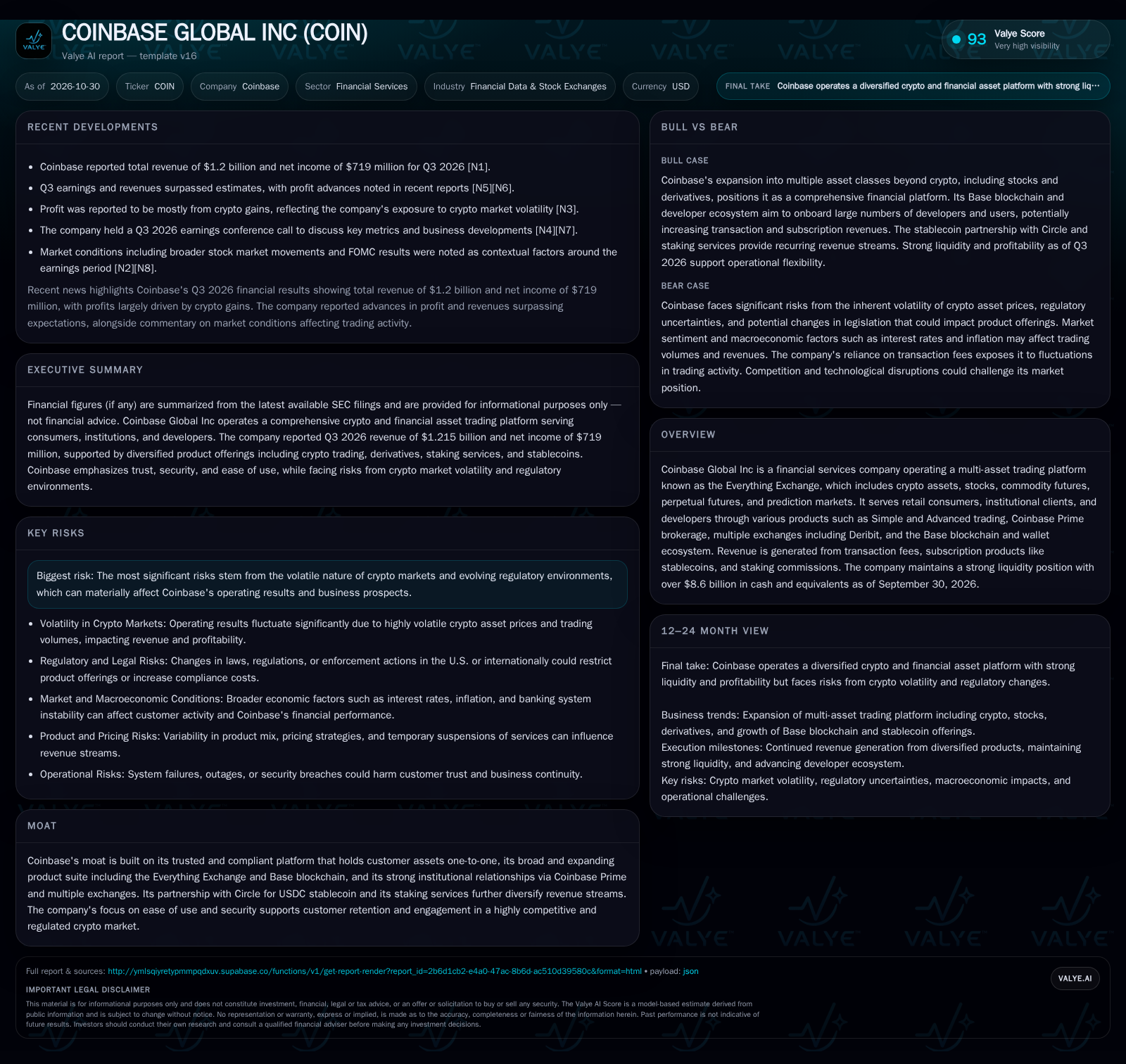
Coinbase’s Q3 2026 net income of $719 million and $1.215 billion in revenue were driven primarily by crypto market gains. The company’s expansion into traditional assets and decentralized finance aims to reduce volatility exposure, but its core economics remain closely tied to crypto trading activity. The critical question is whether diversification and ecosystem growth can create more stable, recurring revenues or if crypto volatility will continue to dominate outcomes. [S2] [N1] [N3]
Coinbase’s latest quarter highlights the promise and peril of its transformation from a pure-play crypto exchange into a multi-asset financial platform. While Q3 2026 results show impressive profitability and a sizable liquidity cushion, much of this success still hinges on the fortunes of the crypto market. The company’s push to integrate stocks, derivatives, and decentralized protocols marks a strategic attempt to diversify revenue streams and reduce cyclicality. However, structural exposure to crypto market swings and the ongoing specter of regulatory intervention raise questions about the durability of Coinbase’s business model. The next phase will test whether its platform ambitions can overcome the gravitational pull of digital asset volatility. [S2] [N1] [N3]
Q3 2026: Crypto Gains Drive Profit, Platform Expansion Continues
Coinbase reported $1.215 billion in revenue and net income of $719 million for Q3 2026, with basic EPS of $2.72. This performance exceeded consensus estimates and was attributed primarily to gains in crypto asset prices, reflecting the company’s high sensitivity to digital asset cycles. [S2] [N1] [N3] [N5] [N6]
The company’s cash and equivalents stood at $8.6 billion as of September 30, 2026, with a current ratio of 2.42. [S2]
Coinbase’s product suite now spans crypto, stocks, commodity futures, perpetuals, and prediction markets, operating across multiple exchanges and offering both retail and institutional trading experiences. The Base blockchain adds a decentralized onchain ecosystem, with revenue from sequencer fees and developer activity. [S1]
How Coinbase Makes—and Could Stabilize—Its Money
Coinbase’s core economics are still driven by transaction fees from trading activity, which fluctuate with asset price volatility and market sentiment. Retail trading typically carries higher fees per transaction, while institutional volumes are larger but lower margin. The introduction of stocks and derivatives could broaden the transaction base, but unless these categories reach scale, crypto will likely remain the dominant driver.
Subscription and services revenue, including stablecoin economics (notably from USDC via Circle), staking commissions, and Base blockchain sequencer fees, represent attempts to generate more recurring and less cyclical income. However, these streams are still sensitive to underlying asset flows and user activity. For example, staking revenue depends on supported asset yields and user engagement, while stablecoin economics are tied to USDC’s circulation and prevailing interest rates.
Fixed costs include technology infrastructure, compliance, security, and regulatory overhead—areas where scale can drive operating leverage if volumes remain robust. However, the need for ongoing investment in security, legal, and product development to meet evolving regulatory standards and user expectations may keep fixed costs elevated.
Coinbase’s capital needs are relatively modest in terms of physical infrastructure, but regulatory compliance and technology development require continual investment. [S2]
Trust, Scope, and Compliance: Where Coinbase Stands in a Crowded Field
Coinbase competes with both traditional financial exchanges (for stocks, futures, and options) and crypto-native platforms, as well as with emerging decentralized protocols. Its core competitive advantages are built around regulatory compliance, user trust (notably holding customer assets one-to-one), and a user-friendly platform. The partnership with Circle for USDC, broad staking support, and the launch of the Base blockchain further differentiate the product offering. [S1]
However, these advantages face counterforces. Traditional exchanges have deep liquidity, established institutional relationships, and regulatory expertise, while decentralized platforms can offer lower fees and greater composability for advanced users. In crypto, competitors can quickly replicate features, and switching costs for retail and institutional traders remain relatively low absent unique liquidity, pricing, or ecosystem lock-in.
Coinbase’s Everything Exchange ambition targets users seeking a one-stop shop for both crypto and traditional assets. If successful, this breadth could improve customer retention and cross-sell opportunities. Yet, regulatory scrutiny is likely to intensify as Coinbase moves further into traditional financial products, potentially raising compliance costs and slowing product rollout.
Ecosystem Effects and Asset Breadth Unlock Durable Revenue Streams
In a favorable scenario, Coinbase’s expansion into stocks, derivatives, and decentralized finance succeeds in onboarding a broader user base, while Base blockchain and developer tools foster a vibrant onchain ecosystem. This multi-asset breadth could drive higher cross-platform engagement, increase average revenue per user, and reduce dependency on crypto trading cycles.
Recurring revenue from stablecoins, staking, and subscription services might scale as users adopt more products and as institutions engage more deeply with Coinbase Prime. If regulatory clarity emerges, Coinbase could leverage its compliance-first reputation to capture outsized institutional flows and onboard traditional finance participants wary of less regulated venues.
Evidence that would confirm this scenario includes: sustained growth in non-crypto trading volumes, rising subscription/service revenue as a percentage of total income, and meaningful developer and user activity on Base. If disclosed, multi-year contracts or deepening institutional relationships would further support this case.
Crypto Cycles Continue to Dominate Despite Product Diversification
The most plausible near-term outcome is that Coinbase’s financial performance remains highly correlated with crypto asset prices and trading volumes, even as new products launch. While the Everything Exchange strategy may gradually diversify revenue streams, crypto market swings will likely continue to drive the majority of profits and losses over the next 12–24 months.
Subscription and services revenue could grow incrementally, but will remain a minority share unless there is a step change in adoption of non-crypto products or Base ecosystem activity. Regulatory uncertainty will persist, requiring ongoing investment in compliance and legal resources, and potentially constraining rapid product expansion.
This scenario would be confirmed by continued volatility in quarterly results tracking crypto asset price cycles, with transaction fees from crypto trading comprising the bulk of revenue. Evidence against this scenario would be a visible, sustained shift in revenue mix or user engagement toward stocks, derivatives, or onchain products.
Regulatory Shocks or Prolonged Crypto Winter Undermine Platform Economics
In a negative scenario, a combination of adverse regulatory action (such as prohibitions on certain products, higher compliance costs, or forced operational changes) and a sustained downturn in crypto asset prices could sharply reduce trading volumes, depress transaction fee revenue, and trigger net outflows from the platform.
Revenue from stablecoins and staking could also decline if regulatory scrutiny increases or if asset yields and user participation fall. Fixed compliance and technology costs may become burdensome in the face of shrinking volumes, eroding profitability despite a reported cash position.
This scenario would be confirmed by regulatory enforcement actions, product suspensions, or significant declines in crypto asset prices and trading volumes over several quarters. If disclosed, rising legal costs, customer attrition, or negative cash flow would further validate this risk.
What Will Determine Whether Coinbase Breaks Free from Crypto Cyclicality?
Revenue mix evolution: Track the percentage of revenue from non-crypto trading (stocks, derivatives, prediction markets) and subscription/services versus traditional crypto transaction fees. If disclosed, this will be a critical indicator of diversification progress.
Base blockchain adoption: Monitor developer activity, transaction volumes, and sequencer fee revenue associated with the Base chain. Sustained growth would suggest traction beyond core exchange activity.
Stablecoin economics: Observe USDC circulation levels and the contribution of stablecoin economics to overall results. Changes here may reveal both adoption and regulatory sensitivity.
Institutional engagement: If disclosed, watch for metrics on Coinbase Prime usage, institutional trading volumes, and the depth of multi-asset relationships.
Regulatory developments: Track any new legislation, enforcement actions, or guidance impacting the scope of Coinbase’s product offerings or compliance costs.
Customer retention and churn: If disclosed, changes in active user numbers, trading activity, or customer attrition rates would help test the platform’s stickiness.
Operating cost discipline: Monitor trends in compliance, legal, and technology spending relative to revenue, especially in the face of market downturns.
Product rollout cadence: The pace and success of new asset class introductions (stocks, derivatives, prediction markets) will indicate execution capability and regulatory agility.
Disclaimer: This is research-only, informational analysis and not investment advice. It may include AI-generated interpretation and general industry context. Always verify important details using primary sources.

Comments