
Farmland Partners: Renewable Potential, Tenant Risk, and the Economics of Farmland REITs
Farmland Partners integrates sustainability and renewable energy projects into its farmland REIT model, but Q3 2026 results highlight the operational and financial challenges inherent in tenant-dependent income and substantial mortgage leverage. The company's future now hinges on its ability to manage debt, diversify income streams, and navigate macroeconomic headwinds.
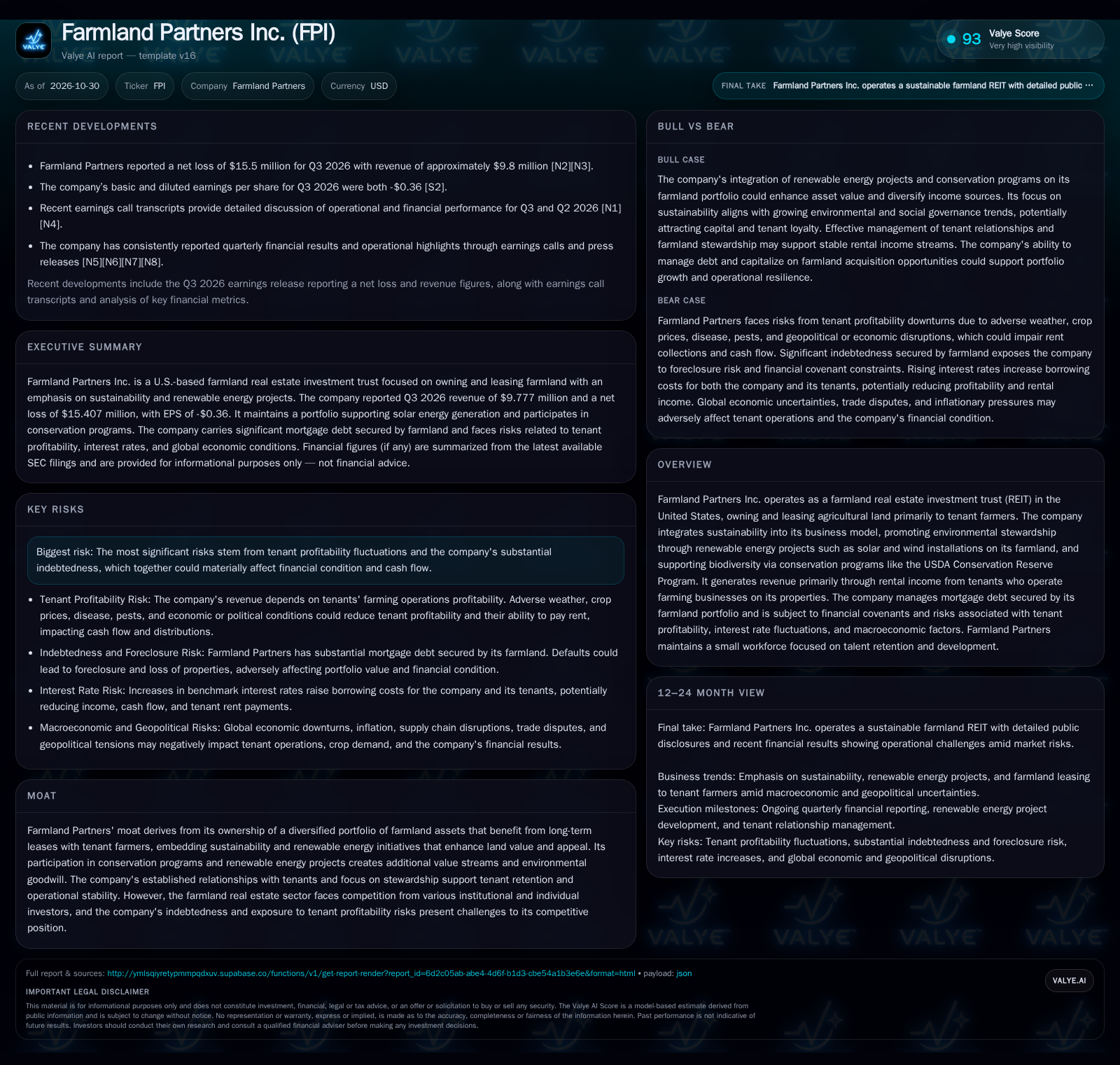
Farmland Partners reported a Q3 2026 net loss and faces persistent risks from tenant profitability, rising rates, and economic volatility. While its sustainability focus and renewable energy initiatives could bolster longer-term asset value and create new revenue streams, near-term performance will largely depend on the resilience of its tenant base and effective debt management. The company’s success in converting environmental initiatives into tangible financial returns remains a central question. [S1] [S2]
Farmland Partners Inc. is navigating a period of operational and financial strain as the traditional farmland REIT model is stress-tested by tenant risk, macroeconomic volatility, and the realities of leveraged ownership. The company’s commitment to sustainability and renewable energy integration may offer longer-term upside, but Q3 2026 results underscore the acute challenges of relying on tenant-driven rents and managing a mortgage-secured portfolio in a rising rate environment. The question for investors: Can Farmland Partners convert environmental initiatives and land stewardship into resilient, diversified earnings before debt constraints or tenant distress overshadow these efforts?
Recent Results and Balance Sheet Realities
Farmland Partners reported Q3 2026 revenue of $9.777 million and a net loss of $15.407 million, with basic and diluted EPS at -$0.36. The company ended 2025 with $161.6 million in outstanding debt, mostly secured by farmland properties, and faces restrictive covenants on additional borrowing and asset sales. The company’s solar energy footprint reached 207 MW as of December 2025, with further project options in place. These facts highlight the core tension between income generation from tenant rents, the promise of renewable energy as a supplementary revenue stream, and the significant fixed obligations from mortgage leverage. [S1] [S2]
How Farmland Leasing and Renewable Projects Shape Earnings Power
Farmland Partners’ primary revenue stream is rent from tenant farmers, making its top line highly sensitive to the agricultural economy, commodity prices, and tenant solvency. Leases are typically structured as fixed cash rents or variable agreements tied to crop yields or prices, which can cushion or amplify volatility depending on contract mix. The company’s sustainability initiatives—solar and wind projects—offer potential for land lease premiums and direct royalties, but the scale and timing of these contributions are not fully disclosed.
Operating leverage is moderate: the company has a small workforce (12 employees as of end-2025) and relatively low direct operating expenses, but debt service is a major fixed cost. Capital requirements are driven by both acquisition opportunities and ongoing maintenance or improvement of farmland assets. High indebtedness increases sensitivity to interest rates and limits flexibility to pursue new investments or weather downturns without asset sales or capital raises.
If Farmland Partners can successfully monetize renewable energy options and conservation programs, these could diversify income and reduce reliance on tenant-driven variability. However, the commercial mechanics—such as revenue share, lease escalators, or participation in renewable project financing—are not fully detailed, so the magnitude of upside remains speculative absent further disclosure.
Farmland REIT Dynamics: Asset Scale, Tenant Mix, and the Search for Differentiation
The company’s moat is partly derived from its portfolio of diversified farmland assets and its relationships with established tenant farmers. In theory, scale allows for risk diversification across crops, geographies, and tenant profiles, but in practice, adverse macro shocks (e.g., commodity price collapses, weather events) can still ripple through the entire portfolio.
Farmland Partners competes with other institutional investors, private equity, and individual landowners for both farmland acquisitions and high-quality tenants. The integration of renewable energy projects and conservation programs may confer some competitive edge by creating incremental land value or appealing to ESG-focused tenants and investors. However, these features are becoming more common among sophisticated farmland investors, and the company’s high leverage may constrain its ability to outbid or upgrade its portfolio relative to less encumbered peers.
Switching costs for tenants are generally low, as agricultural operators can often move to other properties if rents become uncompetitive or lease terms unfavorable. The company’s ability to maintain tenant loyalty may hinge on service, flexibility, and the perceived benefits of its sustainability initiatives.
Sustainability Initiatives Unlock New Value Streams
If Farmland Partners can accelerate the monetization of its renewable energy options—such as converting additional acreage to solar or wind leases—incremental revenue streams could become material. This would diversify the company’s income beyond tenant rent and potentially command higher land valuations, supporting both reported earnings and net asset value.
A favorable scenario would see tenant profitability stabilize or improve due to resilient commodity prices, effective risk management (e.g., crop insurance), and supportive macro conditions. As a result, rent collections would remain robust, supporting debt service and possibly enabling gradual deleveraging.
Evidence that would confirm this upside includes: disclosed increases in renewable energy lease revenues, new project announcements or completions, higher portfolio occupancy and tenant retention, and evidence of rental rate growth outpacing inflation. Conversely, if renewable initiatives stall or fail to deliver meaningful income, or if tenant churn rises, the upside scenario would be weakened.
Tenant-Driven Volatility with Gradual Renewable Contributions
The most plausible trajectory is continued earnings volatility driven by tenant profitability, weather, and macroeconomic factors, with renewable energy and conservation income making incremental but not transformative contributions over the next 12-24 months.
Under this scenario, the company manages to maintain occupancy and rent collections at levels sufficient to cover debt service and basic operations, but faces limited potential financial flexibility due to restrictive covenants and the need to preserve liquidity. Modest growth in renewable project revenues may help cushion some agricultural shocks, but the core risk/return profile remains largely tied to tenant outcomes.
Confirmation would come from steady quarterly rent collections, low tenant turnover, stable or slowly rising renewable-related revenue, and manageable debt metrics. Signs of deterioration—such as a spike in tenant defaults, sustained net losses, or asset sales to meet obligations—would challenge this base case.
Tenant Distress and Debt Constraints Trigger Asset Sales or Dilution
A negative chain of events could be set off by a combination of poor crop yields, falling commodity prices, or macroeconomic shocks that undermine tenant profitability. This would lead to missed rent payments, higher vacancies, and downward pressure on asset values. Given the company’s mortgage leverage and restrictive covenants, a material drop in income could force asset sales, impair book value, or necessitate equity dilution to shore up the balance sheet.
Further, rising interest rates would exacerbate both the company’s and tenants’ financial stress, increasing debt service obligations and reducing refinancing options. If renewable energy projects fail to scale or generate meaningful cash flow in this environment, the hoped-for diversification would not materialize in time to offset core income declines.
Downside confirmation would include a rising trend in tenant delinquencies, forced asset sales at discounts, covenant breaches, or the suspension of dividends to preserve cash.
Testing the Thesis: What Will Determine Farmland Partners’ Resilience?
Quarterly rent collection rates and tenant occupancy levels, as indicators of core operational health.
Disclosure of renewable energy project revenues, completions, and new project signings—tracking the scale and timing of non-farm income streams.
Trends in net debt, interest expense, and compliance with debt covenants, which will signal potential financial flexibility or stress.
Tenant renewal rates and average lease durations, if disclosed, to gauge retention and income visibility.
Evidence of asset sales or portfolio rebalancing, particularly if driven by liquidity needs rather than strategic repositioning.
Changes in average rental rates per acre, especially relative to inflation or local land markets.
Updates on participation in conservation programs or government incentives, quantifying their financial contribution if possible.
Disclaimer: This is research-only, informational analysis and not investment advice. It may include AI-generated interpretation and general industry context. Always verify important details using primary sources.

Comments