
SPS Commerce: Supply Chain Network Effects, Digital Penetration, and the Stakes of Platform Scale
SPS Commerce’s Q3 2026 outperformance highlights the potential leverage of its cloud-based supply chain platform. The future will hinge on deepening customer integration, competitive resilience, and the pace of supply chain digitization.
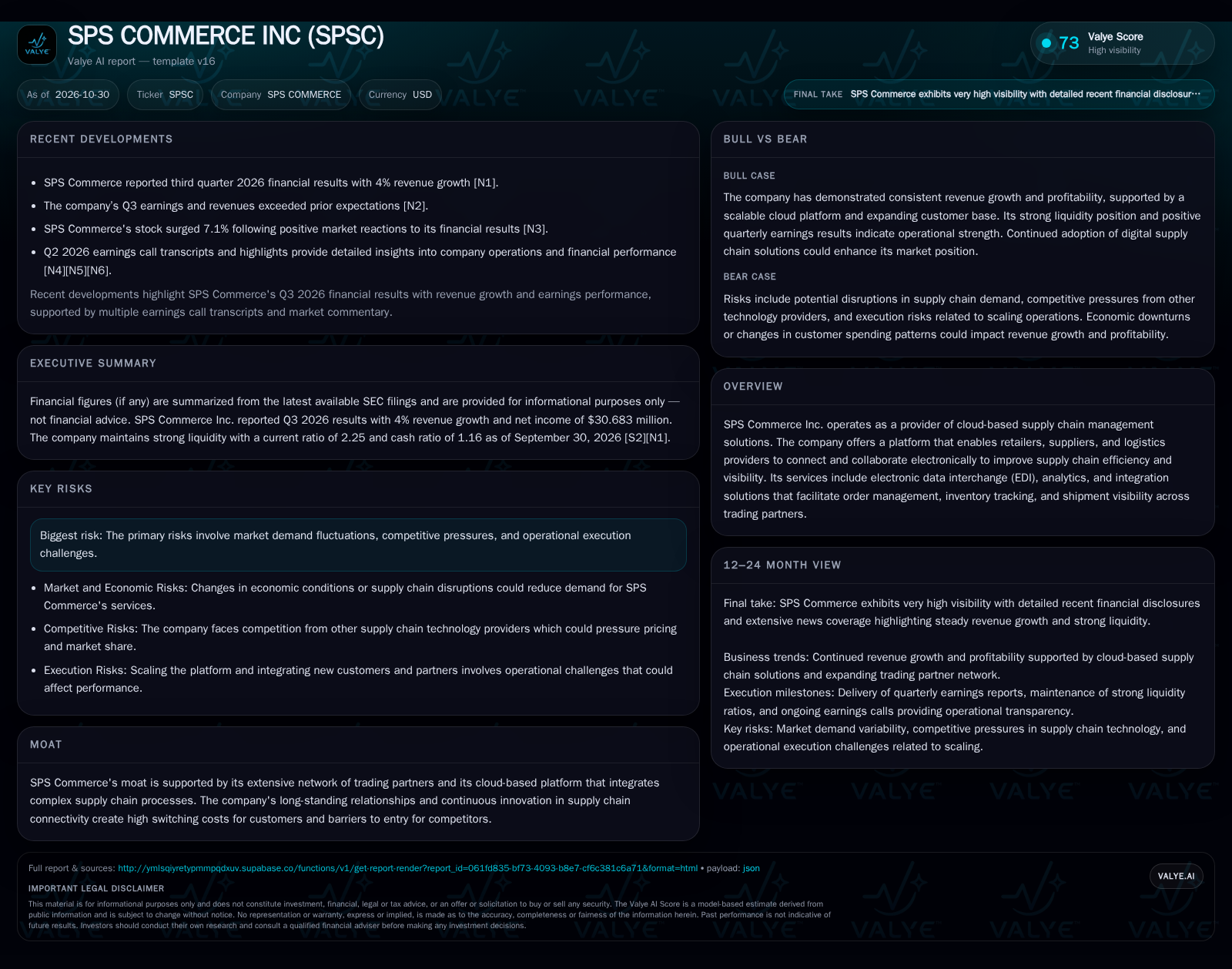
SPS Commerce exceeded Q3 2026 expectations, posting $30.7 million in net income and maintaining a reported cash position. The company’s cloud-based supply chain platform benefits from broad network connectivity and high switching frictions, but faces competitive and execution risks as digital adoption matures. Sustained growth depends on expanding customer integration and defending its network effects.
SPS Commerce’s latest quarterly results reinforce its position as a leading provider of cloud-based supply chain management solutions. With Q3 2026 net income of $30.7 million and a reported liquidity position, the company continues to benefit from the ongoing digitization of retail and supplier relationships. Yet, as adoption of electronic data interchange and analytics matures, the focus shifts to the sustainability of its network effects, the risks of competitive encroachment, and the operational complexities of integrating an ever-broader trading partner ecosystem. The next phase will be defined by SPS Commerce’s ability to deepen customer engagement and defend its moat amid evolving industry dynamics.
Recent Financial Outperformance and Balance Sheet Strength Shape the Near-Term Narrative
SPS Commerce reported net income of $30.683 million and diluted EPS of $0.85 for Q3 2026, beating analyst expectations on both revenue and earnings [S2] [N2]. This outperformance suggests continued demand for its cloud-based supply chain solutions, despite a competitive and uncertain macro environment. As of September 30, 2026, the company held $153.818 million in cash and cash equivalents, with a current ratio of 2.25 and a cash ratio of 1.16 [S2]. The company reported cash and liquidity metrics for the period; these figures do not by themselves establish operating runway, investment capacity, financial flexibility, or financing capacity. The company’s success in exceeding expectations points to operational execution and possibly ongoing digital adoption tailwinds, but the durability of these drivers remains a central question.
Platform Economics: Recurring Revenue, Integration Frictions, and Scalability
SPS Commerce’s business model centers on providing cloud-based supply chain connectivity, enabling customers to transact and collaborate electronically across a broad trading partner network. The company’s economic engine plausibly relies on a mix of recurring and usage-based revenue streams—typically through subscription fees for EDI, analytics, and integration services. While the specific contract structures are not disclosed here, such platforms often benefit from high gross margins, as the incremental cost of adding new trading partners or transactions is relatively low after initial integration.
Fixed costs are primarily associated with platform development, infrastructure, and support, while variable costs scale with customer onboarding and service delivery. As trading partner density increases, operating leverage may improve, provided that investments in platform reliability and customer support do not outpace revenue gains. However, scaling integrations with new customers or complex supply chains can introduce operational and capital demands, especially if customization or ongoing support is required.
A core economic question is the degree to which SPS Commerce can convert integration depth and network breadth into durable pricing power or retention. If customers face substantial switching frictions due to embedded workflows and trading partner dependencies, the company may sustain above-average renewal rates and pricing resilience. Conversely, commoditization or increased competition from alternative platforms could pressure margins and slow growth.
Defensible Network or Disruptable Platform? Assessing Competitive Pressures
SPS Commerce’s competitive position rests on the size and interconnectedness of its trading partner network, as well as the integration depth it offers across retailers, suppliers, and logistics providers. The company’s moat is underpinned by network effects: as more participants join, the value to each user increases, potentially raising switching costs and creating a barrier to entry for new or smaller competitors.
That said, the supply chain technology landscape is crowded, with competition from both legacy EDI providers and newer cloud-native supply chain platforms. Large enterprise software vendors, niche integration specialists, and emerging API-based players represent credible substitutes. The risk is that advances in interoperability, open standards, or disruptive pricing could erode SPS Commerce’s relative advantage, particularly if switching costs are lower than assumed or if new entrants bundle supply chain services with broader enterprise offerings.
The long-term defensibility of SPS Commerce’s model will depend on its ability to sustain integration leadership, deepen customer stickiness, and expand the functionality of its platform without being undercut by more agile or better-capitalized rivals.
Network Density and Embedded Workflows Drive Durable Growth
In a favorable scenario, SPS Commerce leverages its expanding network of trading partners to create self-reinforcing growth. As more retailers and suppliers adopt its platform, the value proposition for new entrants strengthens, accelerating network effects and making the platform increasingly indispensable for supply chain collaboration.
This dynamic could enable the company to sustain high renewal rates, modestly increase pricing, and cross-sell analytics or advanced integration services. Operating leverage would improve as fixed platform costs are spread over a larger transaction base, boosting margins. Confirmation of this scenario would come from continued above-market revenue growth, rising average revenue per customer, and consistently high customer retention rates (if disclosed).
The thesis would be further validated by evidence of customer expansion within existing accounts, new product launches that drive incremental adoption, and limited churn even as competitors intensify their efforts.
Steady Digital Adoption Balanced by Integration and Competitive Headwinds
The most plausible trajectory is one in which SPS Commerce continues to deliver modest organic growth as supply chain digitization progresses, but faces periodic slowdowns due to customer budget constraints, integration complexity, or competitive pricing.
In this scenario, the company maintains a core base of sticky customers, with new wins offsetting some attrition. Margins remain healthy but do not expand dramatically, as incremental investments in platform reliability, security, and customer support absorb a portion of revenue growth. Competitive pressure limits the company’s ability to drive meaningful price increases, and some customers experiment with alternative platforms or hybrid integration strategies.
Evidence confirming this scenario would include stable or gradually rising revenue, consistent profitability, and moderate but not accelerating trading partner growth. Falsification would come from either a sharp drop in retention (if disclosed) or a sudden acceleration in new business that materially outpaces industry trends.
Platform Commoditization and Disrupted Adoption Stall Growth
A negative outcome would result from a confluence of competitive disruption, supply chain demand shocks, and/or execution missteps. Should rival technology providers offer comparable integration at lower cost—or if open integration standards reduce the need for a proprietary network—SPS Commerce could see customer churn increase and pricing power erode.
Additionally, a macroeconomic downturn or sector-specific weakness could lead customers to delay or scale back digital transformation projects, compressing transaction volumes and new customer onboarding. If the company struggles to keep pace with evolving technology standards or integration requirements, it could lose relevance to more agile competitors.
This scenario would be confirmed by declining revenue or profitability, negative customer growth, or public disclosures of major customer losses or pricing concessions. A useful falsification would be the company’s ability to maintain or grow its network in the face of industry headwinds.
Milestones That Will Test SPS Commerce’s Network Advantage and Growth Thesis
Revenue growth rate relative to industry-wide supply chain technology adoption: sustained outperformance would support the network-effect thesis.
Customer retention and renewal rates, if disclosed, to assess the strength of switching frictions and platform stickiness.
Average revenue per customer or trading partner, if available, as a proxy for cross-sell success and pricing power.
Expansion in the number or depth of trading partner integrations, which would indicate network density and potential lock-in.
Gross and operating margin trends to evaluate the scalability of the platform and the presence of operating leverage.
Disclosures regarding major customer additions, losses, or competitive wins, which could signal shifts in competitive balance.
Product innovation cadence and launch of new analytics or integration capabilities, assessing the company’s ability to stay ahead of technological change.
Industry adoption of open integration standards or major platform interoperability breakthroughs, which could impact switching costs and competitive dynamics.
Disclaimer: This is research-only, informational analysis and not investment advice. It may include AI-generated interpretation and general industry context. Always verify important details using primary sources.

Comments