
WESBANCO’s Financial Discipline, Risk Management, and the Stakes of Regional Banking Resilience
WESBANCO INC enters late 2026 with consistent profitability, reported liquidity position, and a multi-layered cybersecurity framework. Yet, its future earnings power will hinge on interest rate dynamics, market volatility, and the ability to sustain trust-based client relationships amid changing regulatory and competitive pressures.
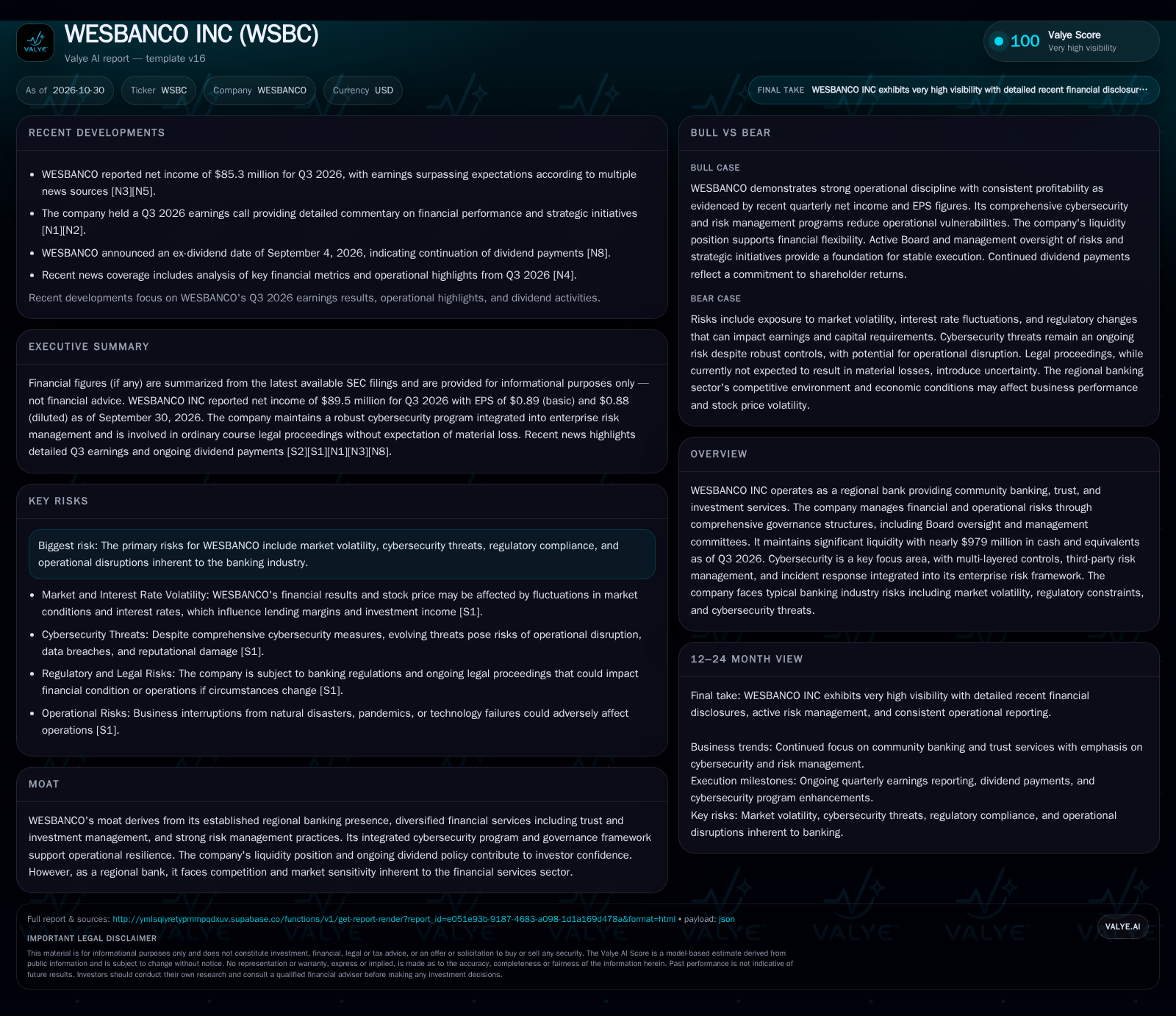
Its enterprise risk management integrates advanced cybersecurity controls, but the regional bank faces sector-wide threats from market volatility, regulatory shifts, and ongoing competition. [S2] [S1] [N3] [N8]
WESBANCO INC’s most recent quarter highlights a bank that continues to deliver steady profitability and maintain significant liquidity, even as the regional banking sector grapples with heightened volatility, regulatory scrutiny, and digital disruption. The company’s advanced approach to cybersecurity and risk governance distinguishes it among peers, but its ability to adapt to shifting market dynamics, defend margins, and sustain client trust will determine whether present strengths translate into durable shareholder value.
Recent Performance and Strategic Risk Posture
WESBANCO INC reported net income of $89.5 million for the third quarter of 2026, representing a continuation of its consistent earnings profile and surpassing analyst expectations [S2] [N5]. The company’s cash and cash equivalents stood at $978.86 million as of September 30, 2026, offering a sizable liquidity position relative to its community banking peers [S2]. The cited source reports dividend-related activity; that disclosure alone does not establish dividend-policy continuity, management confidence, or a material constraint on capital flexibility. [N8] Cybersecurity remains a central pillar of WESBANCO’s enterprise risk management, with controls benchmarked to NIST and CIS standards and subject to regular independent review [S1]. These facts collectively matter because they position WESBANCO as a well-governed regional bank with the financial and operational resources to weather moderate shocks, but not immune to sector-wide headwinds.
Beyond the reported liquidity and profitability metrics, a critical determinant of WESBANCO’s resilience lies in the granularity of its asset quality and funding composition. For instance, the proportion of variable-rate versus fixed-rate loans affects sensitivity to interest rate shifts, while the stability and cost of deposit funding influence margin sustainability. Additionally, the bank’s operational risk framework, including vendor management and internal controls, plays a vital role in mitigating non-financial risks that could impair earnings or reputation. Understanding how these elements interact under stress scenarios would enhance confidence in the bank’s ability to absorb shocks without compromising capital or liquidity buffers.
Earnings Drivers: Margin Dynamics, Fee Income, and Cost Discipline
WESBANCO’s revenue stream is primarily driven by net interest income from lending activities—sensitive to the spread between loan yields and funding costs—as well as non-interest income from trust, investment, and other fee-based services. In the current environment, net interest margins are at risk from both compressed yields on loans and rising deposit competition, especially if the Federal Reserve cuts rates or if depositors seek higher returns elsewhere. The company’s fee-based offerings in trust and investment management provide some diversification, but these lines are typically less scalable and more sensitive to market volatility than core lending. On the cost side, WESBANCO’s fixed expense base includes branch operations, technology investment (including cybersecurity), and compliance, with incremental operating leverage possible if deposit and loan growth accelerate. However, the bank’s ability to materially expand margins is likely constrained by regional competition and regulatory capital requirements, which limit aggressive risk-taking or rapid expansion.
The interplay between interest rate cycles and credit demand will also shape WESBANCO’s earnings trajectory. In rising rate environments, loan demand may moderate, particularly for rate-sensitive sectors, potentially constraining volume growth even as margins initially benefit. Conversely, a declining rate environment could spur loan growth but compress net interest margins, necessitating greater reliance on fee income or cost efficiencies to preserve profitability. The bank’s ability to dynamically price loans and deposits, manage asset-liability duration gaps, and optimize its loan portfolio mix will be crucial in navigating these trade-offs. Moreover, regulatory capital constraints may limit the bank’s willingness or capacity to pursue higher-yield, higher-risk lending segments, affecting risk-adjusted returns.
Regional Bank Resilience and the Threat of Digital Disruption
WESBANCO’s core competitive strengths stem from its established regional market presence, customer relationships, and diversified suite of financial services—including trust and investment management in addition to traditional community banking [S1]. This breadth helps retain customers and support cross-selling, but the bank faces ongoing pressure from larger national banks, fintech entrants, and non-bank asset managers targeting high-value deposit and wealth management segments. The sophistication of WESBANCO’s risk and cybersecurity governance could serve as a differentiator in winning institutional and high-net-worth clients, provided these capabilities are communicated effectively. However, the proliferation of digital banking platforms and the potential for technology-driven customer migration pose a persistent risk to legacy deposit franchises. Regulatory requirements for capital, liquidity, and cybersecurity are rising across the sector, potentially leveling the playing field and eroding traditional scale advantages. The question is whether WESBANCO can leverage its trust-based reputation and operational discipline to defend market share as digital and regulatory forces reshape the competitive landscape.
WESBANCO’s competitive positioning is also contingent on its strategic investment in technology infrastructure beyond cybersecurity, including digital customer interfaces, data analytics, and process automation. These capabilities can enhance customer experience, reduce operational costs, and enable more agile product development, which are increasingly important as fintech competitors erode traditional banking relationships. However, the scale and pace of such investments must be balanced against profitability targets and capital allocation priorities. The bank’s success in integrating digital innovation with personalized service will influence its ability to retain and expand core deposit bases and wealth management clients, particularly among younger, digitally native demographics. Additionally, partnerships or alliances with fintech firms could provide complementary capabilities without necessitating large upfront expenditures.
How Sustained Margin Discipline and Trusted Client Relationships Could Unlock Outperformance
In a favorable scenario, WESBANCO leverages its strong risk management and liquidity to grow high-quality loans, maintain deposit stability, and expand fee-based business even as competitors falter amid volatility. Effective cross-selling of trust and investment services could drive higher non-interest income and deepen customer relationships, reducing sensitivity to interest rate swings. If the company’s cybersecurity posture continues to prevent material incidents and is recognized by clients as a value-add, WESBANCO could attract institutional or high-net-worth business away from less secure peers. Upside confirmation would come from sustained loan growth and stable or widening net interest margins, rising fee income as a share of total revenue, and visible market share gains in target segments. Evidence would include above-peer growth in trust/investment assets under management (if disclosed), positive trends in non-interest income, and minimal credit losses or charge-offs through a cycle.
Earnings Stability Amid Sector Headwinds and Incremental Growth Opportunities
Fee-based revenues from trust and investment services help cushion against net interest income volatility, but are unlikely to transform the growth trajectory absent a step-change in client acquisition. Cybersecurity and risk management remain robust, protecting the bank from major operational disruptions but adding to the cost base. Signs that would challenge this outlook include a significant decline in net interest margins, loss of major clients in trust/investment services, or a cybersecurity breach resulting in operational or reputational damage.
Margin Compression, Credit Deterioration, and Regulatory Drag
In a downside scenario, WESBANCO’s net interest margins are squeezed by aggressive deposit competition, falling loan yields, or a sharp drop in interest rates, while fee-based income fails to offset the pressure. Credit quality deteriorates as macroeconomic weakness leads to rising delinquencies and charge-offs, forcing higher provisioning and eroding reported earnings. Regulatory requirements tighten, raising capital or compliance costs and limiting growth flexibility. A material cybersecurity incident or data breach would exacerbate reputational and operational risks, potentially resulting in client defections or legal liabilities. Downside confirmation would consist of declining quarterly net income, dividend suspension or reduction, rising credit loss provisions, or explicit regulatory enforcement actions. Early warning signals could include a rapid increase in non-performing loans, negative trends in deposit growth, or adverse media coverage around cyber incidents.
Milestones That Will Clarify the Durability of WESBANCO’s Earnings and Franchise
Quarterly trends in net interest margin and loan/deposit growth rates, as reported in future earnings releases.
Fee-based revenue growth from trust and investment services—especially any disclosed assets under management or new client wins.
Credit quality indicators such as non-performing loan ratios, charge-offs, and loan loss provisions (if disclosed).
Annual and interim disclosures of cybersecurity incidents, third-party risk assessments, or Board-level risk management reviews.
Any evidence of major customer attrition or market share loss to digital competitors, as reflected in client or deposit trends.
Regulatory developments that materially affect capital, liquidity, or cybersecurity requirements for regional banks.
Disclaimer: This is research-only, informational analysis and not investment advice. It may include AI-generated interpretation and general industry context. Always verify important details using primary sources.

Comments