
RPC Inc.: Oilfield Service Diversification Tested by Cyclicality, Margin Pressure, and Customer Concentration
RPC Inc.’s broad technical service portfolio and regional exposure provide access to U.S. oilfield activity, but recent losses, pressure on core service lines, and reliance on a few large customers highlight the stakes of industry cyclicality, price competition, and operational execution.
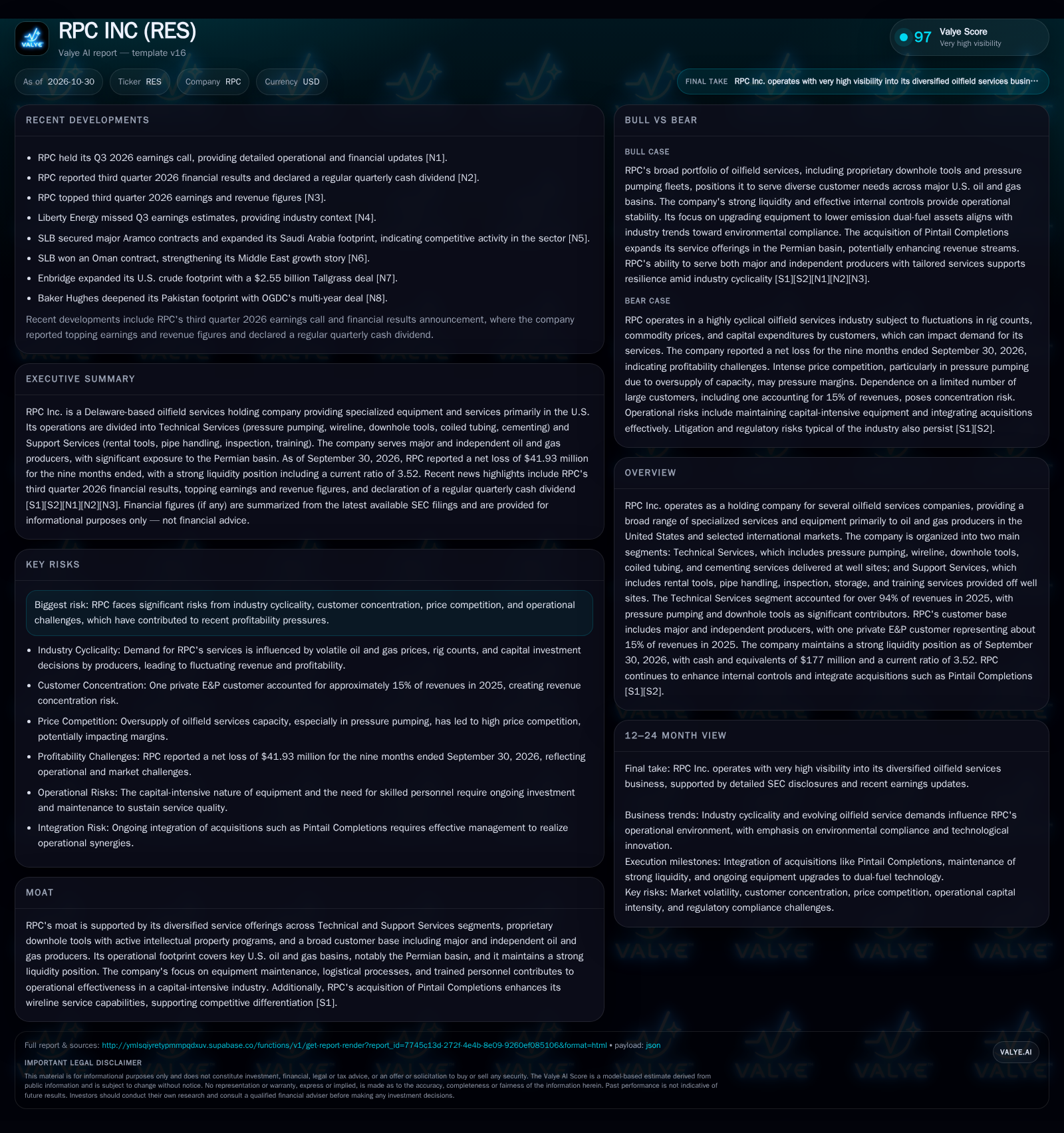
RPC’s revenue mix is heavily weighted toward capital-intensive technical services, with a notable reliance on one private E&P customer. The future hinges on navigating industry cycles, managing customer concentration, and extracting value from recent acquisitions and equipment upgrades. [S1] [S2]
RPC Inc. stands at the intersection of U.S. oilfield activity and the relentless cyclicality of the energy sector. With its portfolio spanning pressure pumping, downhole tools, wireline, and support services, RPC is positioned to serve both independent and major producers, especially in the prolific Permian basin. However, the company’s 2026 results reveal the acute challenges of competing in a market defined by fluctuating rig counts, margin compression, and customer concentration. As RPC absorbs new acquisitions and upgrades its asset base, the critical question is whether operational scale, service breadth, and liquidity can counteract the industry’s structural volatility and persistent price pressures. [S1] [S2]
Declining Rig Count, Margin Pressure, and Customer Concentration Define the 2026 Backdrop
The company reported a current ratio of 3.52 for the period. Notably, pressure pumping alone represents nearly 30% of 2025 revenues, but this segment faces intense price competition and overcapacity. The U.S. rig count averaged 562 in 2025, lower than prior years, directly impacting service demand. Compounding the cyclicality, one private E&P customer represented about 15% of 2025 revenues, elevating concentration risk. The recent acquisition of Pintail Completions has expanded RPC’s wireline offerings, but integration and margin recovery remain live issues. [S1] [S2]
How Capital Intensity, Service Mix, and Cyclicality Shape RPC’s Earnings Power
RPC’s revenue model is driven by the volume and pricing of technical services delivered at the wellsite—primarily pressure pumping, wireline, downhole tools, coiled tubing, and cementing. These are capital- and labor-intensive offerings, requiring significant investment in equipment fleets, skilled personnel, and maintenance. Pressure pumping, the largest single line item, is particularly vulnerable to industry overcapacity and price competition, making margins highly sensitive to utilization and pricing cycles.
Support Services (rental tools, pipe handling, inspection, and training) constitute a small but potentially more stable revenue stream. However, with only 5.6% of 2025 revenues, they do not materially offset the volatility of the technical services segment. The company’s cost structure is weighted toward fixed costs—equipment, facilities, and headcount—so operating leverage can amplify both upturns and downturns. Working capital swings are influenced by the short lead times of service contracts and the financial health of a concentrated customer base. Capital needs remain elevated: maintaining and upgrading fleets (e.g., to dual-fuel or lower-emission assets) is necessary to remain competitive, but return on incremental capital is highly cyclical and vulnerable to downturns.
The company reported cash and liquidity metrics for the period; these figures do not by themselves establish operating runway, investment capacity, financial flexibility, or financing capacity. [S1] [S2]
Service Breadth, Proprietary Tools, and Regional Exposure—But Enduring Margin Headwinds
RPC’s competitive profile is built around its diversified technical offerings (pressure pumping, wireline, downhole tools), proprietary tool development, and a broad customer base spanning major and independent producers. Its operational footprint in key basins, especially the Permian, provides access to the most active U.S. oilfields. The recent integration of Pintail Completions enhances wireline capabilities and may offer some differentiation.
However, the core segments—especially pressure pumping—are subject to commoditization, with many regional and national competitors able to deploy similar fleets. Price competition remains intense, particularly as overcapacity persists and customers leverage short-term contracts to negotiate discounts. Proprietary downhole tools may provide some margin protection if they deliver operational efficiencies or unique value, but the extent of their differentiation is not fully established in the supplied evidence. Customer switching costs are relatively low in commoditized service lines, and the industry’s tendency toward short lead times and rapid project cycles amplifies pricing pressure.
Operational execution, asset uptime, and the ability to support customers’ environmental and efficiency goals (e.g., dual-fuel fleets, geothermal applications) could become sources of incremental advantage, but only if RPC can sustain capital investment and demonstrate superior performance. [S1]
If Industry Activity Rebounds and RPC Extracts Margin from Technology, Recovery Is Possible
A constructive scenario for RPC requires a cyclical recovery in U.S. drilling and completion activity—e.g., a rebound in rig counts, improved oil and gas prices, and renewed capital spending by producers. In this environment, utilization of technical service fleets would rise, supporting both higher volumes and improved pricing. If RPC can leverage its proprietary downhole tools and upgraded equipment to deliver operational efficiencies or differentiated value, it may capture incremental share or margin within its core segments.
The successful integration of Pintail Completions could also expand the addressable market in wireline services, particularly in the Permian basin. To validate this scenario, evidence would include: sequential improvements in revenue and margin per service line, rising rig counts, customer wins for new or differentiated offerings, and positive EPS inflections. Confirmation would also come from sustained or expanding backlog (if disclosed), and greater revenue diversification away from the largest customer. [S1] [S2]
Navigating Cyclicality with Diversification, But Margin Recovery Will Be Gradual
The most plausible trajectory is one in which RPC remains exposed to slow recovery in U.S. oilfield activity, with rig counts stabilizing but not returning to prior peaks. Ongoing price competition in pressure pumping and commoditized service lines will likely limit margin expansion, even as operational execution and equipment upgrades help defend share. The Technical Services segment will continue to dominate the revenue mix, while Support Services remain a modest stabilizer.
Customer concentration risk persists, particularly if the largest E&P customer pulls back on spending or shifts suppliers. Integration of Pintail Completions provides some incremental growth in wireline, but the impact on group profitability may be muted if margin pressure continues in other segments. This scenario would be confirmed by flat to modestly improving revenue, continued net losses or thin profitability, and a stable but not expanding cash balance. Evidence of improved capital discipline (e.g., capex alignment with demand, cost control) and successful renewal of major customer relationships would support the thesis. [S1] [S2]
Extended Downturn, Loss of Major Customer, or Margin Erosion Could Pressure Liquidity
If U.S. oilfield activity deteriorates further—due to sustained low commodity prices, a sharp drop in rig counts, or a retrenchment in E&P capital budgets—RPC could face severe underutilization of its technical service assets. In this scenario, price competition could intensify, driving margins negative, especially in pressure pumping. Should the largest customer (15% of revenues) significantly reduce spending or exit, revenue concentration could translate into abrupt top-line declines.
Persistent losses would erode RPC’s cash reserves, potentially forcing cutbacks in maintenance or equipment upgrades, and increasing vulnerability to operational disruptions. Integration risks with recent acquisitions could compound the challenge if expected synergies or efficiencies do not materialize. Evidence confirming this scenario would include sequential revenue declines, deepening net losses, customer attrition, negative operating cash flow, and any drawdown of credit facilities. [S1] [S2]
Signals That Will Test RPC’s Ability to Withstand Oilfield Cyclicality and Margin Compression
Quarterly revenue and margin trends by service line—especially pressure pumping and downhole tools—would help assess RPC’s ability to defend share and pricing (if disclosed).
U.S. rig count and customer capex announcements, as these are leading indicators for demand in RPC’s primary markets.
Customer concentration metrics: shifts in the proportion of revenue from the largest customer or major contract renewals would test concentration risk (if disclosed).
Operating cash flow and capital expenditure levels, to determine whether RPC can sustain fleet maintenance and upgrades without drawing down cash.
Evidence of successful integration and revenue contribution from Pintail Completions, particularly in wireline services (if disclosed).
Utilization rates for core equipment fleets—especially in pressure pumping and wireline—as a proxy for demand and margin leverage (if disclosed).
Any early signs of sustained improvement in net income or a positive EPS inflection, which would signal a turn in underlying business conditions.
Disclosures on proprietary tool adoption, new technology deployments, or customer wins tied to environmental compliance and efficiency (if disclosed).
Disclaimer: This is research-only, informational analysis and not investment advice. It may include AI-generated interpretation and general industry context. Always verify important details using primary sources.

Comments