
TechnipFMC: Subsea Execution, Capital Constraints, and Offshore Energy Cyclicality Risks
TechnipFMC’s latest results underscore strong operational performance and global reach in subsea and surface technologies, but reported liquidity position highlight the company’s vulnerability to the capital intensity and cyclicality of the oil and gas sector. The balance between executing large-scale offshore contracts and navigating industry volatility will define its medium-term trajectory.
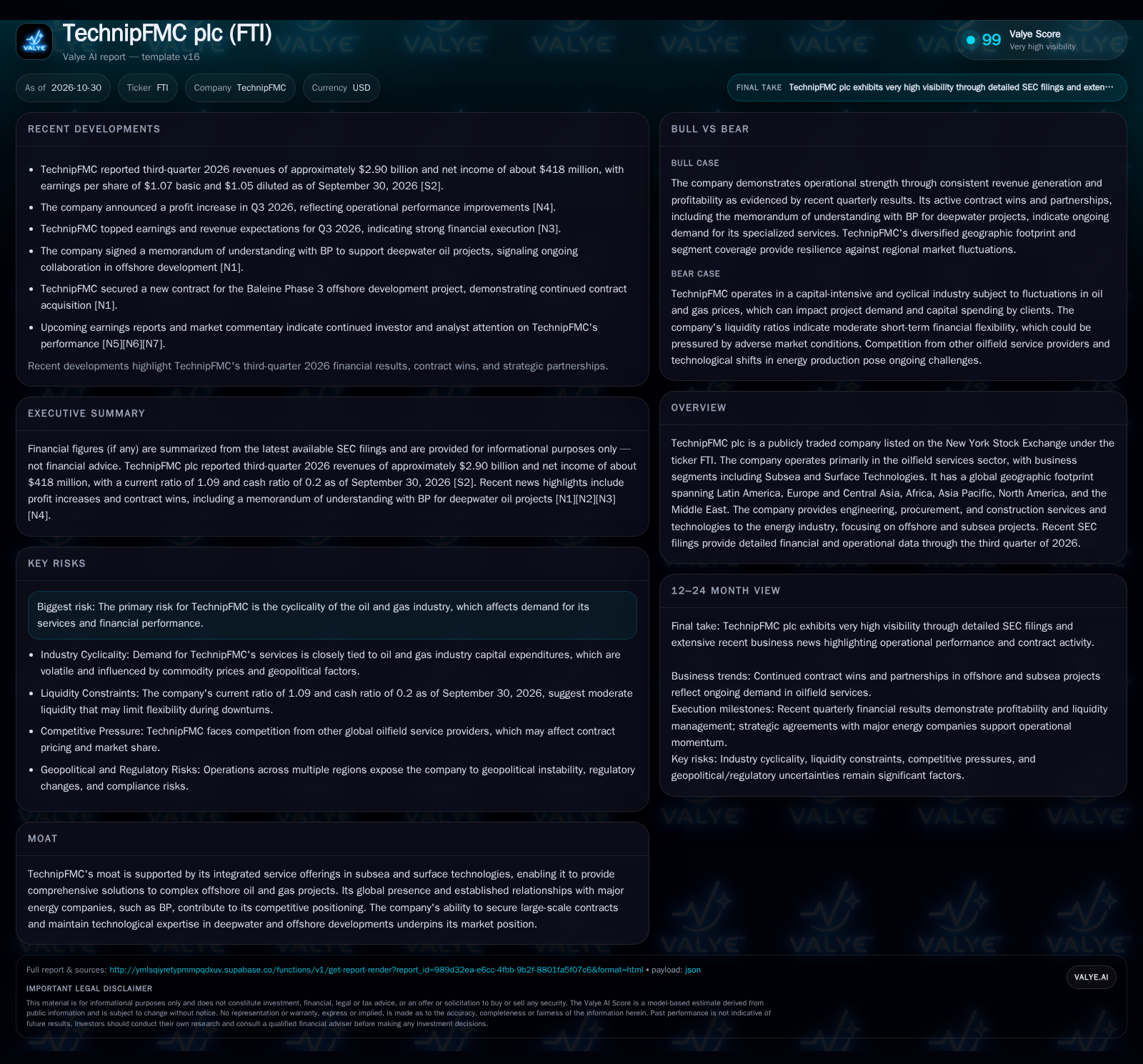
TechnipFMC reported $2.90 billion in Q3 2026 revenue and $418 million in net income, reflecting robust operational execution and profitable contract delivery. Its global presence and expertise in complex subsea projects underpin its competitive positioning, but future performance hinges on sustaining contract wins, managing working capital, and weathering external shocks in a cyclical market. [S2] [N3] [N4]
TechnipFMC’s third-quarter 2026 performance highlights the company’s ability to deliver strong results in a challenging oilfield services market. With $2.90 billion in revenue and $418 million in net income, the company outperformed expectations, buoyed by global contracts and continued execution in subsea and surface technologies. Yet, the company’s balance sheet reveals only moderate short-term liquidity, underscoring its exposure to the capital demands and volatility inherent in the energy sector. The coming quarters will test whether TechnipFMC can leverage its global reach and deepwater expertise to sustain growth while navigating the cyclical swings and competitive pressures that define offshore energy services.
Recent Results Highlight Profit Gains and Liquidity Challenges
TechnipFMC reported Q3 2026 revenues of approximately $2.90 billion and net income of $418 million, with earnings per share of $1.07 basic and $1.05 diluted [S2]. This performance exceeded analyst expectations and was accompanied by positive commentary on operational execution [N3] [N4]. However, the company’s balance sheet as of September 30, 2026, showed cash and cash equivalents of $1.05 billion and a current ratio of 1.09, alongside a cash ratio of 0.2 [S2]. Additionally, the recently announced memorandum of understanding with BP signals TechnipFMC’s continued involvement in major deepwater projects, a core driver of its subsea business [N1].
TechnipFMC’s Project Approach Shapes Revenue, Margins, and Capital Demand
TechnipFMC generates the bulk of its revenue from large-scale engineering, procurement, and construction (EPC) contracts in subsea and surface technologies, primarily serving oil and gas majors. These projects typically involve high upfront costs, long lead times, and milestone-based payments, creating both operating leverage and working capital swings. The company’s profitability stems from its ability to execute complex, capital-intensive projects efficiently—extracting margin from technological integration, project management expertise, and supply chain coordination.
Pricing power is often limited by intense competition and client price sensitivity, especially during industry downturns. Volume is closely tied to global offshore and deepwater investment cycles, which are themselves driven by energy prices and long-term oil and gas demand outlooks. Mix can be influenced by the proportion of higher-margin subsea work versus more commoditized surface projects. The capital structure must support significant working capital requirements, with cash conversion cycles stretching as project milestones are reached. Operating leverage is present—fixed engineering and project management costs mean incremental contract wins can drive outsized earnings—but the flip side is margin compression and potential cash stress if new awards slow or clients delay payments.
The capital intensity inherent in TechnipFMC’s project model necessitates a finely tuned balance between upfront investment and timely cash inflows. Since project payments are milestone-driven, delays in achieving these milestones can disproportionately strain working capital and liquidity. This dynamic underscores the importance of robust project risk management and contingency planning to mitigate cash flow volatility. Additionally, the company’s ability to forecast and manage supply chain complexities directly impacts both cost control and schedule adherence, which in turn affect margin realization. If disclosed, metrics such as days sales outstanding (DSO) and days payable outstanding (DPO) would help quantify the efficiency of working capital management and its sensitivity to project execution cycles.
Leveraging Global Scale and Deepwater Expertise to Secure Offshore Contracts
TechnipFMC’s competitive edge lies in its integrated offering of subsea production systems and surface technologies, which allows it to address complex offshore developments for global energy majors. Its geographic diversification—spanning Latin America, Europe and Central Asia, Africa, Asia Pacific, North America, and the Middle East—helps mitigate regional project lulls but also amplifies exposure to geopolitical and regulatory risks [S2].
The company faces competition from other large oilfield service providers and EPC firms, many of whom are similarly pursuing scale, technological differentiation, and long-term client relationships. Substitutes include alternative energy investments and in-house client capabilities, particularly as global energy transition pressures mount. Technological shifts—such as digitalization, automation, and new offshore extraction paradigms—could disrupt legacy project economics, rewarding those with the most advanced and cost-effective solutions. In this environment, TechnipFMC’s ability to consistently win and execute large, technically demanding contracts with major players like BP is a key test of its enduring competitive position [N1].
TechnipFMC’s global footprint offers advantages in accessing diverse markets and client bases, but it also introduces operational complexity. Variations in regional regulatory frameworks, local content requirements, and geopolitical stability can influence project timelines and cost structures. Navigating these factors requires adaptive project management capabilities and strong local partnerships. Moreover, the company’s emphasis on integrated subsea and surface solutions can create barriers to entry for competitors lacking similar breadth, but it also demands continuous innovation to maintain technological leadership. The pace of digital transformation in offshore operations—such as remote monitoring and predictive maintenance—could redefine competitive parameters, rewarding firms that integrate these capabilities effectively into project delivery.
Margin and Cash Flow Upside Potential from Offshore Investment Recovery
A favorable scenario for TechnipFMC would see a sustained upcycle in global offshore and deepwater oil and gas investment. If energy prices remain robust and oil majors commit to multi-year capital spending, TechnipFMC could benefit from a surge in project awards, especially for technologically complex subsea systems where its expertise is most valued. This would drive higher utilization of fixed engineering resources, boosting operating leverage and potentially expanding margins.
Confirmation of this scenario would come through a visible increase in order backlog, new multi-year contract announcements (especially with supermajors), and rising segment profitability. Evidence that TechnipFMC is winning a disproportionate share of new deepwater projects, or successfully deploying new technologies that command premium pricing, would also support the upside thesis.
Most Probable Outcome: Consistent Execution Through Cyclical Variations
The most plausible outcome is that TechnipFMC continues to deliver solid operational results, maintaining profitability through disciplined project execution and selective contract bidding. Revenue and earnings may fluctuate within a range determined by the pace of new project awards and the ebb and flow of client capital spending. Liquidity will likely remain adequate but not ample, requiring careful working capital management and potentially limiting the company’s ability to absorb simultaneous project delays or cost overruns.
This base case would be confirmed by stable or gradually rising revenues, continued profitability, and liquidity ratios remaining near current levels. Sustained relationships with major clients—evidenced by new agreements or contract renewals—would reinforce the company’s position.
Financial Vulnerability Emerges from Industry Downturns or Project Disruptions
In an adverse scenario, a downturn in global oil and gas investment—triggered by weaker commodity prices, accelerated energy transition trends, or geopolitical disruptions—could sharply curtail new project awards and delay existing contracts. TechnipFMC’s fixed cost base and capital commitments would then create pressure on margins and cash flow, especially if milestone payments are deferred or clients renegotiate terms.
Erosion in competitive position—evidenced by lost bids to rivals or shrinking market share in core segments—would further reinforce the risk that TechnipFMC could struggle to cover its capital needs in a prolonged industry slump.
Factors Influencing TechnipFMC’s Financial Strength and Value Generation
Order backlog growth and the mix of new contract awards—especially for complex subsea projects—would help test demand visibility and competitive win rates.
Announcements of major project milestones, technology deployments, or client renewals—particularly with supermajors like BP—would indicate ongoing operational relevance.
Segment margin trends, if disclosed, would clarify the profitability of subsea versus surface technology operations.
Any material project delays, cost overruns, or client payment issues would signal operational or financial stress.
Disclosures about capital expenditures, project pipeline, or new market entries would illuminate future growth prospects and capital needs.
Evidence of evolving competitive threats from new technologies or alternative energy investments should be monitored for potential structural risk.
Changes in geopolitical, regulatory, or macroeconomic conditions in key operating regions could introduce new uncertainties or opportunities.
Disclaimer: This is research-only, informational analysis and not investment advice. It may include AI-generated interpretation and general industry context. Always verify important details using primary sources.

Comments