
Entegris: Advanced Materials, Margin Levers, and the Stakes of Semiconductor Cyclicality
With a diversified offering in advanced materials and contamination control, Entegris is positioned at the heart of semiconductor manufacturing’s most demanding process nodes. Recent margin tailwinds, robust segment economics, and a global supply strategy are tested by industry cyclicality and geopolitical risk—leaving the company’s path dependent on execution and end-market resilience.
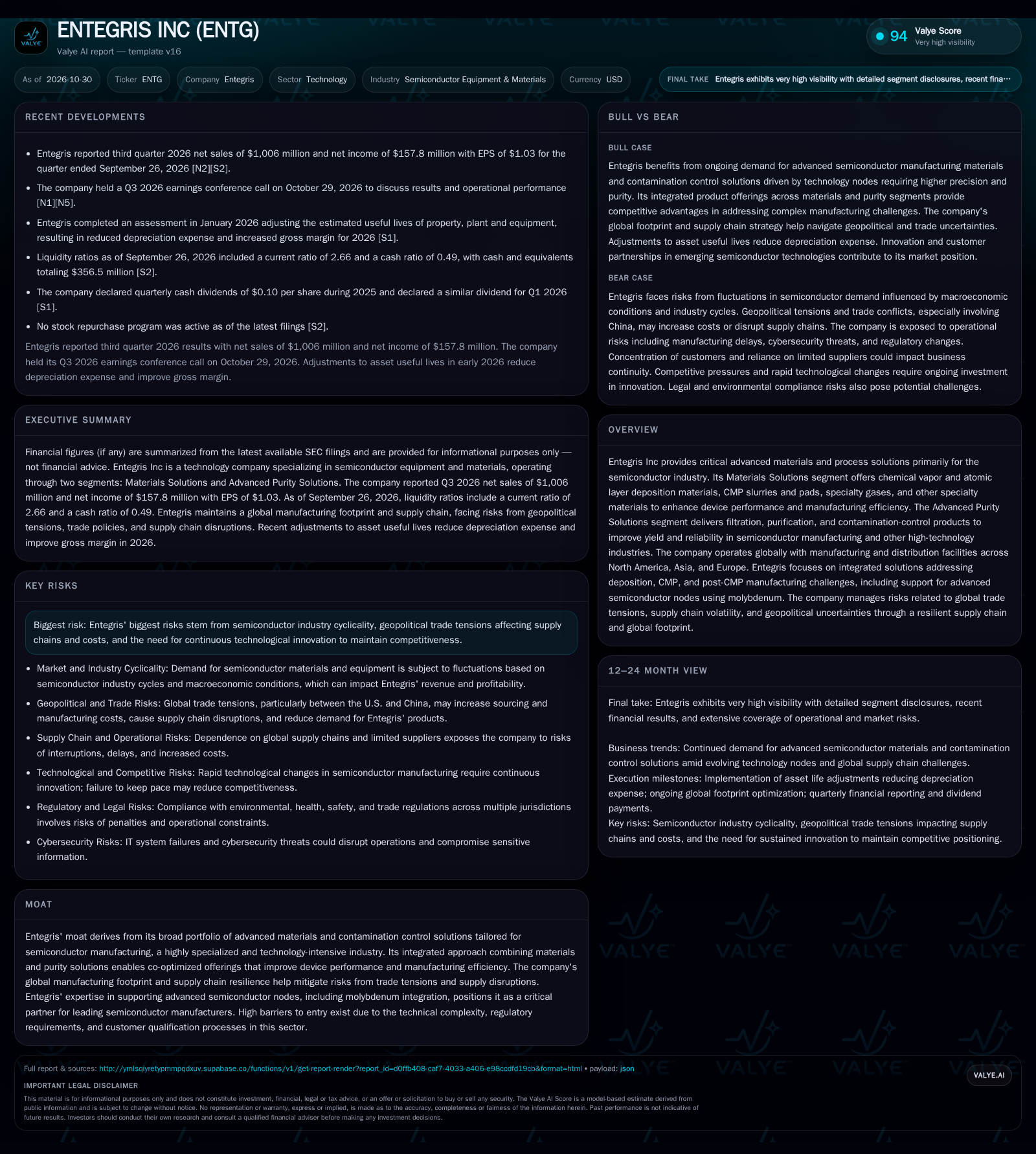
Entegris reported Q3 2026 net sales of $1,006 million and net income of $157.8 million, with recent margin improvement from lower depreciation after asset-life adjustments. Its business spans advanced materials and purity solutions for semiconductor manufacturing, with global operations calibrated to supply chain and geopolitical shocks. The company’s future hinges on sustained semiconductor demand, ability to innovate for next-gen nodes, and the management of trade and supply risks. [S2] [N2]
Entegris stands as a pivotal supplier to the semiconductor industry, delivering advanced materials and contamination control solutions essential to next-generation chip manufacturing. In the third quarter of 2026, the company delivered $1,006 million in net sales and $157.8 million in net income, with recent gross margin uplift from a strategic change in asset depreciation schedules. As global chipmakers push into ever-smaller nodes and more complex architectures, Entegris’ ability to supply critical process materials and maintain a resilient, globally distributed supply chain forms the backbone of its value proposition. Yet, with the sector’s notorious cyclicality and heightened geopolitical risk, the company’s next phase will be shaped as much by external volatility as by operational execution. [S2] [N2]
Recent Margin Gains and Operational Scale Define 2026 Backdrop
Entegris reported Q3 2026 net sales of $1,006 million, with net income of $157.8 million and basic/diluted EPS of $1.03, underscoring the company’s significant scale within the semiconductor supply chain. The company’s January 2026 reassessment of property, plant, and equipment useful lives led to reduced depreciation expense and a resulting increase in gross margin for the year. This accounting shift provides a temporary lift to reported profitability, though it does not affect underlying cash flows. The company reported cash and liquidity metrics for the period; these figures do not by themselves establish operating runway, investment capacity, financial flexibility, or financing capacity. [S1] [S2] [N2]
The cited source reports dividend-related activity; that disclosure alone does not establish dividend-policy continuity, management confidence, or a material constraint on capital flexibility. The operational context is shaped by ongoing exposure to semiconductor demand cycles, global economic uncertainty, and supply-chain/geopolitical risks, all of which remain central to the investment thesis.
How Entegris Monetizes Process Complexity in Semiconductor Manufacturing
Entegris’ revenue is anchored in its ability to supply high-value, specialized materials and contamination control solutions to semiconductor manufacturers—markets characterized by demanding qualification cycles, high switching costs, and a premium on reliability. The Materials Solutions segment focuses on consumables such as advanced deposition precursors, CMP (chemical mechanical planarization) slurries and pads, and specialty gases, all of which are consumed at high volume in advanced logic and memory fabs. Pricing power in this segment is typically tied to material purity, process performance, and qualification at the customer’s specific process node.
The Advanced Purity Solutions segment delivers filtration and contamination-control products that are mission-critical for yield and device reliability. These solutions are often integrated into the fab infrastructure and process flow, potentially creating embedded switching frictions and recurring replacement cycles. While direct evidence of contract structure is not disclosed, it is plausible that a significant portion of APS revenue is tied to ongoing fab operations and maintenance.
Both segments benefit from the rising complexity of semiconductor manufacturing, as smaller nodes and new materials (e.g., molybdenum integration) drive demand for ultra-high-purity inputs and more sophisticated contamination control. The business is capital-intensive, requiring periodic investment in manufacturing capacity, process R&D, and compliance. The recent reduction in depreciation expense temporarily boosts reported margins, but true economic margin expansion relies on product mix, pricing discipline, and operating leverage as volumes scale.
Integrated Offerings and Global Reach: Moat Dynamics and Competitive Pressures
Entegris’ competitive position rests on its broad portfolio and integration across materials and purity solutions. By addressing both process materials and contamination control, the company can offer co-optimized solutions that may be difficult for more narrowly focused peers to replicate. High customer qualification requirements and the mission-critical nature of the supplied materials create meaningful barriers to entry.
However, the company operates in a space with formidable, well-capitalized competitors—ranging from specialty chemical firms to diversified industrials and regional players. Competitive intensity can drive pricing pressure, especially in commoditized material categories or during industry downturns. Rapid technological shifts in chip architecture or fab processes could also enable new entrants or substitution by alternative materials or suppliers. Entegris’ global manufacturing footprint is a strategic advantage in serving multinational fabs and mitigating localized disruptions, but it also exposes the company to regulatory and trade policy volatility, especially in the context of US-China tensions.
What Could Drive Outperformance: Advanced Node Adoption and Margin Expansion
A favorable scenario for Entegris would see sustained or accelerating demand for advanced semiconductor nodes, particularly as foundries and IDMs ramp up production of chips at 3nm and below, or introduce new materials such as molybdenum. In this environment, Entegris could benefit from increased volume, improved pricing on next-gen materials, and higher ASPs (average selling prices) for both materials and purity solutions due to elevated technical requirements.
Further upside would come if the company’s recent asset-life change is followed by genuine improvements in operating efficiency or product mix, leading to sustainable margin expansion rather than a one-off accounting benefit. Confirmation of this scenario would include above-industry growth in both segments, rising gross and operating margins (net of depreciation normalization), and evidence of share gains in key material categories. Additional proof points would be customer announcements of using Entegris solutions in leading-edge fabs, or disclosures of multi-year supply agreements tied to advanced process ramps.
Enduring the Cycle: Steady Demand with Episodic Volatility
The most plausible medium-term outcome is that Entegris continues to ride the broader semiconductor cycle, with periods of robust demand for advanced materials punctuated by episodic slowdowns tied to macroeconomic or inventory corrections. The company’s global supply chain and product breadth provide some resilience, but revenue and margins will remain sensitive to fab utilization rates and customer capex cycles.
In this scenario, the margin benefit from reduced depreciation in 2026 is gradually absorbed, and future profitability depends on the company’s ability to maintain product differentiation and avoid price erosion. Signs of cyclical pressure would be visible in declining order rates, customer inventory adjustments, or increased price competition, but these would be consistent with historical industry patterns rather than structural decline.
How External Shocks or Technology Shifts Could Disrupt the Thesis
A negative scenario would unfold if a severe semiconductor downturn or geopolitical shock—such as an escalation in US-China trade conflict—materially reduces demand or disrupts Entegris’ supply chain. The company’s exposure to global trade dynamics and concentration in top-tier customers leaves it vulnerable to sudden volume contractions or cost inflation from tariffs and supply interruptions.
Alternatively, a disruptive technology shift (e.g., adoption of radically new materials, process flows, or manufacturing paradigms that obviate current product lines) could erode Entegris’ relevance or pricing power. Confirmation of this scenario would include sharp revenue declines, margin compression despite accounting adjustments, customer losses to alternative suppliers, or disclosures of supply chain bottlenecks and cost overruns. Regulatory or cybersecurity events could also trigger operational or reputational damage, compounding financial headwinds.
Milestones and Metrics That Will Test the Entegris Thesis in 2026–2027
Sustained gross margin improvement beyond the one-time depreciation benefit—especially if supported by product mix or operational efficiency gains—would indicate real economic progress rather than temporary accounting effects.
Revenue growth in the Materials Solutions and Advanced Purity Solutions segments relative to industry wafer fab equipment (WFE) and semiconductor capex trends would clarify market share and end-market health.
Announcements of customer wins, particularly for advanced nodes or next-generation materials (such as molybdenum integration), would validate Entegris’ positioning in leading-edge manufacturing.
Disclosures of multi-year supply agreements, recurring revenue contracts, or renewal rates would help assess revenue visibility and embedded customer switching costs.
Updates on trade policy developments, especially involving US-China relations, and their impact on sourcing, manufacturing, or demand would provide early warning of supply chain or cost disruptions.
Material cybersecurity incidents or regulatory investigations would serve as leading indicators of operational and reputational risk.
Disclaimer: This is research-only, informational analysis and not investment advice. It may include AI-generated interpretation and general industry context. Always verify important details using primary sources.

Comments