
Silvercrest Asset Management: Fee Stability, Disclosure Gaps, and the Stakes of AUM Volatility
Silvercrest Asset Management’s Q3 2026 results highlight continued profitability and a reported cash position, but incomplete liquidity disclosures and earnings variability keep the focus on operating leverage and client retention in a competitive, fee-driven sector.
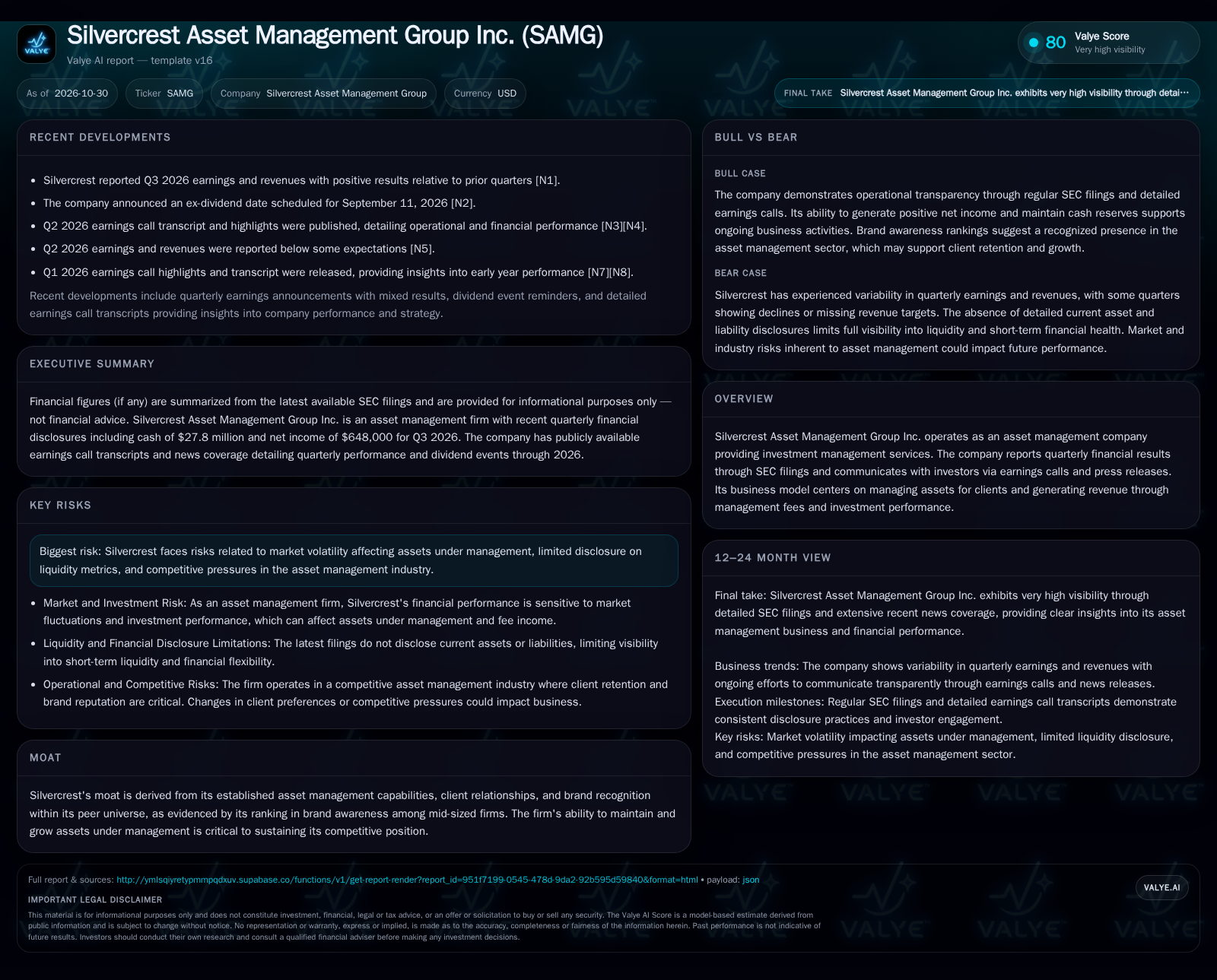
Silvercrest Asset Management reported Q3 2026 net income of $648,000 and cash of $27.8 million, showing ongoing profitability despite mixed quarterly performance. The business model hinges on fee income from assets under management (AUM), but limited current-liabilities disclosure obscures short-term potential financial flexibility. Execution will depend on maintaining client relationships and navigating market-driven AUM swings in a crowded asset management landscape. [S2] [N1]
Silvercrest Asset Management Group enters the final stretch of 2026 with a mixed but resilient operational profile. Yet, the absence of granular liquidity metrics and the inherent volatility of asset management income highlight ongoing sensitivity to market cycles and client flows. The key question is whether Silvercrest can sustain its fee base and defend its client roster amid competitive and macroeconomic headwinds.
Recent Results Spotlight Profitability and Disclosure Limitations
Silvercrest reported net income of $648,000 for Q3 2026, with basic and diluted earnings per share at $0.08. As of September 30, 2026, the company held $27.8 million in cash and cash equivalents. The company reported cash and liquidity metrics for the period; these figures do not by themselves establish operating runway, investment capacity, financial flexibility, or financing capacity. Quarterly earnings and revenues in 2026 have fluctuated, with some quarters missing expectations and others showing positive surprises, underscoring the business’s exposure to variable market and client conditions. [S2] [N1] [N5]
How Silvercrest Converts AUM into Fee Revenue and Operating Leverage
Silvercrest’s core revenue stream is management fees, typically calculated as a percentage of assets under management (AUM). This model provides predictable baseline income when AUM is stable, but exposes the company to both market-driven asset declines and client withdrawals. Fee schedules in the industry often exhibit a declining marginal rate as client assets rise, creating a volume–pricing tradeoff. The cost structure of asset management is characterized by significant operating leverage: personnel, technology, and regulatory costs are largely fixed, so incremental fee revenue from AUM growth can disproportionately boost margins. However, when AUM falls, the fixed-cost base compresses profitability. [S2]
The sensitivity of Silvercrest's fee revenue to AUM fluctuations is further complicated by the timing and structure of client mandates. For instance, certain institutional accounts may have lock-up periods or notice requirements that delay asset withdrawals, providing some revenue visibility and smoothing cash flows. Conversely, retail or high-net-worth individual clients might exercise greater liquidity flexibility, increasing revenue volatility. Additionally, performance-based fees, if part of the revenue mix, introduce asymmetry whereby strong market returns can disproportionately boost income, but poor performance may lead to fee reductions or client attrition. Understanding the proportion of fixed versus performance-linked fees would help clarify revenue stability and operating leverage dynamics.
Client Relationships, Switching Frictions, and Competitive Dynamics in Asset Management
Silvercrest competes in a crowded asset management landscape populated by independent firms, large diversified financial institutions, and fintech entrants. Its moat rests on established client relationships and brand recognition, particularly among mid-sized firms. However, industry-wide switching costs are moderate; clients can and do move assets in pursuit of performance, lower fees, or differentiated service. The commoditization of passive investment products and the rise of digital advisory platforms intensify pressure on traditional fee structures. Silvercrest’s opportunity to defend or expand its client base likely depends on service quality, investment performance, and niche expertise. The lack of disclosed retention rates or client mix makes it difficult to gauge the durability of its revenue base, but persistent brand awareness in industry rankings suggests some degree of embedded trust and inertia.
The competitive landscape also imposes strategic trade-offs on Silvercrest’s client acquisition and retention efforts. Aggressive fee discounting can win new mandates but risks compressing long-term profitability, especially if scale benefits do not materialize. Conversely, prioritizing premium service and differentiated investment strategies may sustain higher fees but limit rapid AUM growth. Moreover, the rise of passive and semi-passive investment products challenges active managers to justify their fees through consistent outperformance or unique exposures. The firm's ability to innovate in product offerings and client engagement, while managing cost structures, will be crucial to maintaining a defensible market position amid evolving client expectations and technological disruption.
Margin Expansion If AUM Grows and Fee Compression Is Contained
A favorable scenario for Silvercrest is one in which market appreciation and/or new client wins drive sustained AUM growth, allowing the company to scale fee revenue faster than expenses. The resulting operating leverage could expand margins and support higher earnings per share, especially if fee compression is limited and client retention remains robust. Confirmation would come from sequential increases in AUM, disclosure of rising management fee revenue, and evidence of cost discipline in filings or earnings calls. Additional upside could be unlocked if Silvercrest successfully cross-sells new investment strategies or leverages technology to enhance operational efficiency. Falsification would involve stagnating or declining AUM, rising expense ratios, or evidence of significant fee pressure from clients shifting to lower-cost alternatives.
In addition to organic AUM growth, margin expansion could be supported by operational efficiencies driven by technology adoption. Automation of portfolio management, client reporting, and compliance processes can reduce incremental costs and enhance scalability. If Silvercrest can leverage data analytics to improve investment decision-making or client segmentation, it may also increase client satisfaction and retention. However, these benefits depend on effective implementation and ongoing investment, which could temporarily elevate expenses. The balance between upfront technology costs and longer-term margin gains is a critical factor in realizing upside potential. Furthermore, cross-selling complementary products or services to existing clients could deepen relationships and increase fee density, enhancing revenue resilience.
Earnings Stability Hinges on Market-Driven AUM Fluctuations and Cost Control
The most plausible trajectory for Silvercrest is continued profitability, but with earnings and cash flow fluctuating in line with market cycles and client activity. Fee revenue may remain broadly stable if market performance is neutral and client retention holds, but periodic drawdowns or redemptions—common in the industry—could drive quarter-to-quarter volatility. Confirmation would involve steady AUM, management fees, and recurring positive net income in future quarters. Falsification would be signaled by a sustained decline in AUM, recurring earnings misses, or a notable contraction in the reported cash position.
Exposure to Market Shocks and Client Attrition Could Pressure Margins
A negative scenario would see a major market downturn or loss of key client accounts, triggering a sharp drop in AUM and, by extension, fee income. Given the fixed-cost nature of the business, this could rapidly erode margins and potentially push earnings negative. The lack of detailed current-liability disclosure magnifies the risk, as sudden outflows may strain working capital or force asset sales. Signs of this scenario playing out would include a pronounced decline in AUM (if disclosed), lower reported management fees, negative net income, and a rapid drawdown in cash. Additional red flags would be management commentary about client redemptions or industry-wide fee compression.
Factors That Will Shape Silvercrest’s Fee Base and Competitive Resilience
Sequential changes in assets under management (AUM), if disclosed, as they directly drive fee revenue and operating leverage.
Trends in management fee income and any commentary on pricing pressure or fee schedule changes.
Net client flows—new accounts versus redemptions—if disclosed, to assess relationship durability.
Operating expense trends, particularly compensation and technology costs, relative to revenue growth.
Quarterly net income and cash balance movements, as signals of underlying business momentum.
Any disclosure of current liabilities or working capital changes in future filings, to clarify short-term liquidity.
Management commentary on competitive threats, client retention, or product innovation in earnings calls.
Industry developments such as regulatory shifts or disruptive fintech platforms that could reprice or reframe the value proposition.
Disclaimer: This is research-only, informational analysis and not investment advice. It may include AI-generated interpretation and general industry context. Always verify important details using primary sources.

Comments