
Invitation Homes: Platform Scale, Operational Control, and the Stakes of Single-Family Rental Integration
Invitation Homes leverages a vast portfolio and a vertically integrated platform to capture the evolving U.S. single-family rental opportunity. Recent financial results and strategic moves—including the ResiBuilt acquisition and expanded share repurchase authorization—underscore both the company's operational ambitions and the sector’s exposure to shifting market, regulatory, and execution dynamics.
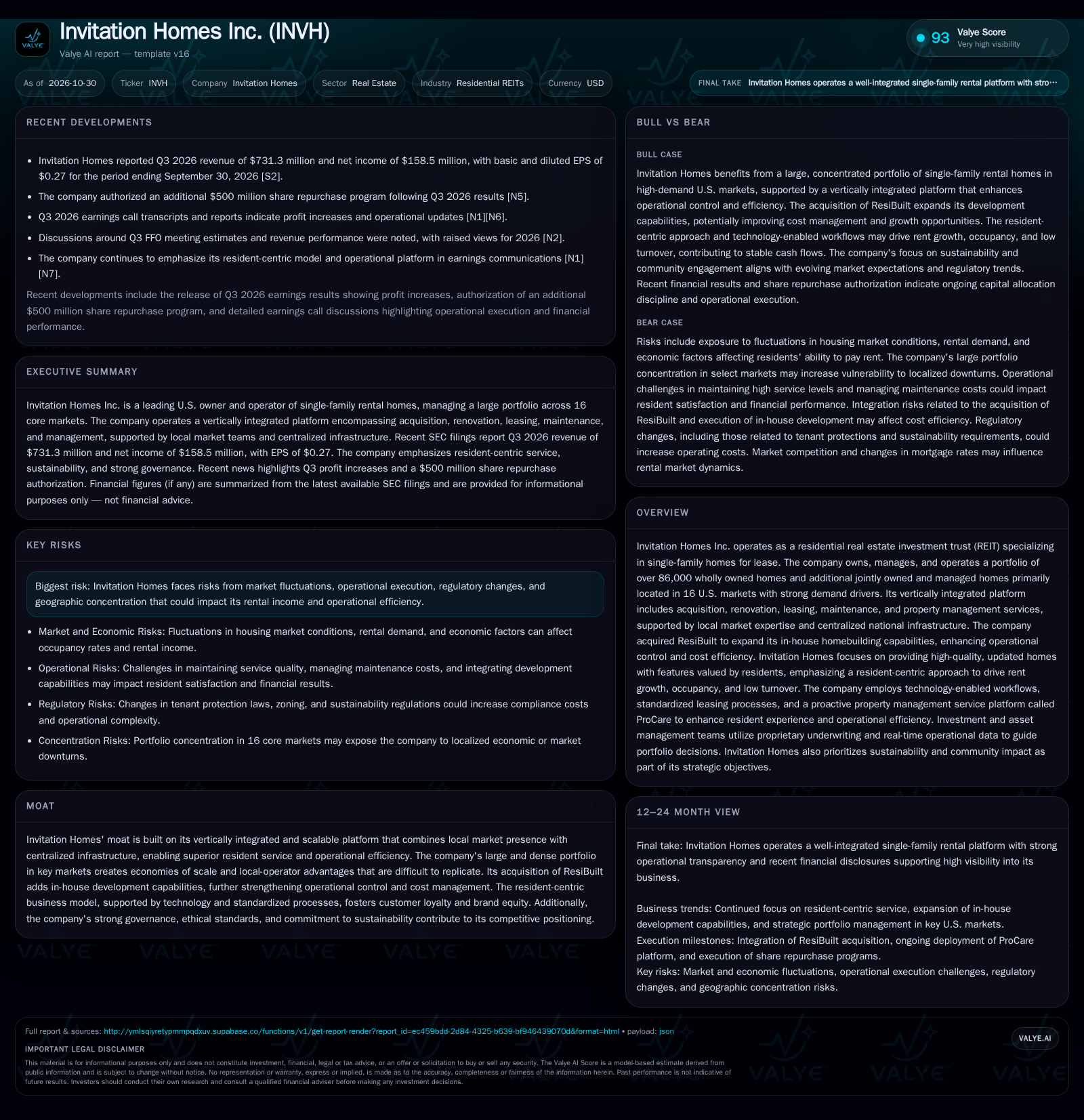
Invitation Homes reported Q3 2026 revenue of $731.3 million and net income of $158.5 million, reflecting ongoing growth in its large single-family rental portfolio. The company’s acquisition of ResiBuilt aims to deepen in-house development capabilities, while a newly authorized $500 million share repurchase signals capital allocation confidence. The key questions are whether operational scale and technology-enabled resident service can continue to drive rent growth and occupancy amid rising regulatory, economic, and competitive pressures.
Invitation Homes Inc. stands at the forefront of the U.S. single-family rental (SFR) industry, managing over 86,000 wholly owned homes and thousands more through joint ventures and third-party arrangements. The company’s vertically integrated platform and emphasis on technology-enabled, resident-centric service have fueled its growth and operational efficiency. Recent moves—including the acquisition of ResiBuilt and a $500 million share repurchase authorization—signal a dual focus on internal development and disciplined capital allocation. The question is whether Invitation Homes’ scale, platform investments, and operational innovations can sustain momentum in the face of housing market volatility, regulatory headwinds, and intensifying competition.
Recent Results and Strategic Moves Reshape the Single-Family Rental Landscape
Invitation Homes reported Q3 2026 revenue of $731.3 million and net income of $158.5 million, demonstrating meaningful profitability and scale in the single-family rental sector [S2]. This financial performance coincides with the company’s ongoing expansion: as of December 31, 2025, Invitation Homes wholly owned 86,192 homes, jointly owned 8,006, and managed 15,866 more for third parties, cementing its leadership in the sector [S1].
A pivotal development is the acquisition of ResiBuilt, a fee homebuilder specializing in SFR communities. This move is designed to internalize development, potentially improving cost structure, asset pipeline visibility, and operational flexibility [S1].
Following Q3 results, management authorized a $500 million share repurchase program, signaling confidence in the company’s capital position and underlying cash flows [N5].
Together, these facts point to a business at scale, investing in deeper operational control, and deploying capital assertively. The challenge is whether these moves can protect or extend returns as housing, regulatory, and competitive dynamics evolve.
How Invitation Homes Converts Scale and Integration Into Cash Flow
The core economics of Invitation Homes are driven by its ability to acquire, renovate, lease, and manage a large, geographically concentrated portfolio of single-family homes. Revenue is primarily generated through rent, with ancillary income streams from fees, managed properties, and potentially from new development via ResiBuilt.
Operational leverage is a critical element: fixed costs—including centralized infrastructure, technology platforms, and in-house maintenance—are spread over a vast asset base, while variable costs scale with home count and turnover. The company's ProCare platform and technology-enabled workflows are designed to reduce resident churn, minimize vacancy periods, and control maintenance costs, all of which directly support margins.
The addition of in-house development through ResiBuilt could improve control over acquisition pipeline quality and construction costs, addressing a major expense driver in SFR operations. If Invitation Homes can reliably source, develop, and lease new homes at below-market replacement costs, it could enhance returns on invested capital and reduce reliance on volatile external acquisition markets.
Capital needs are substantial: maintaining, renovating, and occasionally expanding a portfolio of this size requires ongoing investment. The company reported cash and liquidity metrics for the period; these figures do not by themselves establish operating runway, investment capacity, financial flexibility, or financing capacity. [S2] The newly authorized share repurchase program further reflects management’s view of capital allocation priorities.
Platform Scale and Local Density: Advantages and Emerging Counterforces
Invitation Homes’ competitive edge stems from its scale—both in total homes and in market density—and its vertically integrated operating model. Dense local portfolios allow for more efficient maintenance routing, pricing intelligence, and marketing, while centralized systems lower per-home overhead. The ProCare platform and resident-centric service model aim to foster loyalty and reduce costly turnover.
However, these advantages face real counterforces. Regional and national competitors—including other REITs, institutional investors, and increasingly, homebuilders—are scaling their SFR operations, sometimes with lower legacy cost structures or more flexible capital. Technology platforms and proptech entrants are also lowering the barriers to efficient leasing and management, eroding some of the historical scale advantages.
A key differentiator for Invitation Homes is its investment in proprietary underwriting and real-time operational data, which can drive smarter acquisition and asset management decisions. Yet, as the SFR sector matures and more players adopt similar tools, the durability of this edge will be tested by market saturation, rising regulatory scrutiny, and the threat of substitute housing options (such as build-to-rent communities or evolving multifamily formats).
Operational Integration Unlocks Margin Expansion and Rent Growth
The most favorable scenario for Invitation Homes is that its scale, technology, and in-house development allow it to consistently outperform smaller operators and new entrants. If the ResiBuilt integration succeeds, the company could build and lease new homes at below-market costs, accelerating portfolio growth without diluting returns.
In this case, the ProCare platform would sustain high occupancy and low turnover, driving steady rent growth and margin improvement. If macro conditions support continued demand for single-family rentals—due to high homeownership barriers, demographic trends, and limited housing supply—Invitation Homes could see above-market rental rate increases and stable cash flow.
Evidence that would confirm this scenario includes rising same-home rent growth, improving operating margins, successful delivery and leasing of in-house developed homes, and continued low resident turnover (if disclosed). Sustained or increased share repurchase activity would further support the case for robust free cash flow generation.
Sustained Scale With Incremental Pressures and Execution Demands
The most plausible path is that Invitation Homes maintains its position as a sector leader, leveraging its operational platform and resident focus to deliver stable, modestly growing cash flows. Rent growth and occupancy may remain healthy but could moderate as the SFR market matures and supply gradually increases.
Integration of ResiBuilt provides incremental cost and development advantages, but these may be offset by rising maintenance costs, regulatory compliance burdens, and competitive pricing pressure. The company’s capital allocation—balancing share repurchases, debt management, and ongoing reinvestment—remains disciplined but does not fundamentally alter the return profile.
This scenario would be confirmed by steady, but not accelerating, growth in revenue and net income, stable to slightly improving margins, and continued investment in technology and resident service. Any significant deviation in resident satisfaction metrics, occupancy rates, or cost inflation would challenge this outlook.
Regulatory Shifts, Cost Inflation, or Execution Missteps Undermine Returns
Downside risk centers on a confluence of external shocks and internal execution shortfalls. Regulatory changes—such as stricter tenant protections, rent controls, or costly sustainability mandates—could increase expenses or cap revenue growth, particularly in key markets where Invitation Homes is heavily concentrated.
Operationally, failure to integrate ResiBuilt effectively could result in cost overruns or underutilization of new development capacity. Maintenance cost inflation, labor shortages, or declining resident satisfaction could drive higher turnover and vacancy, eroding operating leverage.
A sharp downturn in local housing markets, or a reversal in single-family rental demand (perhaps due to falling mortgage rates or increased homeownership incentives), would further pressure occupancy and rent growth. Concrete evidence of this scenario would include declining occupancy, rising turnover, margin compression, or regulatory actions impacting major markets.
Milestones and Metrics That Will Define Invitation Homes’ Next Chapter
Quarterly same-home rent growth and occupancy rates: Persistent outperformance or deceleration would provide early signals on demand and pricing power.
Resident turnover and satisfaction metrics (if disclosed): High satisfaction and low turnover are central to the company’s margin model.
Pace and economics of ResiBuilt-developed home deliveries: Tracking development costs, leasing velocity, and contribution margins from in-house builds would validate the integration thesis.
Changes in regulatory environment: New or proposed legislation on rent control, tenant rights, or sustainability in core markets could materially affect operating costs and revenue.
Maintenance and repair cost trends: Rising costs or deferred maintenance could pressure margins and resident satisfaction.
Share repurchase activity and capital allocation: Actual execution of the authorized $500 million buyback, and its impact on per-share metrics, will reveal management’s view of intrinsic value and capital flexibility.
Competitive landscape developments: New entrants, major portfolio acquisitions, or tech-driven efficiency gains by peers could shift the relative advantage of scale and integration.
Market-level economic indicators: Local employment, migration, and housing supply/demand in the company’s 16 core markets will shape both risk and opportunity.
Disclaimer: This is research-only, informational analysis and not investment advice. It may include AI-generated interpretation and general industry context. Always verify important details using primary sources.

Comments