
Four Corners Property Trust: Portfolio Diversification, Acquisition Strategy, and the Stakes of Net-Lease Economics
Despite a recent lag in funds from operations and revenue growth, Four Corners Property Trust’s strategy of broad tenant and sector diversification, disciplined acquisitions, and long-duration net leases frames both its resilience and exposure. The introduction of a $100 million share repurchase program underscores management’s capital allocation priorities as the company navigates higher interest costs and evolving sector risks.
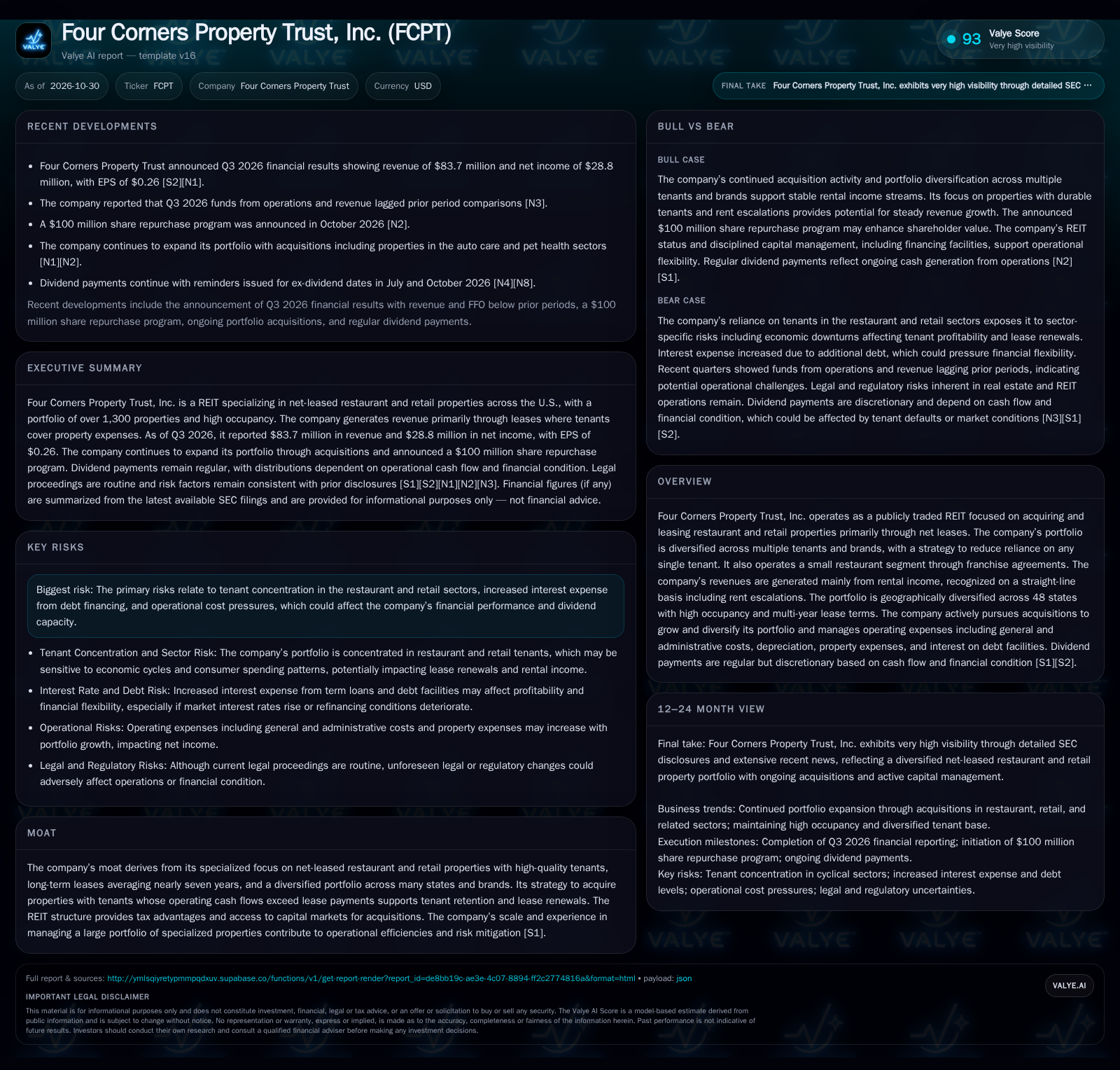
Four Corners Property Trust (FCPT) continues to expand its net-leased restaurant and retail property portfolio, maintaining high occupancy and multi-year lease durations. While recent financials show slower growth and rising interest expense, the REIT’s broad tenant mix, regular dividend payments, and new share repurchase program highlight its commitment to shareholder value and operational stability amid sector headwinds and capital cost pressures. [S1] [S2] [N2] [N3]
Four Corners Property Trust (FCPT) sits at a strategic crossroads for net-lease REITs, balancing the defensive characteristics of long-term, triple-net leases with the cyclical sensitivities of restaurant and retail tenants. Recent results spotlight both the strengths and vulnerabilities of this model: high occupancy and lease duration provide income stability, while slower growth in funds from operations and rising interest expense highlight the impact of acquisition-led expansion and sector headwinds. The company’s active capital management, including a new $100 million share repurchase authorization, suggests a focus on shareholder returns even as it continues to broaden its portfolio across tenant types and geographies. The next phase will test whether diversification and contractual rent bumps can offset mounting cost and macro risks.
Recent Financial Results and Portfolio Actions Reshape the Investment Narrative
As of Q3 2026, Four Corners Property Trust reported revenue of $83.7 million and net income of $28.8 million, with basic and diluted EPS of $0.26. Notably, funds from operations and revenue lagged prior-year comparisons, suggesting operational or sector-specific headwinds may be weighing on growth. The company’s portfolio now encompasses 1,303 properties across 48 states with 99.6% occupancy and an average remaining lease term of 6.9 years, reinforcing near-term income stability. In October 2026, management introduced a $100 million share repurchase program, a move that may reflect both confidence in intrinsic value and a recalibration of capital allocation priorities amid a more challenging operating environment. Ongoing acquisitions—particularly in auto care and pet health—signal continued efforts to diversify beyond core restaurant exposure. [S1] [S2] [N1] [N2] [N3]
How Net-Lease Structures and Acquisition Pace Shape Cash Generation and Cost Exposure
FCPT’s revenue engine is powered by net lease arrangements, where tenants are responsible for nearly all property-level operating expenses, insulating the REIT from direct inflationary pressures on utilities, taxes, insurance, and maintenance. This structure yields highly predictable cash flows and reduces operational volatility—a core appeal of the model. Rent escalations averaging 1.5% annually through 2030 are contractually embedded, providing a modest but reliable source of organic growth. Operating leverage is primarily driven by portfolio expansion: new property acquisitions can increase revenue with relatively small incremental overhead, but also introduce acquisition and financing risk.
The company’s acquisition strategy is capital-intensive, requiring ongoing access to debt and equity markets. Recent increases in interest expense, tied to additional term loans and financing costs, illustrate the double-edged nature of this approach. While leverage amplifies returns in stable or growing rent environments, it can also compress margins and reduce flexibility if revenue growth slows or capital costs rise. The cited source reports dividend-related activity; that disclosure alone does not establish dividend-policy continuity, management confidence, or a material constraint on capital flexibility. The announced share repurchase program adds another layer to capital allocation decisions, potentially supporting per-share metrics but also competing for capital with future acquisitions. [S1] [S2] [N2]
Where FCPT Stands in the Net-Lease Competitive Landscape
FCPT’s primary competitive advantage is its focus on single-tenant, net-leased restaurant and retail properties, coupled with a deliberate diversification strategy across brands, tenants, and geographies. This approach mitigates concentration risk, particularly the historical reliance on Darden-operated restaurants, and aims to buffer the portfolio from localized economic shocks or individual tenant distress. The average lease term of nearly seven years and high occupancy position FCPT favorably against peers with shorter lease durations or greater sector concentration.
However, the net-lease REIT space is crowded, with competitors ranging from large diversified platforms to other sector-focused landlords. Access to attractive acquisition opportunities, disciplined underwriting, and tenant credit quality are key differentiators. FCPT’s recent push into non-restaurant verticals such as auto care and pet health could help reduce correlation with consumer discretionary cycles, but also presents underwriting and operational risks associated with less familiar asset types. Substitutes include other net-lease REITs, direct real estate investments, and alternative yield vehicles, all of which compete for institutional and retail capital.
If Diversification and Rent Escalators Outpace Cost Pressures
The bullish scenario hinges on FCPT’s ability to maintain high occupancy, limited tenant defaults, and steady acquisition activity in sectors with durable tenant demand. The share repurchase program, if executed at attractive valuations, could further boost per-share financial metrics. Evidence that would confirm this scenario includes a return to year-over-year growth in funds from operations, rising same-property net operating income, and continued high occupancy with minimal lease expirations or tenant distress. [S1] [N2]
Steady Portfolio Growth but Margin Compression from Higher Debt Costs
The most plausible outcome is a continuation of slow but steady portfolio expansion, with organic rent growth from escalators partially offset by rising interest expense and incremental operating costs. While occupancy is likely to remain high, sector-specific pressures—especially among weaker restaurant tenants—could result in a modest uptick in lease defaults or rent concessions. Funds from operations may stabilize but not materially outpace prior years, given the drag from higher capital costs. Acquisitions may shift further toward defensive, non-discretionary categories, but the pace could slow if capital markets remain tight.
Signs of margin compression—such as a rising ratio of interest expense to revenue—would also support the base case. [S1] [S2] [N3]
Tenant Stress and Debt Burden Converge to Pressure Cash Flows
The adverse scenario would unfold if economic weakness or sector-specific downturns lead to a spike in tenant defaults, especially among restaurant brands. This could drive down occupancy rates, force rent concessions, and reduce overall cash flow. If acquisition opportunities become less attractive or harder to finance, external growth could stall, limiting the company’s ability to offset organic headwinds.
Evidence confirming this scenario would include a decline in occupancy below historical norms, a notable increase in lease modifications or tenant bankruptcies, reductions or suspensions in the dividend, and a material slowdown in acquisition activity. A rising leverage ratio and deterioration in credit metrics would further validate the downside case. [S2] [N3]
Milestones That Will Test the Resilience of FCPT’s Diversification and Net-Lease Model
Trends in funds from operations (FFO) growth or decline, especially relative to prior-year quarters and sector peers, would help gauge cash flow trajectory. [N3]
Occupancy rates and changes in lease renewal or default activity, particularly among recently acquired non-restaurant tenants, would provide early warning of tenant stress. If disclosed, tenant-by-tenant performance would be highly informative.
Interest expense as a percentage of revenue and changes in the company’s leverage profile will indicate whether debt costs are eroding net returns. [S1] [S2]
The scale, pricing, and pacing of new acquisitions—especially outside the core restaurant segment—will clarify the effectiveness of diversification efforts. [N1] [N2]
Execution and utilization of the $100 million share repurchase program, including timing and average repurchase price, would signal management’s view of valuation and capital priorities. [N2]
Disclosure of property-level or segment-level net operating income (NOI) trends, if provided, would help test the strength of the portfolio’s underlying economics.
Any shifts in tenant concentration risk, as measured by the proportion of revenue from the largest tenants or brands, would help assess the success of diversification.
Disclaimer: This is research-only, informational analysis and not investment advice. It may include AI-generated interpretation and general industry context. Always verify important details using primary sources.

Comments