
HCA Healthcare’s Scale, Staffing Pressures, and the High Stakes of Network Expansion
HCA’s latest quarter demonstrated strong admissions-driven revenue growth and ongoing operational momentum, but rising labor competition, a heavy debt load, and shifting reimbursement dynamics frame the company’s future economics and risk. The core question is whether HCA’s scale and digital investments can offset intensifying cost and regulatory pressures.
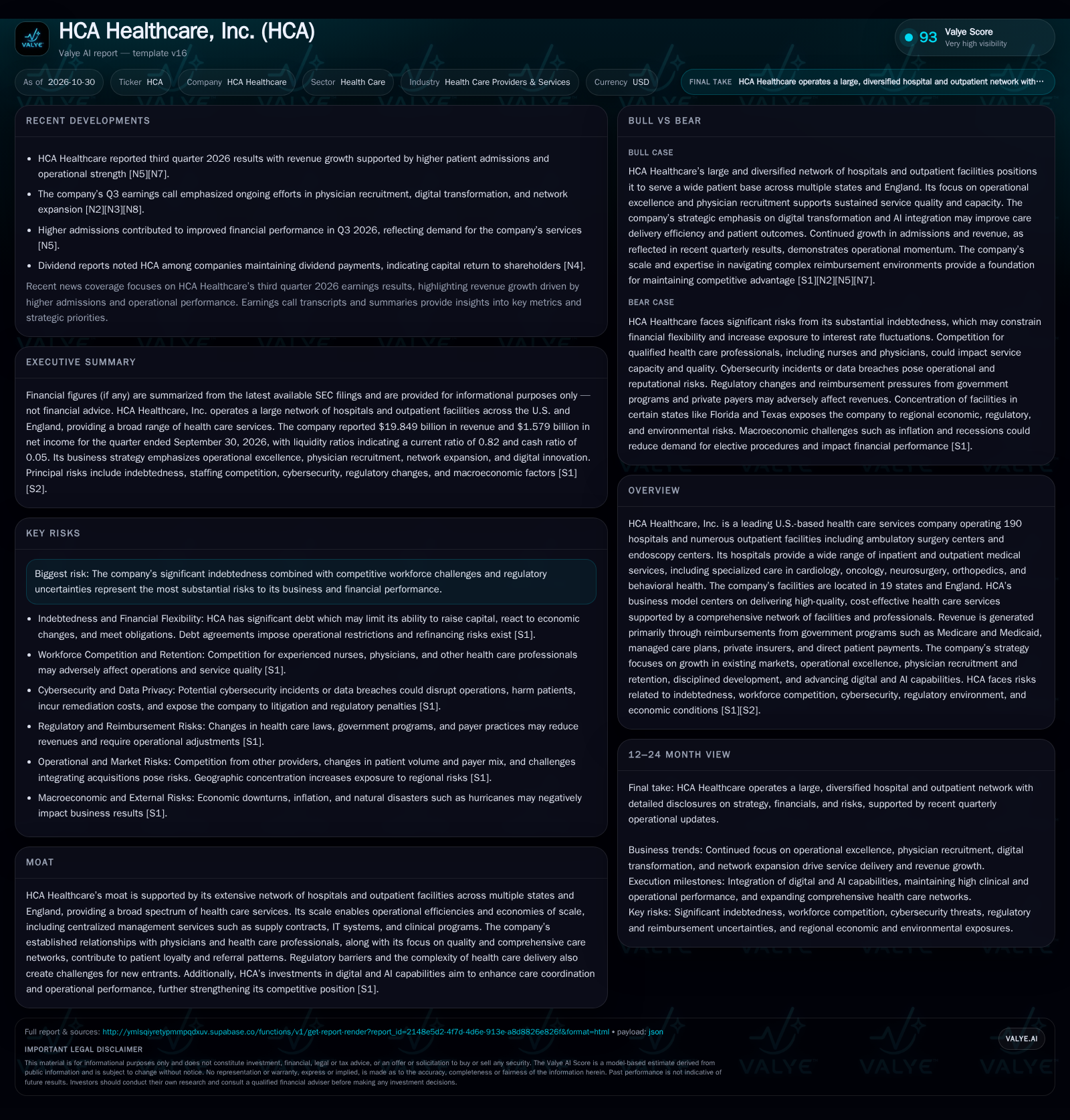
HCA Healthcare reported robust Q3 2026 results, with higher admissions and revenue growth, while continuing to expand its network and digital capabilities. However, the company’s significant debt, workforce competition, and exposure to regulatory and economic shifts represent persistent challenges. The sustainability of margin expansion hinges on HCA’s ability to manage staffing costs, execute on digital transformation, and maintain payer mix stability in a changing healthcare landscape. [S1] [S2] [N5] [N7]
HCA Healthcare’s third quarter 2026 results highlight a company at the intersection of operational strength and mounting structural challenges. Higher admissions and revenue reinforce HCA’s position as a dominant U.S. hospital operator, but the company’s considerable debt, rising labor costs, and evolving reimbursement landscape create a complex risk-reward calculus. The next phase of value creation for HCA will likely depend on its ability to leverage scale, digital transformation, and physician relationships to offset the headwinds of cost inflation, workforce shortages, and regulatory change.
Admissions Growth and Financial Performance Define the Latest Quarter
HCA Healthcare reported $19.849 billion in revenue and $1.579 billion in net income for the quarter ending September 30, 2026, reflecting strong operational performance and higher patient admissions. Diluted earnings per share reached $7.27, underlining the company’s ability to convert volume into profit at scale. The company reported cash and liquidity metrics for the period; these figures do not by themselves establish operating runway, investment capacity, financial flexibility, or financing capacity. HCA’s network now spans 190 hospitals and more than 150 outpatient centers, with continued investment in digital transformation and physician recruitment highlighted in recent earnings calls. These facts anchor the company’s short-term momentum but also sharpen focus on structural risks—especially debt, labor, and reimbursement exposure. [S1] [S2] [N2] [N5] [N7] [N8]
Hospital Economics: Scale, Payer Mix, and the Cost of Labor
HCA’s revenue is generated primarily through reimbursements from a mix of government programs (Medicare and Medicaid), managed care plans, private insurers, and direct patient payments. The company’s large fixed cost base—including real estate, equipment, and salaried staff—creates high operating leverage: incremental admissions and procedures can drive disproportionate profit growth when capacity is available. However, this model is vulnerable to swings in volume and payer mix. Government reimbursement rates are typically lower than commercial rates, so shifts toward Medicare/Medicaid or uninsured patients can compress margins even as volumes rise.
Labor is the most significant variable cost and a growing pressure point. Competition for nurses and physicians has escalated, driving up wages and bonus demands, especially in high-growth states and urban markets. As a result, HCA’s future margin trajectory may hinge on its ability to recruit, retain, and efficiently deploy clinical staff. Digital investments—such as AI-enabled scheduling, telehealth, and predictive analytics—are intended to improve operating efficiency and reduce unnecessary staffing, but the degree of realized savings is still to be proven at scale.
Capital needs remain substantial. Network expansion, facility upgrades, and digital infrastructure require ongoing investment, much of it funded through debt, which raises sensitivity to interest rates and refinancing risk.
How HCA’s Network Scale and Digital Push Shape Its Market Standing
HCA’s competitive position rests on its extensive hospital and outpatient network, which enables broad geographic coverage, referral capture, and bargaining leverage with payers and suppliers. This scale supports centralized procurement, shared IT systems, and standardized clinical protocols, potentially driving cost advantages relative to smaller regional providers.
However, competition is intense—from national health systems, regional hospital chains, nonprofit hospital alliances, and emerging outpatient and telehealth entrants. Physician relationships are a double-edged sword: while HCA’s recruitment and retention efforts support stable referral flows, competitors are also aggressively courting clinical talent, sometimes with higher upfront incentives or more flexible work arrangements.
Technology is a potential differentiator but also a moving target. HCA’s investments in digital health, AI, and data analytics may improve efficiency and patient outcomes, but the pace of adoption and the risk of disruption from new care models (such as virtual-first primary care or value-based care networks) remain open questions. Regulatory barriers and the complexity of healthcare delivery offer some protection against rapid displacement, but they also slow the company’s ability to pivot.
If Digital Transformation and Physician Retention Drive Margin Expansion
A favorable scenario for HCA would see its digital and AI investments translate into measurable operating efficiencies—optimizing staffing, reducing administrative burden, and improving patient throughput without compromising care quality. These gains, combined with successful physician recruitment and retention, could enable HCA to absorb wage inflation and maintain or expand margins even as labor markets remain tight.
Sustained admissions growth, especially in commercially insured populations, would support revenue expansion and improved payer mix. If HCA can leverage its scale to secure better supply terms and payer contracts, the incremental margin on new volume could be significant.
Evidence for this scenario would include: declining labor cost as a percent of revenue, improved staff retention rates, rising EBITDA margins, and positive commentary on digital ROI in future earnings calls. Confirmation would also come from continued outperformance in admissions growth relative to peers and stable or improving reimbursement rates despite regulatory change.
Sustaining Growth Amid Cost and Regulatory Headwinds
The most plausible outlook is that HCA continues to grow admissions and revenue, but faces ongoing margin pressure from rising labor costs and uncertain reimbursement dynamics. Digital initiatives yield incremental efficiencies but do not fully offset wage inflation or the costs of network expansion. The payer mix remains relatively stable, but incremental shifts toward government programs cap margin upside.
HCA’s scale helps it weather regional shocks and maintain negotiating leverage, but also exposes it to heightened scrutiny and the risk of regulatory or legal actions.
Evidence confirming this scenario would include steady but modest margin compression, continued growth in admissions and revenue, and management reiterating a cautious but constructive outlook on labor and reimbursement trends. Falsification would require either a sharp deterioration in cost control or a notable outperformance in digital-driven efficiency gains.
When Labor, Debt, or Regulation Tip the Balance
A negative scenario would materialize if HCA is unable to control labor costs—due to severe nurse shortages, unionization, or escalating wage demands—leading to margin erosion despite rising admissions. If regulatory changes or payer rate cuts further compress reimbursement, revenue growth could decouple from profit, and debt service could become a more acute concern given the company’s low liquidity ratios.
In this scenario, HCA might be forced to slow network expansion, divest assets, or restructure debt, all of which would signal a break from its historical growth model.
Confirmation would come from a spike in labor costs, reduced EBITDA margins, negative free cash flow, or management guidance cuts linked to regulatory or staffing headwinds. Warnings would also include rising turnover rates among clinical staff, adverse regulatory actions, or credit rating downgrades.
How to Test the HCA Thesis Over the Next Year
Quarterly trends in labor cost as a percentage of revenue—if disclosed—would reveal whether staffing inflation is being contained or accelerating.
Admissions growth by payer type: A shift toward higher-margin commercial admissions versus government payers would support margin resilience.
Physician and nurse retention rates: Rising turnover could presage higher labor costs and operational disruption.
EBITDA margin trajectory: Sustained or improving margins would indicate successful cost management and efficiency gains.
Updates on digital and AI initiative ROI: Management’s disclosure of realized cost savings or productivity improvements would help gauge the payoff from digital investments.
Regulatory or reimbursement changes: Monitoring for new state or federal policies affecting payment rates, staffing mandates, or compliance costs is critical.
Evidence of asset sales, network contraction, or postponed capital projects would indicate financial or operational strain.
Disclaimer: This is research-only, informational analysis and not investment advice. It may include AI-generated interpretation and general industry context. Always verify important details using primary sources.

Comments