
Mobileye’s Strategic Stakes: Supply Chain Fragility, ADAS Margin Tension, and the Contest for Autonomous Scale
Mobileye’s leadership in ADAS and autonomous driving is defined as much by its proprietary EyeQ™ SoC as by its vulnerabilities: a single-source supply chain, cost pass-through limitations, and the accelerating arms race for automotive AI. The next phase will test whether technological edge and balance sheet strength can offset structural risks and margin compression.
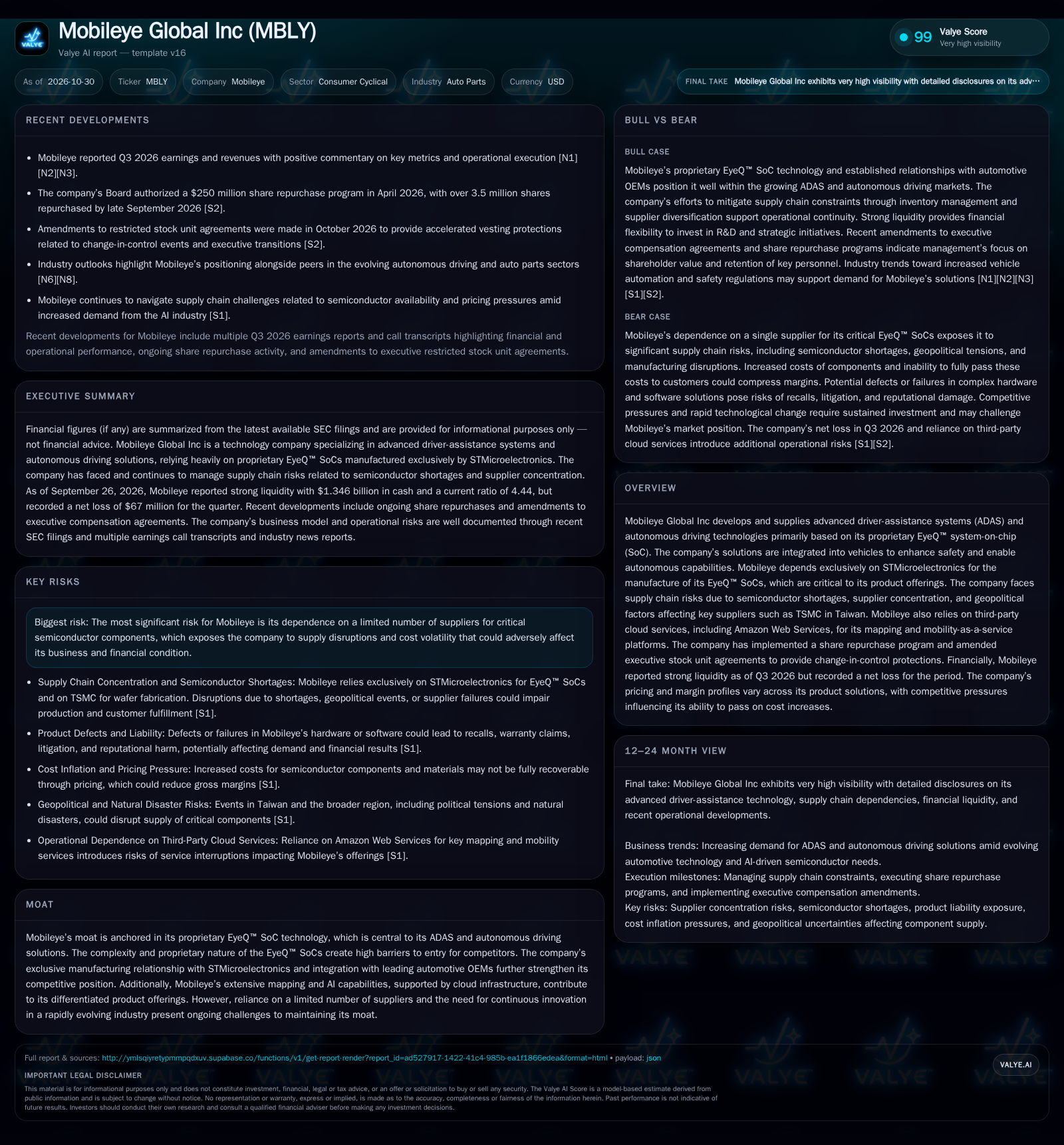
Its reliance on STMicroelectronics for EyeQ™ SoCs leaves it exposed to geopolitical and manufacturing risks, while mounting competition and the inability to fully pass rising costs to OEMs threaten margin expansion. The real test is whether Mobileye’s deep OEM integrations and proprietary technology can preserve its edge as the ADAS/autonomous market matures and supply volatility persists. [S2] [N1] [N2] [N3]
Mobileye occupies a critical junction in the automotive technology race, supplying advanced driver-assistance and autonomous systems built on its proprietary EyeQ™ SoC. The latest quarter’s net loss underscores the challenge of defending margins in an inflationary, supply-constrained environment. The next act for Mobileye will hinge on whether its technological edge and operational adaptability can outpace the risks inherent in a concentrated supply chain and a fiercely competitive ADAS market. [S2] [N1] [N2] [N3]
Q3 2026: Liquidity Status, Ongoing Losses, and Supply Chain Concentration
As of September 26, 2026, Mobileye reported $1.346 billion in cash and cash equivalents, with current assets of $2.106 billion and current liabilities of $474 million, yielding a current ratio of 4.44 and a cash ratio of 2.84. The company reported cash and liquidity metrics for the period; these figures do not by themselves establish operating runway, investment capacity, financial flexibility, or financing capacity. However, the company posted a net loss of $67 million and diluted EPS of -$0.08 for the quarter, signaling ongoing profitability challenges. The company’s exclusive dependence on STMicroelectronics for manufacturing its EyeQ™ SoCs remains a central vulnerability, with no long-term pricing or quantity guarantees in supplier contracts. Supply chain constraints—particularly semiconductor shortages—continue to impact production and inventory management, with the need to build up SoC inventories tying up capital and risking obsolescence. Mobileye also executed a $250 million share repurchase program, repurchasing over 3.5 million shares by late September, reflecting confidence or a tactical capital return. [S2]
Mobileye’s Economic Drivers: SoC Margins, Volume, and Pricing Influence
Mobileye’s revenue is primarily generated from the sale of advanced driver-assistance systems (ADAS) and, increasingly, autonomous driving solutions, all anchored by its proprietary EyeQ™ SoC. The business model is fundamentally volume-driven: OEM integration means high unit shipments, but ASP (average selling price) and margin depend heavily on the product mix and the complexity of bundled solutions. Higher-end autonomous systems may command premium pricing, but also require more sophisticated hardware and software investments.
A key dynamic is the tension between component cost inflation—driven by semiconductor shortages and supply chain fragility—and Mobileye’s ability to pass these costs to automotive OEM customers. The company faces significant competitive and procurement pressure from OEMs, who are often large, price-sensitive buyers with alternative ADAS suppliers. As a result, margin profiles vary by solution, and Mobileye’s ability to defend or expand gross margins is not assured, especially if cost increases outpace pricing power.
Fixed costs are substantial, particularly in R&D and software development, but the company’s high-volume, high-integration model offers operating leverage if volumes scale as projected. However, the need for capital-intensive inventory buildup to buffer against supply shocks can erode working capital efficiency and increase the risk of technological obsolescence if demand shifts or new generations of hardware/software are introduced.
Balancing Proprietary Tech and Ecosystem Vulnerabilities in the ADAS Market
Mobileye’s competitive edge is rooted in its proprietary EyeQ™ SoC technology, which is deeply integrated into global OEM platforms. This integration creates switching frictions: once an OEM has designed a platform around EyeQ™, changing suppliers can be costly and time-consuming. Mobileye’s extensive mapping and AI capabilities, supported by cloud infrastructure, further differentiate its offerings—especially for higher-level autonomous solutions.
However, competitive pressures are escalating. The ADAS and autonomous driving market is now contested by major semiconductor companies, dedicated sensor firms, and vertically integrated automakers developing in-house solutions. Substitutes—such as alternative SoCs, camera/radar/LiDAR stacks, and software-first platforms—are increasingly viable, especially as automotive OEMs seek to diversify supplier risk and reduce dependency. Mobileye’s reliance on a single foundry and limited supplier diversification is a structural disadvantage relative to competitors with broader supply bases or internal chip capabilities.
Moreover, regulatory shifts and rapid advances in AI-driven perception may compress the lifecycle of current solutions, forcing Mobileye to accelerate its innovation cycle and increase R&D intensity merely to maintain parity.
Potential for Margin Growth with Aligned OEM Demand and Supply Chain Stability
The bullish pathway for Mobileye hinges on two reinforcing factors: the sustained ramp in global ADAS/autonomous adoption and a stabilization of semiconductor supply. If Mobileye can secure reliable SoC deliveries from STMicroelectronics (and indirectly from TSMC), it can fulfill growing OEM orders without disruptive inventory swings or spot-market price spikes.
In this favorable scenario, continued integration wins with major automakers and the rollout of higher-margin, advanced autonomy solutions (e.g., L2+/L3) would increase blended ASPs and margin mix. The company’s reported liquidity position could be deployed into next-generation R&D, further solidifying its lead. Evidence for this scenario would include a return to net profitability, sequential gross margin improvement, OEM contract wins for higher-level autonomy, and public disclosure of successful supply chain diversification or long-term supply agreements.
Falsification would come from persistent supply interruptions, margin compression, or OEM defections to alternative ADAS platforms.
Margins Held Back by Supply Limits and Competitive Pricing Pressures
The most plausible outcome is that Mobileye continues to grow shipment volumes as ADAS penetration rises, but faces ongoing supply chain volatility and cost inflation that it cannot fully offset through pricing. The company’s exclusive reliance on STMicroelectronics persists, and while inventory management mitigates some disruption, it ties up capital and exposes Mobileye to obsolescence risk if demand shifts or next-generation products launch earlier than expected.
Gross margins remain under pressure as Mobileye absorbs a portion of increased component costs, particularly for lower-end ADAS solutions where OEMs resist price increases. Operating leverage is only partially realized, as R&D and inventory costs stay elevated and the company cycles between modest profitability and breakeven performance. Confirming evidence would include stable or slightly improving revenue, but persistently thin or volatile gross margins, muted EPS, and continued inventory buildup. Falsification would be a clear breakout in margin or a major shift in supplier relationships.
Risks of Margin Erosion and Market Share Decline from Supply or Demand Disruptions
A negative inflection could occur if geopolitical tensions or natural disasters disrupt STMicroelectronics or TSMC operations, leading to a severe EyeQ™ SoC shortage. This would force production cuts, missed OEM deliveries, and potentially open the door for competing ADAS suppliers to win business from dissatisfied automakers. Alternatively, a serious defect or high-profile failure in Mobileye’s hardware/software stack could trigger recalls, litigation, and reputational damage, further eroding OEM trust.
In this scenario, Mobileye’s inability to pass on soaring costs or replace lost supply would drive gross margin collapse and possibly sustained net losses. Evidence supporting this view would include a sharp drop in shipments, loss of major OEM contracts, public defect disclosures, or emergency capital-raising efforts. Falsification would be demonstrated by continued stable supply and retention of major OEM relationships despite external shocks.
Factors Shaping Mobileye’s Capacity to Maintain Competitive Advantage
Quarterly gross margin trends—especially Mobileye’s ability to defend margins in the face of cost inflation and supply chain volatility.
OEM contract announcements or disclosures of new high-level autonomy platform wins, which would indicate continued technology leadership and customer retention.
Any disclosure of diversification in SoC manufacturing—such as additional foundry partners or long-term supply agreements—that could reduce single-supplier risk.
Inventory levels and turnover rates, as persistent buildup could signal ongoing supply chain stress or demand mismatches.
Updates on product defect rates, recalls, or litigation, which would test the reliability and reputation of Mobileye’s complex hardware/software stack.
R&D expenditure trends and the pace of new product introductions, as these signal both innovation health and future margin potential.
Evidence of cost pass-through in pricing to OEMs—if disclosed—as a sign of market power and pricing flexibility.
Cloud service continuity or major outages, given Mobileye’s reliance on AWS for mapping and mobility services.
Disclaimer: This is research-only, informational analysis and not investment advice. It may include AI-generated interpretation and general industry context. Always verify important details using primary sources.

Comments