
SAIA INC: Operational Leverage, Capital Return, and the Structural Stakes in Freight Transport
SAIA's Q3 2026 results highlight robust revenue and earnings momentum, bolstered by a sizable stock repurchase plan. The company's operating model faces classic freight sector headwinds—economic cycles, labor and fuel volatility, and regulatory flux—yet its financial disclosures and capital discipline position it to capitalize on network scale and service differentiation if industry risks are managed.
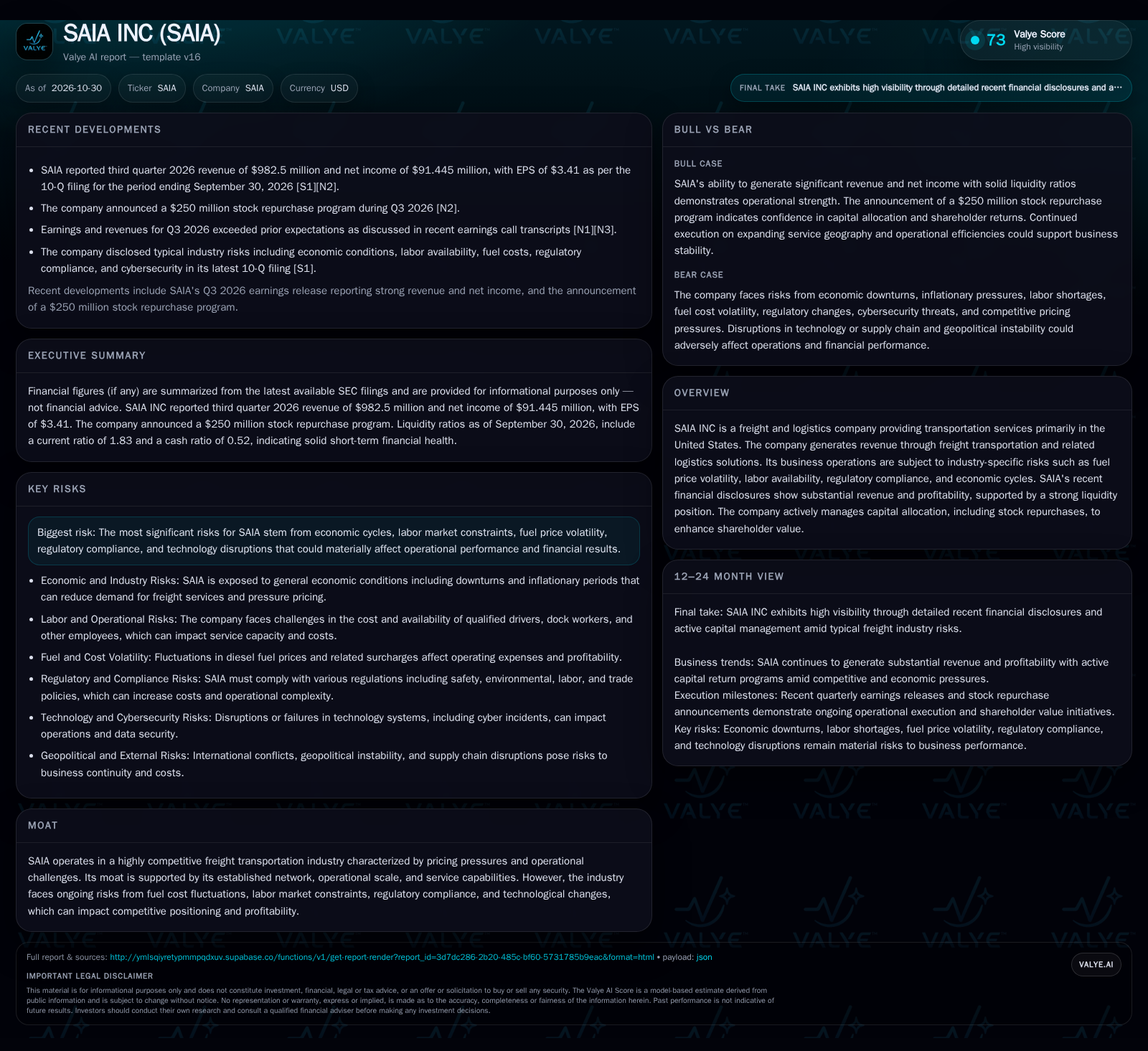
SAIA INC reported Q3 2026 revenue of $982.5 million and net income of $91.445 million, outpacing estimates and launching a $250 million stock repurchase program. Execution on operational efficiencies and capital allocation could enhance returns, while volatility in demand and cost inputs remains a persistent threat. [S1] [N2] [N3]
SAIA INC’s latest quarterly results reinforce its position as a major player in the U.S. freight and logistics sector, with Q3 2026 revenue and earnings coming in above expectations and a fresh $250 million stock repurchase program signaling management’s confidence in the business. Yet, beneath these headline figures, the company remains tightly bound to the volatility of the transportation industry—where macroeconomic cycles, labor constraints, and cost pressures can swiftly reshape margins. The question for investors is whether SAIA can sustain operational leverage and capital returns while navigating the structural headwinds inherent to the sector. [S1] [N2] [N3]
Recent Results and Capital Allocation: What the Numbers Reveal
SAIA reported third quarter 2026 revenue of $982.5 million and net income of $91.445 million, with EPS of $3.41—figures that exceeded prior expectations and suggest operational momentum. The company reported cash and liquidity metrics for the period; these figures do not by themselves establish operating runway, investment capacity, financial flexibility, or financing capacity. Management’s announcement of a $250 million stock repurchase program in Q3 2026 points to a focus on shareholder returns and capital discipline, especially in the context of ongoing industry volatility. These developments matter because they indicate both financial resilience and an active approach to capital allocation—critical levers in a sector where both demand and costs can be unpredictable. [S1] [N2] [N3]
Freight Revenue, Cost Structure, and the Leverage Puzzle
SAIA’s core business model is built on transporting freight and providing logistics solutions, primarily in the U.S. LTL (less-than-truckload) segment. Revenue is driven by shipment volumes, pricing per mile, and service mix (e.g., expedited, regional, or specialized freight). Fixed costs—terminals, fleet, and salaried labor—are high, but variable costs such as fuel, driver wages, and maintenance scale with shipment volume. This structure creates significant operating leverage: incremental volume growth or pricing improvement can translate into outsized profit gains if fixed costs are well covered, but sharp volume declines or unexpected cost inflation can quickly erode margins. Capital intensity is moderate to high, given ongoing investments in fleet renewal, technology, and terminal infrastructure.
Navigating Industry Pressures: Scale, Service, and Substitution
SAIA operates in a fragmented but highly competitive industry, facing pressure from national LTL carriers, regional operators, and, increasingly, technology-driven logistics platforms. Its network scale and established service coverage provide some insulation from new entrants, but pricing power is limited by customer bargaining strength and the commoditized nature of much LTL freight. Differentiation can come from service reliability, technology integration (e.g., real-time tracking, automated dispatch), and value-added logistics solutions. However, industry-wide risks—such as acute driver shortages, regulatory shifts (e.g., emissions standards, safety mandates), and the threat of modal substitution (e.g., intermodal rail for longer hauls)—remain persistent. SAIA’s ability to invest in operational efficiency and digital tools may help defend margins, but competitive intensity and low switching costs for customers mean that any advantage is likely to be incremental rather than structural barring a step-change in service or network reach.
How Operational Excellence Could Unlock Margin Expansion
If SAIA continues to execute on operational improvements—such as optimizing route density, deploying automation in terminals, and leveraging data analytics for pricing—incremental improvements in shipment yield and cost per mile could drive margin expansion. A favorable macro environment, characterized by stable or rising industrial activity and manageable fuel costs, would amplify these effects. Confirmation of this scenario would come from sustained outperformance versus industry volume or pricing benchmarks, a rising operating margin in subsequent quarters, and disclosure of efficiency gains or reduced claims/accident rates. Evidence that would falsify this scenario includes sequential declines in margin despite stable volumes, or indications that cost reductions are being offset by pricing concessions or service degradation.
Sustained Profitability Amid Cyclical Headwinds
The most plausible medium-term outcome is that SAIA maintains its current revenue and profit trajectory, with moderate fluctuations linked to broader economic cycles. Freight demand may soften during periods of industrial slowdown, but the company’s network and operational discipline should allow it to defend core profitability, especially if cost management remains a focus. This outcome would be confirmed by quarterly results that track closely with industry averages on revenue per shipment and margin, and by the absence of sharp deviation in labor, fuel, or insurance expense lines. A deviation from this scenario would be signaled by pronounced volatility in earnings, unexpected spikes in cost ratios, or a material contraction in volume or yield relative to peers.
What a Freight Downturn or Cost Shock Could Mean for Returns
A less favorable scenario would see SAIA exposed to a combination of declining freight demand—driven by recession, inventory destocking, or trade disruptions—and rising input costs, particularly for labor and fuel. In this environment, the company’s fixed-cost structure could amplify the impact of lower volumes, rapidly compressing margins. Regulatory changes or labor actions could further increase costs or disrupt operations. Confirmation of this scenario would include year-over-year drops in volume and revenue, a falling operating margin, negative operating cash flow, or the suspension of capital return programs such as buybacks. Conversely, stabilization in input costs or a rebound in industrial activity would help falsify this outcome.
Milestones and Metrics That Will Shape SAIA’s Freight Thesis
Quarterly operating margin trends, especially as a reflection of cost control and pricing discipline.
Volume per day and revenue per shipment, if disclosed, to gauge demand resilience and pricing power.
Labor cost as a percentage of revenue and updates on driver/dockworker availability.
Fuel expense trends and the effectiveness of fuel surcharge pass-through to customers.
Capital expenditure levels and the balance between network investment and shareholder returns.
Progress on technology adoption—such as automation, digital dispatch, and customer-facing platforms.
Any material regulatory or legal developments affecting labor, safety, or environmental compliance.
Stock repurchase execution pace and its relationship to free cash flow generation.
Disclaimer: This is research-only, informational analysis and not investment advice. It may include AI-generated interpretation and general industry context. Always verify important details using primary sources.

Comments