
Baxter International: Regulatory Hurdles, Manufacturing Investments, and Navigating Margin Pressure in MedTech
Baxter International’s latest quarter delivered broad-based growth and an improved outlook, but recurring supply chain and regulatory challenges continue to shape its operating economics and risk profile. The company is investing in manufacturing efficiency amid inflation-driven cost pressure—yet faces limited pricing flexibility and ongoing recall management, raising questions about the sustainability of margin improvement.
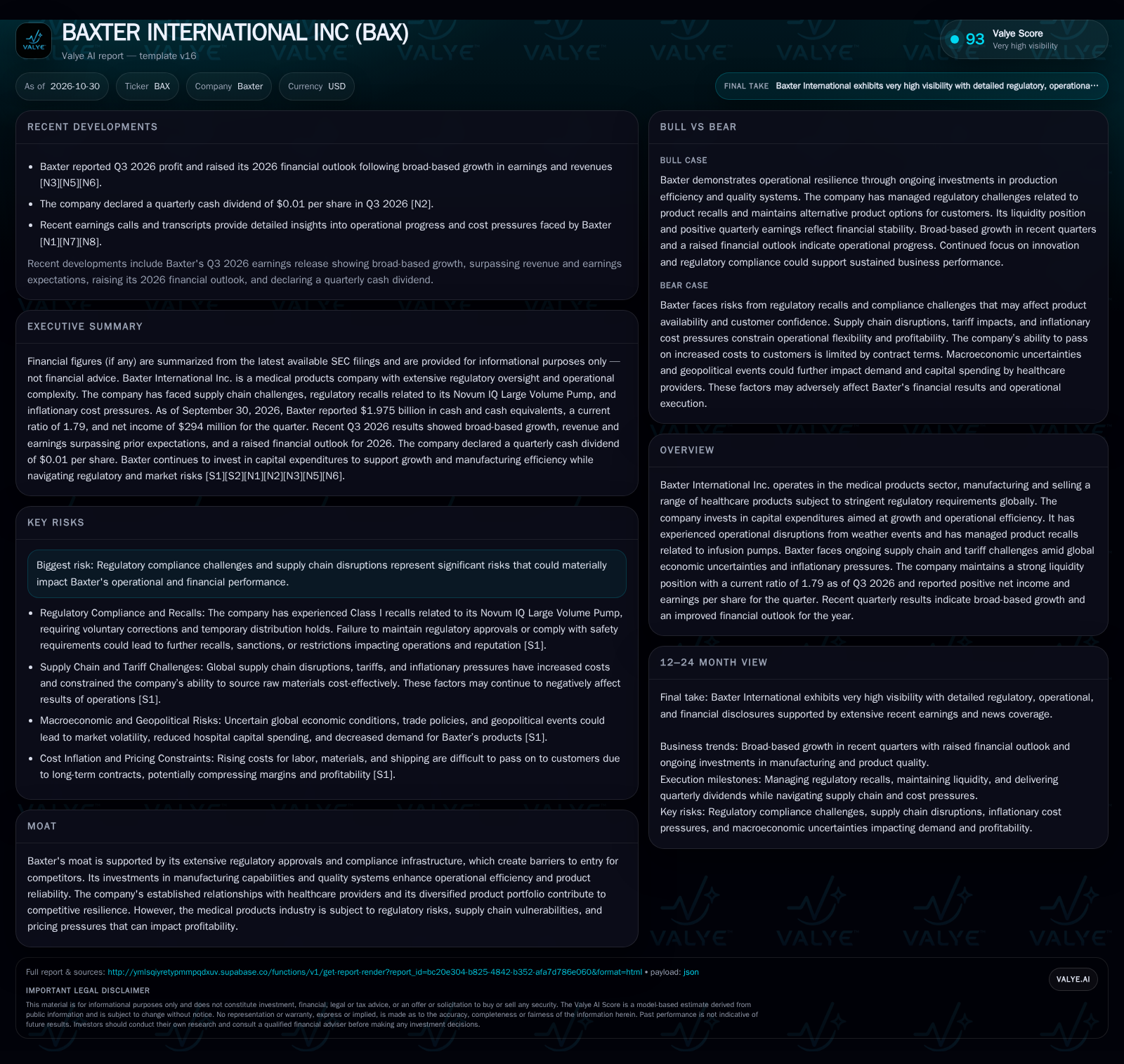
Baxter International beat Q3 2026 expectations and raised its financial outlook, supported by resumed operations and continued capital investment. However, persistent supply chain and regulatory headwinds—including ongoing product recalls and inflationary cost constraints—limit the company’s pricing power and could pressure margins going forward. The critical question is whether manufacturing investments and operational resilience can offset these structural challenges and support sustained earnings growth. [S1] [S2] [N3] [N5] [N6]
Baxter International’s recent quarterly performance underscores both its operational resilience and the persistent headwinds it faces as a global medical products manufacturer. The company has weathered facility disruptions and managed to restore full operations, while capital investments aim to boost efficiency and support growth. However, ongoing regulatory recalls—most notably for its Novum IQ infusion pump—continue to highlight the sector’s compliance risks. At the same time, Baxter’s ability to convert higher costs into sustainable margin expansion is constrained by the structure of its customer contracts and broader macroeconomic pressures. The next phase for Baxter hinges on whether its manufacturing and operational investments can outpace headwinds from regulatory, supply chain, and pricing dynamics. [S1] [S2] [N3] [N5] [N6]
Recent Growth and Ongoing Regulatory Scrutiny Shape Baxter’s Operating Backdrop
Baxter International reported net income of $294 million and basic and diluted EPS of $0.57 for Q3 2026, with both earnings and revenue surpassing expectations. The company raised its 2026 financial outlook in response to this broad-based growth, marking a positive inflection after a period of operational disruptions and cost pressures. [S2] [N3] [N5] [N6]
Operationally, Baxter resumed full activity at its North Cove facility after hurricane-related disruption in 2024, demonstrating resilience in the face of physical plant risk. However, the company remains under regulatory and operational pressure due to the voluntary recall and restricted distribution of its Novum IQ Large Volume Pump, which has not yet returned to normal sales channels in the U.S. and Canada except for medical necessity. [S1]
On the balance sheet, Baxter held $1.975 billion in cash and cash equivalents as of September 30, 2026, with a current ratio of 1.79 and a cash ratio of 0.84. The company reported cash and liquidity metrics for the period; these figures do not by themselves establish operating runway, investment capacity, financial flexibility, or financing capacity. [S2]
Supply chain and tariff challenges remain persistent, with inflation-driven input costs that are difficult to pass on due to existing contract terms. This dynamic directly impacts Baxter’s ability to translate top-line growth into sustainable margin improvement. [S1]
Margin Dynamics, Pricing Constraints, and the Leverage of Manufacturing Investment
Baxter generates revenue from a diverse portfolio of medical products, many of which are sold under long-term contracts to hospitals, clinics, and health systems. These contracts provide volume stability but also limit the company’s ability to quickly adjust pricing in response to inflationary pressures or supply chain disruptions. As a result, even as costs for labor, materials, and logistics rise, Baxter may be forced to absorb much of this pressure directly—compressing gross and operating margins unless offset by efficiency gains or product mix shifts. [S1]
The company’s ongoing capital expenditures are directed toward improving production efficiency and optimizing manufacturing capabilities. If successful, these investments could yield operating leverage by reducing per-unit costs and supporting higher-margin product lines. However, such benefits tend to accrue over multi-year horizons and are vulnerable to regulatory setbacks, such as product recalls or manufacturing holds.
Fixed costs in regulated medical manufacturing—including compliance, quality assurance, and plant depreciation—are significant, raising the stakes for maintaining high utilization rates and minimizing disruptions. Regulatory recalls, like the current Novum IQ issues, can therefore have outsized effects not only on revenue but also on cost absorption and overall profitability.
Barriers, Substitutes, and the Limits of Differentiation in Medical Devices
Baxter’s competitive position is anchored by its regulatory approvals, compliance infrastructure, and established relationships with major healthcare providers. These factors create meaningful barriers to entry for new competitors, especially in high-complexity or life-sustaining product categories where switching costs and clinical inertia are high.
However, the broader medical products market is characterized by intense pricing pressure, periodic reimbursement changes, and the constant threat of substitute products—especially for more commoditized devices. Large, diversified medtech peers and specialized device manufacturers alike can compete aggressively on both price and innovation.
Product recalls and regulatory events can erode customer confidence and create openings for competitors, particularly if alternative devices are available without similar compliance overhangs. Moreover, as healthcare systems face their own cost pressures, procurement departments may prioritize price and supply reliability over incumbent relationships, raising the risk of share erosion if Baxter’s operational challenges persist.
The company’s diversified portfolio and manufacturing investments provide some resilience, but the sector’s structural risk profile means that moat advantages are not absolute and can be undermined by regulatory or quality failures.
Efficiency Gains and Regulatory Recovery Drive Outperformance
If Baxter’s manufacturing investments deliver meaningful productivity improvements—allowing the company to reduce per-unit costs and shift mix toward higher-margin products—there is potential for operating margins to expand even in a tough pricing environment. A successful resolution to the Novum IQ recall, with regulatory clearance to resume unrestricted distribution, would restore a key revenue stream and reduce compliance costs.
Additionally, if inflationary pressures moderate or Baxter is able to renegotiate contract terms with major customers, the company could regain some pricing flexibility, supporting further margin recovery.
Confirmation of this scenario would come from sustained improvement in gross and operating margins, a return to normal sales levels for previously recalled products, and evidence of reduced quality-related expenses. Watch for management commentary on contract renegotiations and new product launches that command premium pricing.
Incremental Progress Amid Persistent Cost and Compliance Pressures
The most probable path for Baxter is gradual improvement in operational efficiency and revenue growth, but with continued margin pressure due to inflation and contract-driven pricing rigidity. Manufacturing investments may yield moderate cost reductions over time, partially offsetting higher input costs, but large-scale margin expansion is unlikely as long as recall-related costs and regulatory scrutiny persist.
Product recalls and compliance events are likely to remain episodic risks, especially given the complexity of Baxter’s product portfolio. The company’s liquidity and established customer base should allow it to weather these challenges, but competitive gains will be incremental rather than transformational.
Evidence for this scenario would include steady, but not accelerating, margin trends, ongoing mention of cost pressures on earnings calls, and a gradual normalization (rather than full rebound) of sales from affected product lines. Recurring regulatory disclosures and moderate capital investment levels would further confirm this middle path.
Escalating Recalls or Supply Chain Shocks Undermine Profitability
Should Baxter face additional or prolonged regulatory recalls—especially if new issues arise in other high-volume products—the company could experience both revenue loss and a significant increase in compliance and remediation costs. Extended supply chain disruptions, exacerbated by geopolitical or macroeconomic instability, could further increase input costs and risk lost sales due to product shortages.
Because Baxter’s contracts limit pricing pass-through, rising costs would likely erode margins directly, potentially turning broad-based growth into flat or declining earnings. Loss of customer confidence from repeated recalls could drive share loss to competitors, particularly in segments where alternatives exist.
Warning signs for this scenario would include a rise in the frequency or severity of recall disclosures, deterioration in gross margin, downward revisions to financial outlook, or evidence of customer defections. Persistent supply constraints or adverse regulatory actions would further reinforce this risk.
Milestones That Will Determine the Durability of Baxter’s Growth and Margin Story
Progress toward full regulatory resolution and unrestricted market return for the Novum IQ Large Volume Pump; sales trends for this product would help test recovery.
Gross and operating margin trends over the next several quarters, especially in the context of inflation and manufacturing cost reductions.
Changes in Baxter’s ability to renegotiate contract terms or introduce products with greater pricing flexibility—management commentary or customer disclosures would be informative.
Frequency and severity of new product recalls or regulatory filings; a useful metric would be the number of Class I recall events per year, if disclosed.
Evidence of successful capital deployment—such as measurable improvements in manufacturing efficiency or capacity utilization rates.
Shifts in customer retention or share-of-wallet among major hospital systems and group purchasing organizations, to the extent disclosed.
Updates on supply chain stability, including lead times for critical inputs and inventory levels.
Disclaimer: This is research-only, informational analysis and not investment advice. It may include AI-generated interpretation and general industry context. Always verify important details using primary sources.

Comments