
PTC Therapeutics: Rare Disease Portfolio Expansion, Regulatory Stakes, and the Economics of Milestone-Driven Growth
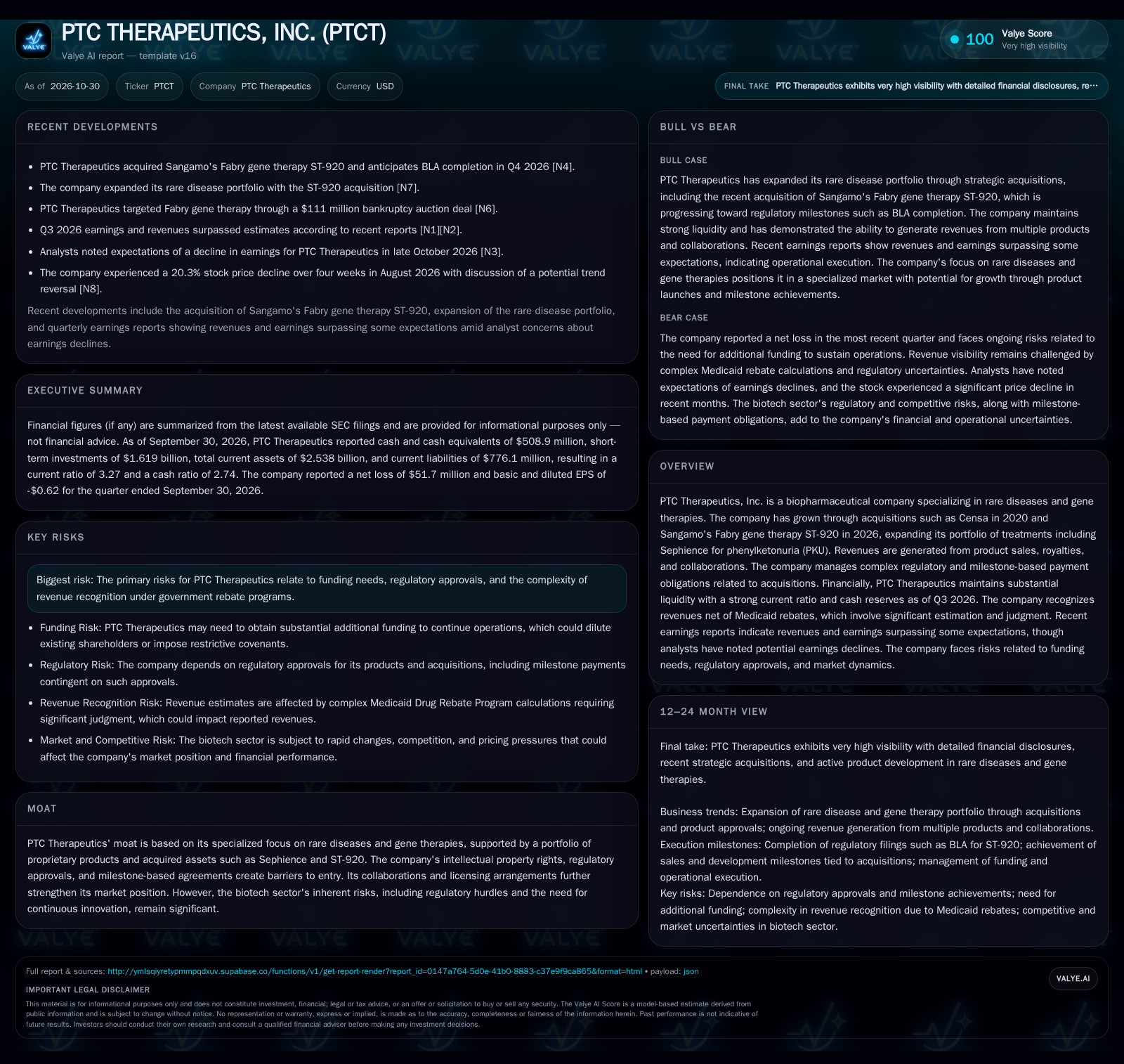
PTC Therapeutics has recently expanded its rare disease and gene therapy portfolio with the acquisition of Sangamo's Fabry gene therapy ST-920, while maintaining substantial liquidity and a diversified product mix. Yet, the company's trajectory is shaped by complex regulatory milestones, milestone-based acquisition obligations, and persistent earnings volatility.
PTC Therapeutics is executing a high-stakes rare disease strategy, recently acquiring a late-stage gene therapy asset (ST-920) and advancing multiple marketed products. The company holds significant liquidity, but faces net losses, complex milestone payments, and regulatory dependencies. Its future will hinge on successful product launches, regulatory approvals, and the ability to convert pipeline assets into sustained revenue.
PTC Therapeutics stands at a pivotal juncture, blending a robust rare disease and gene therapy pipeline with the financial realities of milestone-driven growth. The recent acquisition of Sangamo’s Fabry gene therapy ST-920 not only deepens its portfolio but also adds near-term regulatory and commercial catalysts. However, recurring net losses, complex contingent payment structures, and the inherent uncertainties of biotech commercialization continue to shape both opportunity and risk. The company’s ability to translate late-stage pipeline assets into durable revenue streams—while managing regulatory, funding, and pricing headwinds—will be decisive in determining long-term shareholder value.
Recent Acquisitions and Financial Position: Setting the Stage for the Next Clinical Milestone
PTC Therapeutics has made a significant portfolio addition with the September 2026 acquisition of Sangamo's Fabry gene therapy ST-920, a one-time AAV gene therapy candidate for Fabry disease. The company expects to complete a rolling BLA submission for accelerated FDA approval in Q4 2026, with milestone payments to Sangamo potentially reaching $100 million contingent on regulatory events [N4] [S2]. This comes alongside a $111 million bankruptcy auction deal to secure the asset [N6].
Financially, as of September 30, 2026, PTC reported $508.9 million in cash and cash equivalents, $1.619 billion in short-term investments, and total current assets of $2.538 billion against $776.1 million in current liabilities—yielding a current ratio of 3.27 and a cash ratio of 2.74 [S2].
Despite surpassing Q3 2026 earnings and revenue estimates, the company posted a net loss of $51.7 million and EPS of -$0.62, with analysts highlighting expectations for further earnings declines and recent stock price volatility, including a 20.3% decline over four weeks in August 2026 [N1] [N2] [N3] [N8].
Milestone-Driven Revenue Streams and the Cost Dynamics of Rare Disease Commercialization
PTC Therapeutics generates revenues from a mix of product sales, royalties, and collaborations. Its focus on rare diseases and gene therapies means individual products can command premium pricing, but address relatively small patient populations. This creates an economic model that is highly sensitive to regulatory timelines, payer negotiations, and the speed of adoption in each indication.
The company’s economics are further shaped by milestone-based acquisition structures. The Sangamo ST-920 deal includes up to $100 million in additional milestone payments, while prior acquisitions like Censa involved several hundred million dollars in contingent regulatory and sales-based obligations. Such milestone frameworks can create lumpy cash outflows and affect overall capital planning—especially if multiple assets approach regulatory decision points in close succession [S2].
Fixed costs are elevated due to ongoing R&D, regulatory, and post-marketing requirements, while variable costs are tied to manufacturing, distribution, and commercial support. PTC’s broad product mix (including Sephience, Upstaza, Kebilidi, Translarna, Emflaza, and others) provides some diversification, but the company’s reported net losses underscore the challenge of achieving operating leverage in a sector where each new launch requires substantial up-front investment.
Revenue recognition is further complicated by Medicaid Drug Rebate Program discounts, which require complex and judgmental estimates. This not only introduces volatility to reported revenues but can also obscure the underlying profitability of individual products [S2].
Portfolio Breadth, Regulatory Barriers, and the Realities of Rare Disease Competition
PTC’s competitive position is anchored by its specialized focus on rare diseases—an area with high unmet need but also substantial regulatory and scientific hurdles. The company's intellectual property estate, regulatory exclusivities (such as orphan drug status), and established relationships with advocacy groups and specialized treatment centers provide some insulation from generic competition.
However, the rare disease and gene therapy landscape is becoming increasingly crowded, with large pharmaceutical companies and biotech peers also targeting metabolic and neurological indications. The acquisition of late-stage assets like ST-920 is both a response to and a driver of this competitive intensity: while it gives PTC a potential first-mover or best-in-class opportunity in Fabry disease, it also exposes the company to execution risk if rival therapies reach the market first or demonstrate superior efficacy/safety profiles.
Switching costs for prescribers and patients can be high in rare diseases due to limited therapeutic options and the need for specialized administration or monitoring. Still, payer scrutiny over high-cost therapies and the potential for alternative gene therapies or small molecules to enter the market represent ongoing counterforces. Broader commercial partnerships and licensing deals may help PTC secure global reach, but also dilute economics relative to direct sales.
Accelerated Approvals and Commercial Uptake Could Drive a Step-Change in Profitability
In a favorable scenario, PTC Therapeutics successfully completes the BLA submission for ST-920 and secures accelerated FDA approval in late 2026 or early 2027. If early clinical evidence of durable enzyme activity and safety translates into strong prescriber adoption and reimbursement, ST-920 could quickly become a leading therapy for Fabry disease, driving significant revenue growth.
Simultaneously, continued growth in existing products (such as Sephience, Upstaza, and Translarna) and the achievement of additional regulatory milestones (for label expansions or new geographies) could reduce the company’s reliance on equity or debt financing and improve operating leverage. Successful management of Medicaid rebate complexities—evidenced by stable or expanding gross margins—would further support profitability.
Confirmation would come from sequential revenue growth exceeding consensus, positive operating cash flow, and regulatory approvals for key pipeline assets. Upward revisions to forward guidance and evidence of strong launch trajectories for new products would also support this scenario.
Portfolio Diversification Offsets Losses, but Regulatory and Payment Headwinds Limit Near-Term Gains
The most plausible trajectory is one in which PTC continues to generate steady revenues from its diversified rare disease portfolio, but remains challenged by net losses and milestone-driven cash outflows. The company advances ST-920 through the BLA process in Q4 2026, but approval and commercial uptake are gradual, reflecting typical regulatory timelines and the need for payer negotiations.
Existing products provide a revenue base, but complex Medicaid rebate calculations and market access hurdles limit margin expansion. The company continues to invest in R&D and business development, with periodic equity or debt raises to fund operations and meet milestone obligations. Earnings volatility persists, but the risk of insolvency is mitigated by substantial liquidity as of Q3 2026 [S2].
Evidence for this scenario would include continued net losses (albeit narrowing over time), stable or modestly growing revenues, and ongoing regulatory filings for pipeline assets. Delays in major product launches or slower-than-expected uptake would confirm the persistence of headwinds.
Regulatory Delays, Pipeline Setbacks, and Funding Pressures Threaten Value Creation
In a negative scenario, PTC faces delays or negative outcomes in the regulatory review of ST-920 or other key pipeline assets. If the FDA or ex-US regulators require additional data or impose restrictive labeling, the timing and magnitude of revenue contributions from new launches could be materially impaired.
Simultaneously, if existing products underperform due to competition, payer pushback, or adverse safety signals, the company’s revenue base could erode. Milestone and contingent payment obligations (from the Sangamo and Censa deals) may further pressure liquidity, especially if additional capital raises are required in a challenging market environment.
Downside confirmation would come from missed regulatory milestones, sequential revenue declines, widening net losses, or disclosures of new financing needs. Stock price underperformance relative to rare disease peers and negative analyst revisions would also signal thesis impairment.
Testing the PTC Therapeutics Thesis: Milestones, Margins, and Pipeline Progress
Progress and outcome of ST-920’s BLA submission and subsequent FDA regulatory decisions.
Quarterly product revenue growth, especially for newly launched or recently acquired therapies such as Sephience and ST-920 (if disclosed).
Gross margin trends and the impact of Medicaid rebate adjustments on reported product profitability (a useful metric would be gross-to-net sales ratios by product).
Magnitude and timing of milestone and contingent payments tied to acquisitions, and their effect on operating cash flow.
R&D spending trajectory and the balance between pipeline investment and commercial execution.
Disclosure of additional financing events (equity, debt, or partnerships), particularly in relation to funding runway and milestone obligations.
Competitive developments in rare disease and gene therapy markets, including new approvals or launches by peers.
Analyst revisions to revenue and earnings forecasts following regulatory or commercial updates.
Disclaimer: This is research-only, informational analysis and not investment advice. It may include AI-generated interpretation and general industry context. Always verify important details using primary sources.

Comments