
Thunder Bridge Capital Partners V: The Economics, Uncertainties, and Strategic Stakes of a Pre-Combination SPAC
Thunder Bridge Capital Partners V, Ltd. (TBCV) remains in its pre-business-combination phase as of late 2026, with operations limited to capital management and target identification.
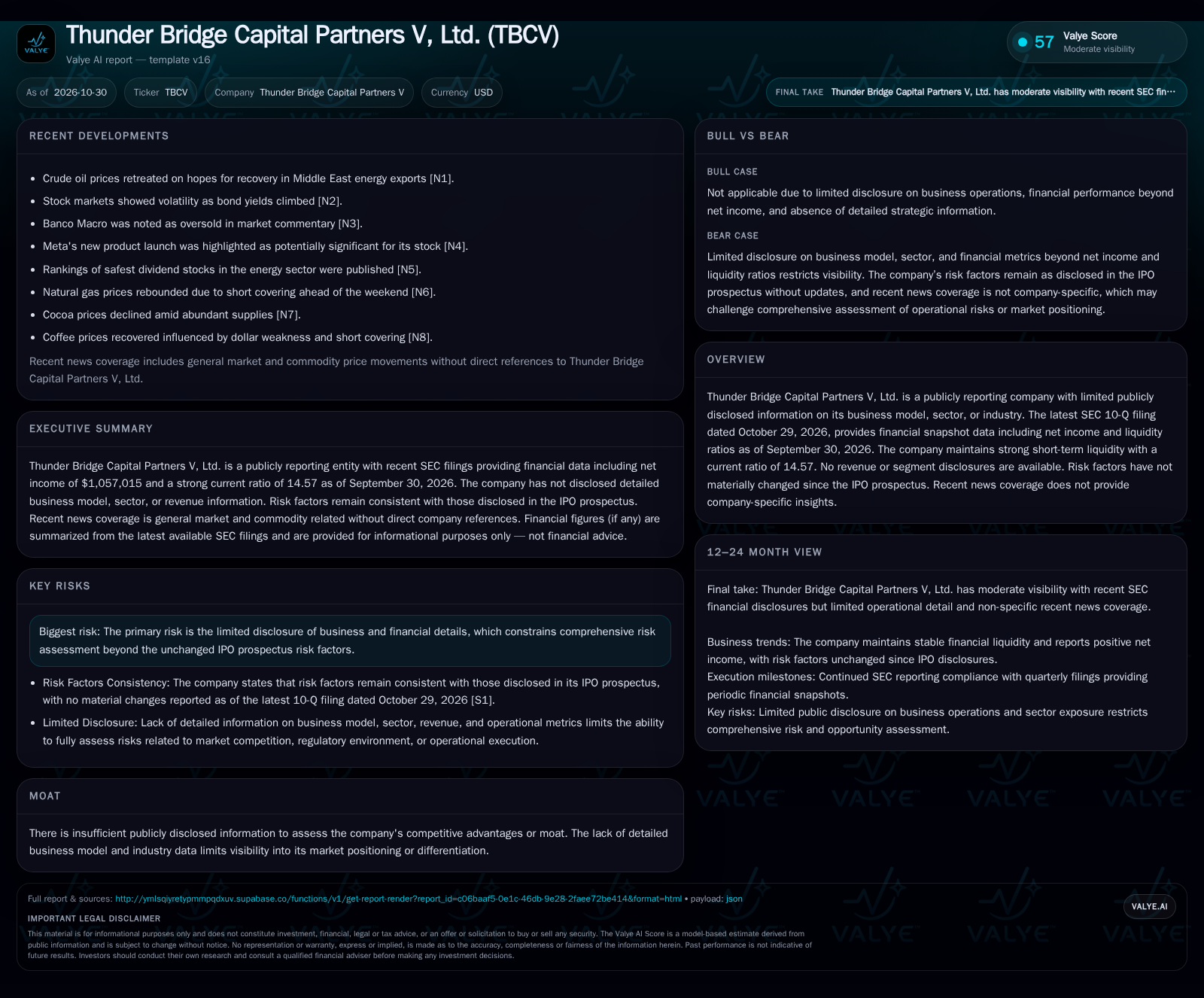
TBCV, a blank check company, reports reported liquidity position and net income from trust interest but has not yet completed or announced a business combination. The company's future value will be determined by its ability to identify, acquire, and integrate an attractive target. Until then, financial results reflect passive income rather than operating business fundamentals, and the primary risk remains the uncertainty and opacity typical of pre-deal SPACs. [S1]
Thunder Bridge Capital Partners V, Ltd. (TBCV) exemplifies the pre-merger SPAC model: flush with capital, reporting positive net income from trust interest, but offering no insight into future business direction or commercial operations.As of September 2026, its reported current ratio and net income are artifacts of its trust structure, not of underlying business activity. The real stakes—and risks—lie ahead: TBCV's ability to source, negotiate, and close a value-creating business combination will ultimately determine whether early financial comfort translates into enduring shareholder value. The opacity typical of SPACs at this stage means investors are betting on future deal execution, not present fundamentals.
Financial Snapshot: Trust-Driven Income and Balance Sheet Strength
As of September 30, 2026, Thunder Bridge Capital Partners V, Ltd. reported current assets of $1,203,127 and current liabilities of $82,588, yielding a current ratio of 14.57. Net income for the quarter was $1,057,015, derived almost entirely from interest earned on investments in the trust account. No operating revenue or business segment information has been disclosed. The company remains a blank check entity, still seeking a suitable acquisition target. Risk factors have not changed since the IPO, and there are no substantive company-specific news items or business developments beyond routine SEC filings. [S1]
How SPAC Economics Shape Pre-Combination Value
Thunder Bridge Capital Partners V’s economics are currently defined by its status as a SPAC. Until a merger is executed, income is generated passively from interest on the trust account, not from operating activities. Expenses primarily include public company compliance, due diligence, and organizational costs. The capital structure is designed for flexibility: proceeds from the IPO and private placements are held in trust and can be deployed as cash, shares, or debt to fund a business combination.
The economics will fundamentally change once a merger is consummated. At that point, the business model, revenue streams, margin structure, and capital needs will depend on the acquired company. Pre-merger, the key economic risk is deal failure—if no combination occurs, capital may be returned to shareholders, often with little or no upside. Conversely, a successful deal can create rapid value, but also exposes shareholders to execution, integration, and post-merger performance risks.
The trust structure that underpins SPAC economics also introduces nuanced timing and liquidity considerations. Since funds are typically held in low-risk, interest-bearing instruments, the yield environment significantly impacts pre-merger income generation. In a rising interest rate scenario, the trust income could increase, marginally enhancing reported net income, whereas a low or declining rate environment compresses these returns, potentially affecting the SPAC’s ability to cover ongoing expenses without eroding trust principal. Additionally, the timing of deal announcements and shareholder redemptions can materially influence the capital available for the business combination, underscoring the importance of managing investor expectations and market conditions throughout the pre-combination phase.
SPAC Market Dynamics: Competing for Attractive Targets
In the current SPAC landscape, Thunder Bridge Capital Partners V faces intense competition—not for customers, but for acquisition targets. Hundreds of SPACs have been seeking deals, often in overlapping sectors such as technology, fintech, healthcare, or industrials. The abundance of capital chasing a finite pool of attractive private companies can drive up valuations and make target selection more challenging.
SPAC sponsors attempt to differentiate themselves through sector expertise, sponsor reputation, or by offering creative deal structures. However, TBCV has not disclosed its intended sector or target focus, so its competitive positioning is opaque. The core risk is that, in a crowded field, less experienced or less well-connected SPACs may end up with weaker targets or fail to close a deal altogether.
The competitive dynamics for acquisition targets are further complicated by sector-specific valuation trends and the evolving preferences of private companies considering public listings. For example, sectors experiencing rapid technological disruption or regulatory shifts may see heightened demand, driving premiums and complicating deal terms. Moreover, the reputational capital and network access of SPAC sponsors play a critical role in sourcing proprietary deals that are less exposed to auction dynamics. Without disclosed sector focus or demonstrated sponsor expertise, a SPAC may face challenges in differentiating itself, potentially leading to compromises on target quality or deal economics. This environment incentivizes sponsors to leverage strategic relationships and operational insights to identify targets that align with emerging market opportunities and investor appetite.
Value Creation Through a High-Quality Business Combination
The most favorable scenario for TBCV shareholders is that the company identifies and acquires a high-growth, well-managed private business at a reasonable valuation. If the target has robust revenue, margin expansion potential, and clear public-market comparables, the merger could catalyze a rerating of shares and deliver long-term value.
Evidence that would confirm this scenario includes a definitive merger agreement with a credible, growth-oriented target; detailed pro forma financials showing operating leverage and cash flow potential; and post-merger execution milestones such as revenue growth and profitability. Early market reaction to a well-received deal announcement—e.g., share price appreciation and high redemption rates—would also support the upside case.
What If TBCV Secures an Average Target in a Crowded SPAC Field?
The most plausible outcome is that TBCV ultimately identifies a target and completes a business combination, but the target's quality and valuation are in line with the broader SPAC market—neither a standout success nor a clear disappointment. The post-merger entity may face the typical challenges of public transition, including integration costs, heightened scrutiny, and uncertain market reception.
This scenario would be confirmed if the chosen target is in a competitive sector with modest growth prospects, or if the deal terms include significant sponsor concessions to reduce redemptions. Post-merger, steady but unspectacular revenue and margin trends, and muted stock performance relative to initial projections, would further support this middle-path scenario.
Deal Failure, Target Quality Risk, and Redemption Overhang
The primary adverse scenario is that TBCV is unable to identify or close a business combination within its permitted timeline, forcing a return of capital to shareholders with minimal or no upside. Alternatively, the company might acquire a subpar target—either due to competitive pressure or misjudgment—which then underperforms operationally or financially. High redemption rates at the time of the merger could further deplete the cash available for the post-merger business, compounding integration and execution risk.
Evidence for this scenario would include repeated delays or extensions of the SPAC timeline, vague or generic target announcements, or a definitive agreement with a company lacking scale, growth, or profitability. Post-deal, a sharp increase in redemptions, negative market reactions, or early operational setbacks would further corroborate the downside thesis.
Testing the SPAC Thesis: What Will Reveal TBCV’s Real Value?
Announcement of a definitive business combination agreement, including target sector, valuation, and deal structure.
Redemption rates at the time of merger completion—high redemptions would signal weak investor confidence and reduce available cash.
Pro forma financial projections for the target business: revenue growth, margins, and capital needs (if disclosed).
Actual post-merger operating results versus projections, especially in the first 2-4 quarters after deal close.
Any extensions or amendments to the SPAC timeline, indicating difficulty in sourcing or closing a deal.
Changes to risk disclosures in future SEC filings, which could flag emerging operational or market challenges.
Sponsor’s track record and alignment: insider participation in the post-merger entity or additional capital commitments (if disclosed).
Disclaimer: This is research-only, informational analysis and not investment advice. It may include AI-generated interpretation and general industry context. Always verify important details using primary sources.

Comments