
NWPX Infrastructure: Record Sales, Profitability, and the Strategic Stakes of Liquidity and Cybersecurity in Infrastructure Markets
NWPX Infrastructure, Inc.
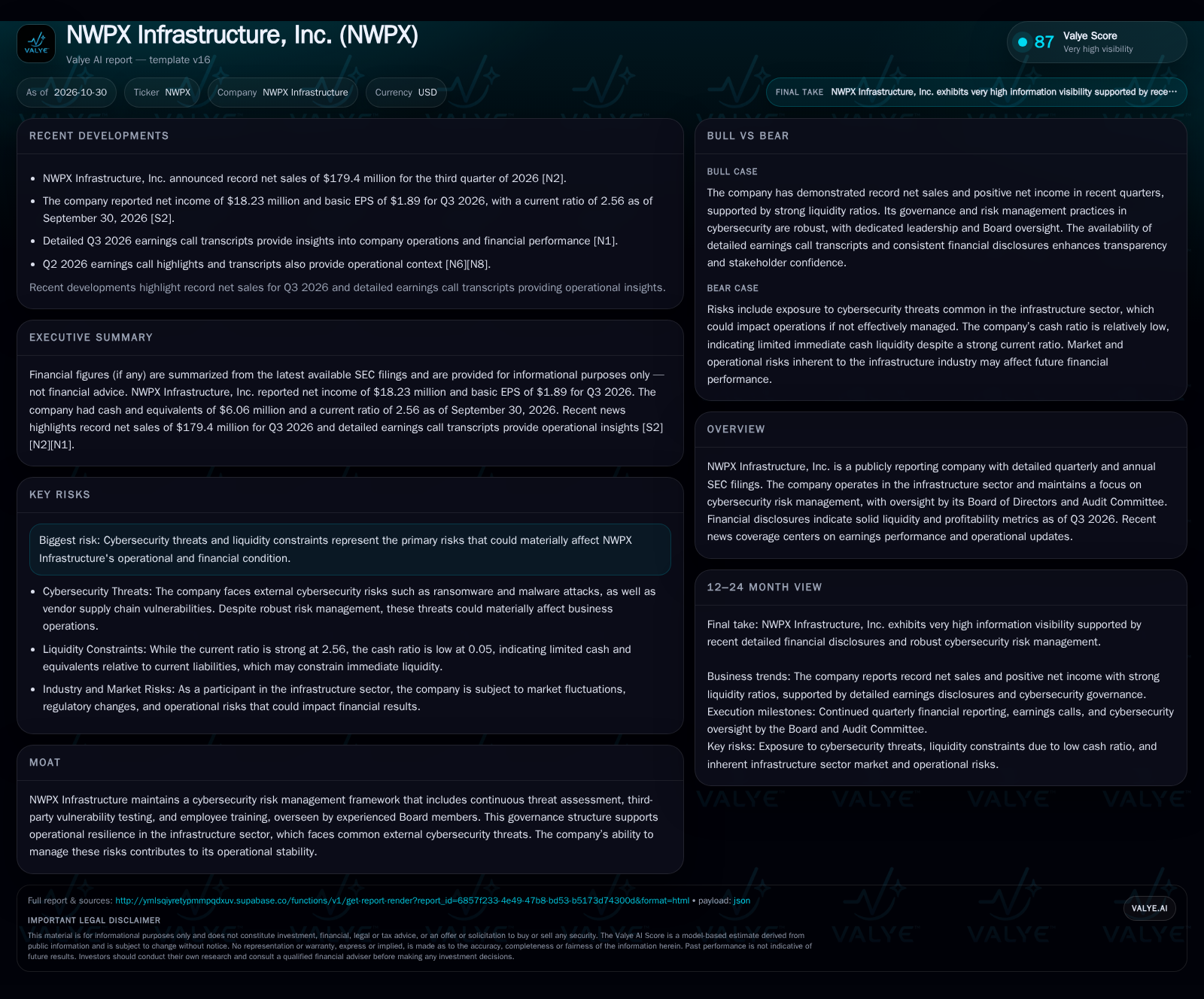
NWPX Infrastructure, Inc. posted record Q3 2026 net sales and strong net income, supported by a robust current ratio but limited immediate cash reserves. The company’s enterprise-wide cybersecurity risk management program is a central pillar of its operational stability.
NWPX Infrastructure, Inc. is demonstrating notable operational momentum, reporting record net sales and double-digit net income in the third quarter of 2026.Its reported current ratio reflects prudent short-term asset management, yet a reported cash ratio points to a reliance on non-cash current assets rather than immediate liquidity. With a cybersecurity risk management program embedded at both the executive and Board levels, NWPX is proactively addressing a key threat vector for infrastructure operators. The company’s next phase will likely hinge on its ability to convert operational strength into sustainable cash flows while maintaining digital resilience.
Recent Performance: Sales Records, Profitability, and Liquidity Profile
NWPX Infrastructure, Inc. announced record net sales of $179.4 million for the third quarter of 2026, accompanied by net income of $18.23 million and earnings per share of $1.89 (basic) and $1.86 (diluted) [N2] [S2]. As of September 30, 2026, the company reported $6.06 million in cash and cash equivalents, current assets of $317.13 million, and current liabilities of $123.73 million, resulting in a current ratio of 2.56 but a cash ratio of only 0.05 [S2]. These figures indicate a business with strong recent sales execution and profitability, but with a liquidity structure weighted toward non-cash current assets. The company also maintains a formal cybersecurity risk management program, with oversight by its Board of Directors and quarterly reporting to its Audit Committee [S1].
How NWPX Infrastructure Makes Money: Revenue Mix, Working Capital, and Margin Levers
While the precise breakdown of NWPX’s revenue streams is not disclosed, infrastructure companies typically generate revenue through large-scale project contracts, recurring maintenance agreements, and potentially value-added services. The record net sales and net income figures suggest a period of strong project execution and margin capture in Q3 2026 [N2] [S2]. Operating leverage in this sector often arises from the ability to spread fixed costs (such as plant, equipment, and skilled labor) over higher sales volumes. However, these businesses are also working-capital intensive, with significant receivables, inventories, and payables. This dynamic could heighten sensitivity to customer payment timing, project delays, or supply chain disruptions. Capital needs may rise if the company pursues larger projects or faces extended receivable cycles, making cash flow conversion and working capital turnover key metrics to monitor.
The interplay between revenue mix and working capital management is particularly critical in infrastructure businesses like NWPX. If a larger portion of revenue derives from long-term contracts with milestone-based billing, the timing of cash inflows may lag behind revenue recognition, increasing the risk of working capital strain. Conversely, recurring maintenance agreements might provide steadier and more predictable cash flows, supporting liquidity. Additionally, margin levers extend beyond simple cost control to include strategic procurement, supply chain optimization, and labor productivity improvements. For instance, if NWPX can negotiate better terms with suppliers or improve project scheduling to reduce idle labor, it could enhance margins even in a competitive pricing environment. Monitoring changes in days sales outstanding (DSO) and days payable outstanding (DPO) would help assess how effectively the company manages its cash conversion cycle.
Sector Dynamics: Digital Risk, Project Execution, and Differentiation in Infrastructure Markets
NWPX Infrastructure operates in a sector characterized by project-based revenues, cyclical demand, and increasing digital exposure. Competitive advantage in this landscape may derive from project delivery track record, customer relationships, cost control, and the ability to win repeat or multi-phase contracts. The company’s investment in cybersecurity risk management sets a baseline for operational resilience, which is becoming a differentiator as infrastructure assets grow more connected and vulnerable to cyber threats. However, most competitors in the infrastructure space are responding to similar pressures, investing in digital controls and compliance. Substitution risk is typically low for established infrastructure providers due to the critical and regulated nature of their offerings, but margin pressure can arise from competitive bidding and rising input costs. The company’s transparency through detailed earnings calls and disclosures may foster stakeholder trust, but sustained advantage will depend on continued operational discipline and digital risk mitigation.
Digital risk management is evolving from a compliance necessity to a competitive differentiator in infrastructure sectors. Companies that can demonstrate robust cybersecurity protocols may gain preferential treatment in contract awards, especially for projects involving critical or sensitive infrastructure. However, the arms race in cybersecurity also means that investments must be continuously updated to counter emerging threats, which can create ongoing cost pressures. Furthermore, digital transformation initiatives—such as integrating IoT sensors, automation, and data analytics—can improve operational efficiency but simultaneously expand the attack surface. Balancing innovation with security requires a nuanced approach that aligns technology adoption with risk tolerance and regulatory expectations. The ability to articulate this balance to customers and regulators may influence NWPX’s reputation and contract pipeline.
What Could Drive Outperformance: Cash Flow Conversion and Cyber Resilience as Multipliers
If NWPX Infrastructure can accelerate the conversion of its record sales and profits into operating cash flows—reducing the gap between accounting earnings and liquidity—it could unlock greater potential financial flexibility for reinvestment, debt reduction, or shareholder returns. Evidence of improved cash flow from operations, better working capital turnover, and a reported liquidity-ratio trends would confirm this dynamic. Additionally, if the company’s cybersecurity framework prevents material incidents while enhancing customer trust, it may win larger or more complex contracts, particularly as digital risk becomes a gating factor for infrastructure awards. Outperformance could be further fueled by sector tailwinds, such as increased public infrastructure spending or regulatory incentives favoring providers with demonstrated digital risk controls. Falsification would occur if receivables balloon, cash flow lags persist, or a significant cyber event disrupts operations or damages reputation.
Sustaining Momentum: Operational Execution Meets Working Capital Discipline
The most plausible near-term trajectory for NWPX Infrastructure is continued solid project execution, with sales and earnings remaining at or near recent levels, subject to sector cycles and contract timing. The company is likely to maintain its focus on cybersecurity governance and operational transparency. Confirmation would come from stable or growing net sales, consistent net income, and gradual improvement in operating cash flow metrics. Falsification would be evident if sales contract or if liquidity metrics deteriorate further, especially in the face of sector shocks or execution missteps.
Where Weakness Could Emerge: Liquidity Stress and Cyber Incidents as Value Risks
Downside risk for NWPX Infrastructure centers on the potential for liquidity stress. If non-cash current assets such as receivables become impaired or collection cycles lengthen, the company may face challenges meeting obligations without drawing on external financing or delaying investments. A material cybersecurity incident could also disrupt operations, erode customer confidence, or trigger regulatory scrutiny, especially given the sector’s exposure to critical infrastructure. Additionally, project delays, cost overruns, or a downturn in infrastructure demand could compress margins and expose the fragility of the current liquidity position. Downside confirmation would include a rising proportion of overdue receivables, negative operating cash flow, or public disclosure of a significant cyber breach.
What Will Test NWPX Infrastructure’s Playbook Over the Next Year
Trends in receivables and inventory turnover—faster cycles would reduce liquidity risk; material slowdowns would heighten it.
Cash ratio movement—an increasing ratio would indicate a stronger immediate liquidity buffer.
Incidence and disclosure of cybersecurity events—absence of material incidents would validate the company’s digital risk management.
Earnings call commentary on project pipeline and backlog—expansion or diversification would support top-line visibility.
Gross and operating margin trends—sustained or expanding margins would reflect pricing discipline and cost control.
Sector-wide infrastructure spending or regulatory developments—public investment or digital compliance mandates could change demand dynamics.
Board and management disclosures regarding capital allocation priorities—clarity on investment, debt, or return-of-capital strategies would inform risk/reward balance.
Disclaimer: This is research-only, informational analysis and not investment advice. It may include AI-generated interpretation and general industry context. Always verify important details using primary sources.

Comments