
Penske Automotive’s Take-Private Deal Reshapes Strategic Options and Industry Dynamics
A $16.3 billion take-private transaction led by Penske Corporation and Mitsui will drive Penske Automotive Group’s next chapter, imposing operational constraints and raising new questions about flexibility and long-term value creation.
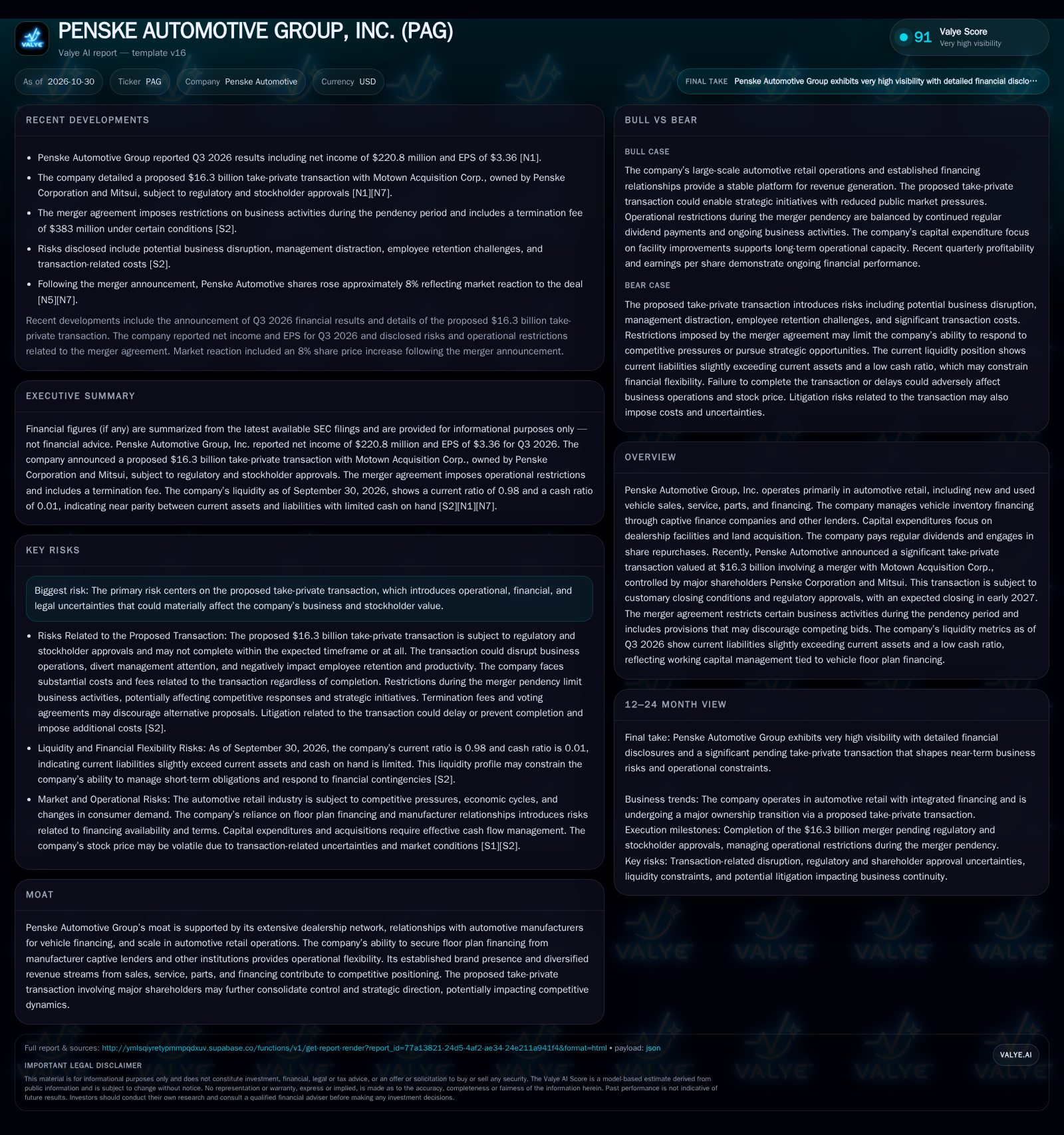
Penske Automotive Group’s pending $16.3 billion take-private merger, led by controlling shareholders, imposes significant operational restrictions and shapes near-term strategy. The company’s latest quarter showed $220.8 million net income but reflected a current ratio below 1 and a minimal reported cash balance. These factors, combined with merger-related uncertainties and a changing automotive retail landscape, create a narrow window for strategic maneuvering and make the long-term implications of private ownership the central variable for investors and stakeholders. [S2] [N1] [N7]
Penske Automotive Group’s imminent transition from public to private ownership, via a $16.3 billion acquisition by its controlling shareholders, marks a turning point for one of the world’s largest automotive retailers. While the company’s global dealership network and diversified revenue base have delivered steady profitability, the current environment is defined by tight liquidity and strategic restrictions imposed by the merger process. The outcome of this transaction could fundamentally reshape Penske’s ability to invest, adapt, and compete in an industry facing rapid change, making the next several quarters pivotal for both operations and long-term value creation.
Deal Structure and Liquidity Profile Set Penske’s Immediate Operating Framework
Penske Automotive Group is entering a transformative phase following the announcement of a $16.3 billion take-private transaction with Motown Acquisition Corp., owned by Penske Corporation and Mitsui, which together hold approximately 72.6% of outstanding shares [S2] [N1] [N7]. The merger, slated for early 2027 pending regulatory and shareholder approval, imposes operational restrictions on acquisitions, asset sales, and leverage—limiting management’s flexibility during the pendency period [S2].
For the quarter ended September 30, 2026, Penske reported net income of $220.8 million and EPS of $3.36. [S2]
The merger agreement’s $383 million termination fee and voting commitments substantially reduce the possibility of alternative bids, further entrenching the current transaction as the likely outcome [S2]. The company has also flagged risks of business disruption, management distraction, and employee retention issues stemming from the deal process [S2].
Revenue Intensity, Margin Challenges, and Capital Demands in Automotive Retail
Penske Automotive’s core business spans new and used vehicle sales, high-margin service and parts, and dealership-based financing arrangements. With over 369 franchised dealerships and 13 used vehicle outlets across the U.S., U.K., and other markets as of September 2026, Penske leverages geographic and brand diversification for revenue stability [S2]. Premium brands contributed 71% of retail automotive dealership revenue in the last nine months, while volume brands and commercial trucks round out the mix [S2].
The economics of automotive retail are defined by high revenue throughput but relatively modest gross and operating margins—typical for the sector. Variable costs are driven by inventory, sales commissions, and floor plan interest, while fixed costs center on facility operations and labor. Service, parts, and F&I (finance and insurance) products offer higher incremental margins, helping mitigate margin compression in new vehicle sales. Penske’s business model also relies on floor plan financing, using manufacturer captive lenders and other institutions, which ties working capital management closely to vehicle inventory levels and interest rates [S1] [S2].
Capital expenditures are primarily allocated to dealership upgrades, new construction, and land acquisitions, funded by operating cash flow or credit agreements [S1]. The company’s regular dividend and share repurchase program reflect a historically shareholder-friendly capital allocation, but these policies are now constrained by the merger agreement [S2].
Competitive Strength Rooted in Scale, OEM Partnerships, and Brand Mix
Penske’s competitive positioning is anchored in its scale, global reach, and deep relationships with automotive OEMs. Its extensive dealership network provides access to over 40 vehicle brands and a large, diversified customer base. Geographic diversification—59% of retail automotive revenues are U.S.-based, with 41% international—offers some insulation from local demand shocks and regulatory changes [S2].
Long-term franchise agreements and preferred access to premium and volume brands support inventory availability and customer traffic. The ability to secure floor plan financing from manufacturer captive lenders is a crucial differentiator, especially in an interest-rate sensitive environment. However, the rise of agency models in Europe—where the dealer acts as a facilitator rather than a principal—could compress dealership margins over time, shifting some economics back to OEMs.
Competitive threats include consolidation among dealer groups, direct-to-consumer sales by manufacturers, and digital retail platforms that pressure legacy dealership economics. Penske’s scale offers some negotiating leverage with OEMs and suppliers, but the company remains exposed to cyclical demand swings, inventory risk, and evolving consumer preferences.
Private Ownership Could Unlock Strategic Reinvestment and Margin Growth
A favorable outcome would see Penske leveraging private ownership to make strategic investments and operational changes that are more difficult under public market scrutiny. Freed from quarterly earnings pressures, management could accelerate modernization of dealership facilities, invest in digital retailing, and expand higher-margin service offerings. The backing of Penske Corporation and Mitsui, with their deep industry ties and long-term perspective, could enable bolder capital allocation and targeted M&A once merger restrictions lift.
Confirmation would come from post-transaction announcements of new investment programs, digital platform rollouts, or expansion into adjacent mobility services. Improved margins, higher service/parts revenue mix, and enhanced employee retention—if reported—would further validate the thesis. Evidence that the company is able to attract or retain top management and talent in the private phase would also be supportive.
Maintaining Operations Under Margin Pressure While Awaiting Industry Shifts
The most plausible scenario is that Penske continues to operate with relative stability through the merger pendency, maintaining core dealership operations, but with minimal strategic moves due to imposed restrictions. Short-term liquidity remains tight but manageable through normal industry practices such as inventory turnover and floor plan financing.
Margins may remain under pressure from industry headwinds—such as rising interest rates, changing consumer demand, and OEM margin recapture through agency models. Service, parts, and F&I will continue to provide margin support, but significant operational or strategic shifts are likely deferred until after the transaction closes.
Any slippage in employee retention, customer service metrics, or dealership productivity could signal emerging strain.
Risks from Market Disruption, Talent Retention, and Merger Execution Delays
The adverse case centers on merger-related disruption undermining Penske’s operational stability. Prolonged uncertainty could distract management, weaken employee morale, and slow dealership execution—especially if competitors exploit the window to lure away talent or customers. Employee retention challenges, flagged in disclosures, could translate into higher turnover, lost sales productivity, or degraded customer experience [S2].
Litigation or regulatory delays could further erode value.
Evidence of declining same-store sales, service revenue, or employee engagement metrics would be early warning signs. An uptick in competitor gains or negative OEM relationship developments would further reinforce the downside risk.
Evaluating Penske’s Value Creation Following the Take-Private Transaction
Progress toward regulatory and shareholder approval of the merger, with any delays or legal challenges scrutinized for impact on timing and transaction certainty.
Disclosure or reporting of employee retention and turnover figures during the pendency period—if disclosed—as a proxy for organizational stability.
Dealership same-store sales and service revenue trends, which would indicate whether operational disruption is affecting core business performance—if disclosed.
Changes in floor plan financing terms or availability, especially if industry credit markets tighten or OEMs alter support.
Post-transaction capital allocation announcements, including any new investment programs, digital initiatives, or M&A activity.
Reporting on service, parts, and F&I revenue mix and margin trends, which could buffer against new vehicle margin pressures—if disclosed.
Any signs of OEMs further shifting to agency or direct-to-consumer models in Penske’s key markets, affecting margin structure and dealership economics.
Legal or regulatory proceedings related to the transaction, with potential to delay, renegotiate, or block the deal.
Disclaimer: This is research-only, informational analysis and not investment advice. It may include AI-generated interpretation and general industry context. Always verify important details using primary sources.

Comments