
Starz After the Lions Gate Split: Cost Controls, Content Strategy, and the Liquidity Squeeze
With competitive pressures intensifying in U.S. streaming, the company’s ability to balance premium content investment against financial discipline will shape its future.
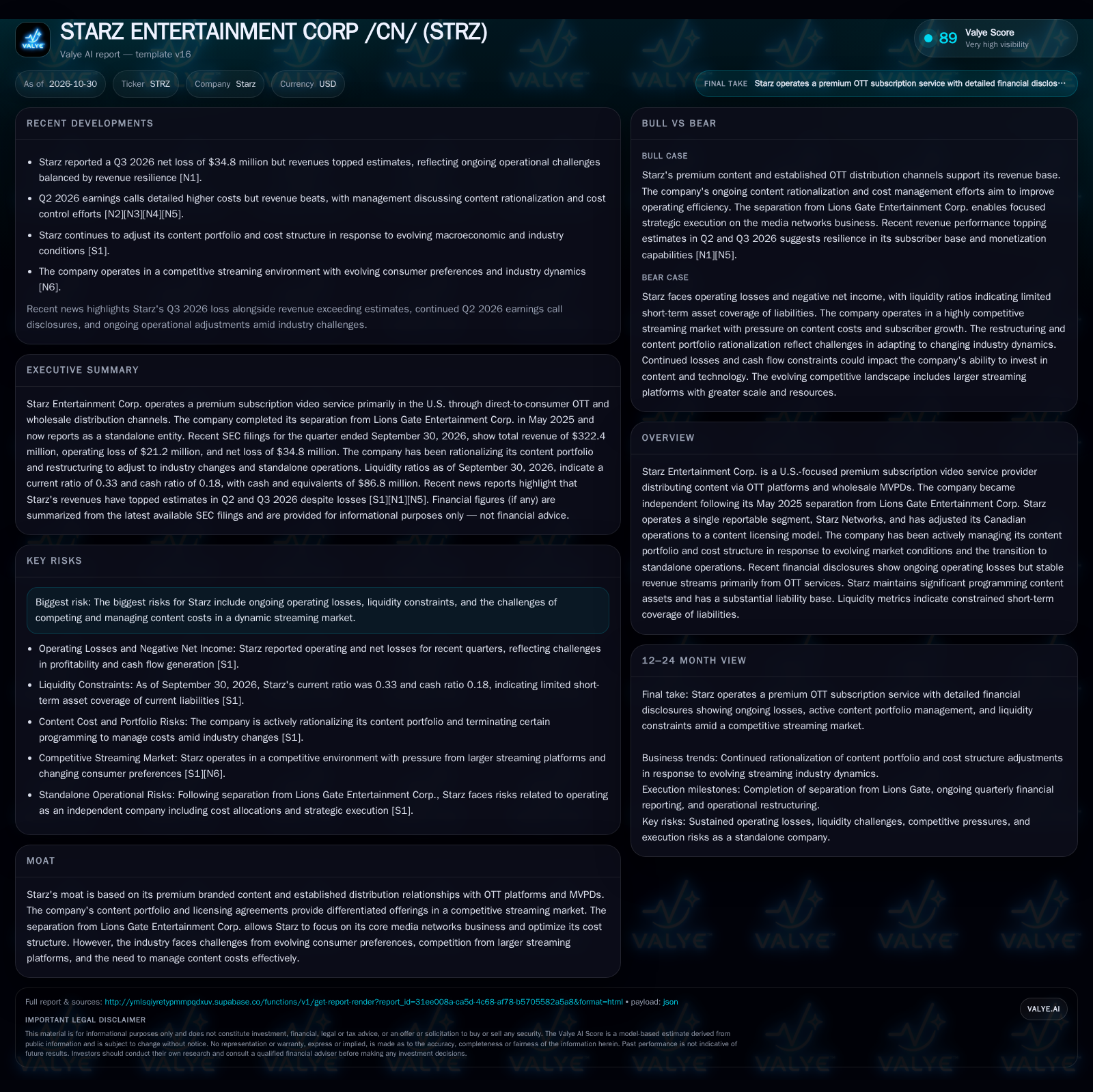
Starz, now a standalone OTT subscription service post-Lions Gate separation, reported Q3 2026 revenues above estimates but remains in the red, with a $21.2 million operating loss and a current ratio of just 0.33. The company’s next chapters hinge on its ability to improve cost structure, retain subscribers, and manage liabilities without sacrificing its premium content edge. [S1] [N1] [N5]
Starz’s emergence as an independent public company in 2025 marked a strategic inflection point, but the transition has brought acute financial and operational challenges into focus. Despite topping revenue estimates in recent quarters, Starz continues to report operating and net losses, with liquidity metrics underscoring a narrow margin for error. The company’s ongoing push to rationalize its content portfolio and streamline costs reflects both necessity and opportunity in a crowded streaming landscape. Whether Starz can stabilize its finances and carve out a defensible niche will depend on its ability to balance premium content investment with disciplined execution.
Recent Results Highlight Financial Strain and Strategic Shifts
For the quarter ended September 30, 2026, Starz reported total revenue of $322.4 million, with the majority ($226.6 million) derived from its OTT platform and the remainder from linear and other sources. Despite exceeding revenue expectations, the company posted an operating loss of $21.2 million and a net loss of $34.8 million for the period. These figures reflect persistent operating losses and a constrained liquidity position, even as Starz continues to reshape its content and cost structure following its May 2025 separation from Lions Gate Entertainment Corp. [S1] [N1] [N5]
Management’s ongoing content rationalization and cost containment efforts—including the termination of certain programming and a shift in Canadian operations to a licensing model—underscore a drive to align expenses with the realities of subscriber growth and evolving industry conditions. The company’s financial disclosures put a spotlight on the urgency of these actions to counterbalance intensifying competition and the secular decline of traditional linear TV.
Subscription Revenue Model Meets Content Cost Pressures
Starz’s core business model is built on premium subscription video services distributed through a mix of direct-to-consumer OTT channels and wholesale distribution via MVPDs (cable, satellite, telecom). Revenue is driven by subscriber volume, monthly pricing, and the mix between direct and wholesale channels—which can carry different margins depending on partner economics and contractual arrangements. While direct OTT subscriptions may offer higher margins and more granular customer data, wholesale deals can provide scale and reduce marketing costs, albeit at the expense of pricing power.
The company’s largest cost center is programming amortization, which reached $141.5 million in Q3 2026—reflecting the capital-intensive nature of acquiring, producing, and licensing premium content. Advertising and marketing ($74.2 million) and general administrative expenses ($31.3 million) add further fixed costs, while depreciation and amortization ($67.4 million) reflect both tangible and intangible asset investments. With operating leverage inherent in content-driven streaming, margin improvement may hinge on either scaling the subscriber base or materially lowering content costs. However, Starz’s ability to reduce content spend without sacrificing subscriber appeal is a delicate balancing act. [S1]
Navigating a Streaming Market Dominated by Scale and Content Depth
Starz operates in an intensely competitive U.S. streaming landscape, facing direct competition from global giants with far greater scale, such as Netflix, Disney+, Amazon Prime Video, and Max, as well as niche platforms targeting specialized audiences. The company’s differentiation historically rests on its branded premium content—often serialized dramas and movies—and established relationships with MVPDs and OTT aggregators.
However, as consumer preferences shift toward consolidated streaming bundles and original content exclusivity, the question is whether Starz’s content portfolio remains sufficiently compelling to drive both acquisition and retention. Larger rivals benefit from diversified content libraries, deeper original production budgets, and global reach, which can dilute the relative value proposition of a smaller, single-brand service. Industry consolidation, aggressive promotional pricing, and the rise of ad-supported tiers further compress margins and raise subscriber acquisition costs across the sector. Starz’s recent moves to pare back its content slate and focus on higher-value programming may help sharpen its brand, but risk reducing the volume and breadth that some subscribers expect.
If Content Rationalization Yields Leaner Growth and Subscriber Stickiness
A favorable outcome for Starz would see content and cost rationalization translating into a more focused, efficient content portfolio that resonates with a loyal subscriber base. If the company can identify and invest in programming that drives both acquisition and retention—while eliminating underperforming titles—it could stabilize operating margins and slow cash burn. This scenario assumes that subscriber churn remains manageable, and that the direct-to-consumer channel continues to grow, potentially improving blended margins.
Confirming evidence would include sustained or growing OTT subscriber numbers, improved average revenue per user (ARPU), and a clear inflection in operating margins or cash flow. If Starz can demonstrate that its content investments are yielding higher engagement and lower churn, while keeping content amortization and marketing spend in check, the case for a leaner, more resilient business model strengthens. Conversely, if content cuts lead to rising churn or revenue declines, the upside scenario would quickly unravel.
Content Cuts Offset by Ongoing Margin Pressure and Competitive Churn
The most plausible scenario is that Starz’s content and cost rationalization efforts help slow—but do not fully reverse—operating losses. The company may achieve some efficiency gains by focusing on higher-performing content and streamlining operations, but faces continued pressure from rising subscriber acquisition costs, ongoing competition, and the need to keep its content slate fresh enough to retain and attract subscribers.
Under this middle path, Starz manages to maintain stable to slightly declining revenues, with modest improvements in operating margins offset by the need to periodically reinvest in marquee content. Liquidity remains tight, and the company may require external funding or asset sales to bridge periods of negative cash flow. Evidence for this scenario would be stable subscriber base, flattish ARPU, and gradual improvement in operating loss trends—without a dramatic turnaround in profitability or cash generation. Signs of sustained negative free cash flow or declining subscriber metrics would challenge even this moderate outlook.
Liquidity Constraints Force Asset Sales or Strategic Retrenchment
In an adverse scenario, ongoing operating losses and reported liquidity position could force Starz to pursue emergency measures such as selling content assets, renegotiating distribution agreements under unfavorable terms, or seeking dilutive capital raises. If content portfolio rationalization leads to subscriber attrition or ARPU declines, revenue could deteriorate faster than costs can be removed, deepening losses and accelerating cash burn.
This scenario could be triggered by a combination of factors: intensified competitive pressure from larger streaming players, failure to launch or retain successful original programming, and inability to secure favorable content licensing or distribution deals. Confirming evidence would include rapid declines in subscriber numbers, a spike in churn, further deterioration in liquidity ratios, or announcements of asset sales or debt restructuring. If Starz cannot restore positive operating cash flow, its independence and strategic options may be at risk.
Benchmarks for Testing the Starz Turnaround Thesis
Quarterly OTT subscriber counts and churn rates, if disclosed, to gauge the impact of content portfolio changes on customer retention.
Average revenue per user (ARPU) trends across direct-to-consumer and wholesale channels, as a measure of pricing power and mix shift.
Content amortization and programming spend as a percentage of revenue, to track progress in aligning costs with revenue realities.
Operating cash flow and free cash flow figures, if disclosed, to assess financial sustainability and runway.
Announcements of new original programming or high-profile licensing deals, which could signal continued investment in the premium content strategy.
Any updates on refinancing, asset sales, or capital-raising activities that would affect liquidity and balance sheet risk.
Changes in distribution partnerships with MVPDs or OTT aggregators, which could materially affect reach and revenue visibility.
Management commentary on subscriber engagement metrics (e.g., viewing hours per user), which would clarify the effectiveness of content strategy.
Disclaimer: This is research-only, informational analysis and not investment advice. It may include AI-generated interpretation and general industry context. Always verify important details using primary sources.

Comments