
Middlesex Water: Navigating Rate Relief, Environmental Mandates, and Capital Demands in a Regulated Utility Landscape
Middlesex Water Company is a regulated utility serving New Jersey and Delaware, recently securing significant rate increases amid a multi-year $506 million capital program focused on PFAS compliance and infrastructure renewal.
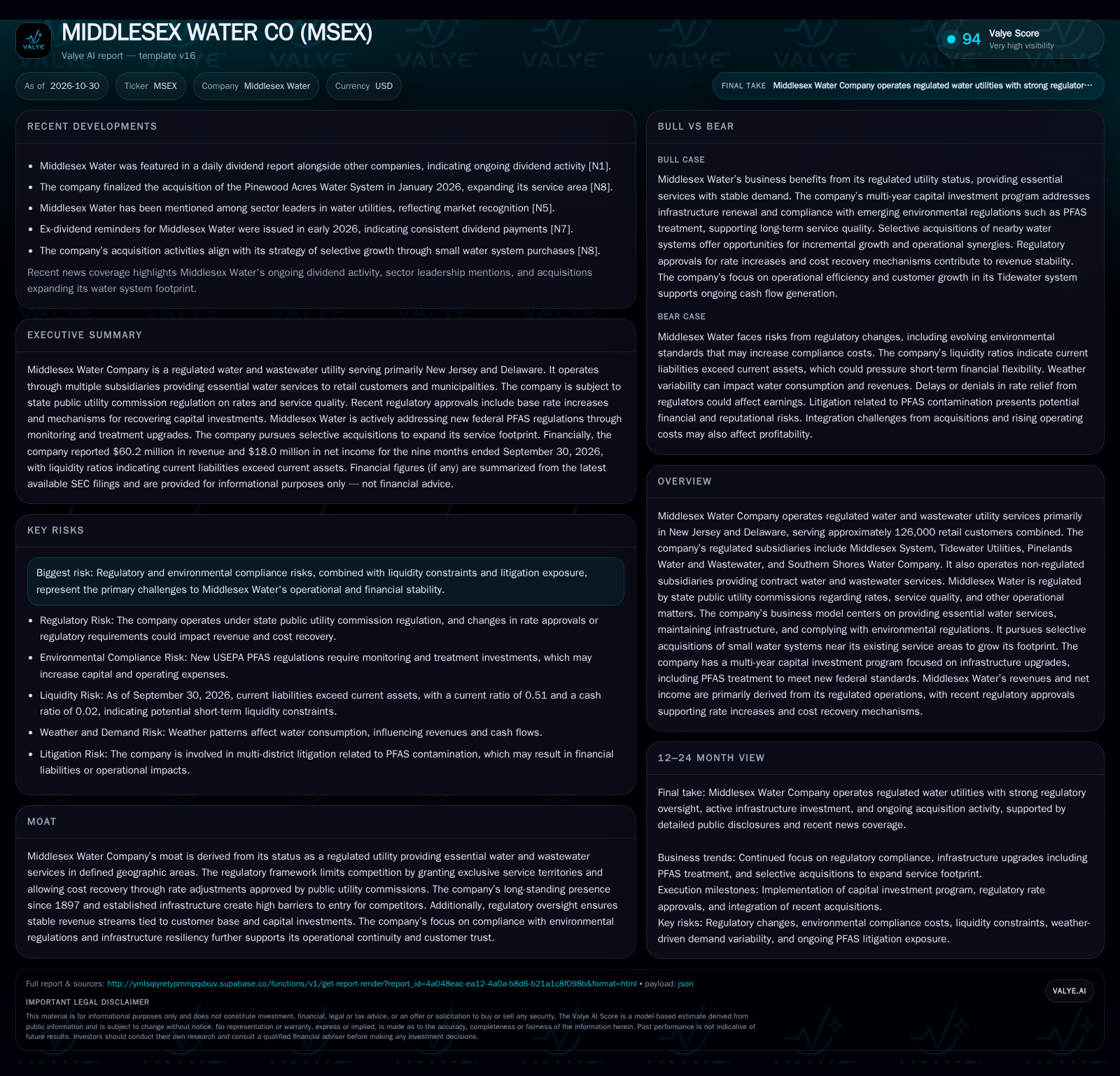
Middlesex Water Company is a regulated utility serving New Jersey and Delaware, recently securing significant rate increases amid a multi-year $506 million capital program focused on PFAS compliance and infrastructure renewal. The company’s revenues and earnings remain anchored in state-approved rates, but a reported current ratio and rising environmental obligations create financial tension. Acquisitions like Pinewood Acres support incremental growth, yet integration and regulatory risks persist. The core question is whether Middlesex can translate rate relief and capital investment into durable earnings growth while managing liquidity and compliance hurdles. [S1] [S2] [N8]
Middlesex Water Company stands at the intersection of regulated stability and mounting operational complexity. Its core business—delivering essential water and wastewater services to over 126,000 retail customers in New Jersey and Delaware—remains protected by state regulation, with recent rate increases bolstering revenue visibility. The next phase will test whether regulatory relief and infrastructure investment can outpace rising costs and operational risks, all while maintaining the trust of customers and regulators alike.
Recent Rate Relief, Capital Commitments, and Liquidity Constraints Define the 2026 Backdrop
Middlesex Water has recently secured two major base rate increases: $14.5 million for its New Jersey and Pinelands operations effective February 2026, and $5.5 million for its Delaware Tidewater subsidiary effective July 2025. These approvals are pivotal for offsetting the impact of a multi-year, $506 million capital investment program that includes $126 million planned for 2026 alone, largely targeting PFAS treatment upgrades and infrastructure renewal. The company’s acquisition of Pinewood Acres Water System in January 2026 signals ongoing expansion, but also adds to the integration workload. This combination of regulatory progress, capex acceleration, and financial pressure sets the stage for the next phase of Middlesex Water’s evolution. [S1] [S2] [N8]
Regulated Revenue, Capex Cycles, and the Economics of Water Utility Operations
Middlesex Water’s core economics are shaped by its status as a regulated utility. The vast majority of revenues (94% in recent years) and earnings are generated from state-sanctioned rates, which are intended to provide a fair return on invested capital while ensuring service quality. This model typically produces stable cash flows, but ties revenue growth directly to regulatory approval rather than market expansion. Pricing is determined through rate cases that consider historical and projected costs, required capital investments, and allowed returns. Volume growth tends to be modest, reflecting population changes and incremental customer additions rather than significant swings in demand.
The company is entering a period of elevated capital intensity, with PFAS-related treatment upgrades and ongoing main replacements comprising the bulk of its $506 million, three-year capex plan. These projects are necessary for regulatory compliance but require upfront funding, often through a mix of operating cash flow, debt, and potential equity issuance. The burden of funding such investments can strain near-term cash flow and increase leverage, especially given the company’s currently low liquidity ratios. Operating leverage is present but limited by the need for continual infrastructure renewal and compliance spending. Non-regulated contract operations and selective acquisitions offer some diversification, but are small relative to the regulated core.
Regulatory Protection, Infrastructure Barriers, and the Limits of Monopoly Advantage
Middlesex Water’s competitive moat is rooted in its regulated monopoly status, with exclusive rights to serve defined geographic territories in New Jersey and Delaware. This framework sharply limits direct competition, as new entrants face prohibitive infrastructure costs and regulatory hurdles. The company’s long operating history and established asset base further reinforce these barriers. However, the monopoly advantage is not absolute: regulators effectively set the ceiling on returns, and public utility commissions can be slow to grant rate relief, especially in periods of rising costs or public opposition to higher bills.
Substitution risk is low—customers cannot easily switch providers—but there is growing scrutiny of water quality and affordability, particularly as PFAS and other contaminants become regulatory flashpoints. In addition, larger utilities and infrastructure funds are active acquirers of small systems in the region, raising the stakes for Middlesex to execute on its own acquisition strategy while maintaining service standards. Contract operations for municipalities and third parties provide modest incremental growth, but are subject to renewal risk and do not fundamentally alter the company’s competitive position.
Translating Rate Recovery and Capex Execution into Sustainable Earnings Growth
A favorable scenario for Middlesex Water hinges on the successful alignment of rate recovery, capital deployment, and operational execution. If the company efficiently implements its PFAS and infrastructure investments on time and within budget, while regulators continue to approve timely rate adjustments, Middlesex could see its earnings and cash flows grow in step with its expanding rate base. Integration of new acquisitions, such as Pinewood Acres, could deliver cost synergies and incremental revenue with minimal disruption. If customer growth in service territories exceeds expectations, or if weather patterns favorably boost consumption, operating leverage could further enhance margins.
Additional evidence would include successful regulatory filings for future rate cases, smooth integration of acquired systems, and positive updates on PFAS compliance progress. Conversely, project delays, cost overruns, or regulatory pushback on future rate requests would undermine the upside thesis.
Navigating Heavy Capex and Regulatory Complexity with Modest Earnings Progress
The most plausible outlook is that Middlesex Water manages to execute its capital investment program and comply with new PFAS standards, but faces ongoing pressure from rising costs and tight liquidity. Rate increases already approved provide partial relief, but the lag between investment outlays and full cost recovery through rates may compress margins and limit free cash flow. Acquisitions add incremental customers but also require integration resources and may not materially shift the earnings profile. The company continues to generate stable, regulated revenues, but net income growth is restrained by higher depreciation, interest expense, and regulatory-driven opex.
This scenario would be supported by steady, if unspectacular, financial results—EPS and cash flow track with inflation and capex cycles, but do not inflect materially higher. Liquidity remains tight, necessitating careful capital allocation and potential external financing. The company maintains its dividend, but payout growth is constrained. Evidence would include continued regulatory engagement, periodic rate filings, and routine updates on PFAS compliance and capex progress. Watchpoints would be any sign that cost inflation or project delays are eroding the company’s ability to keep pace with regulatory recovery.
Delayed Rate Relief, PFAS Litigation, and Liquidity Stress Create a Negative Spiral
In a negative scenario, Middlesex Water encounters regulatory resistance or delays in securing future rate relief, just as PFAS compliance costs and capital spending accelerate. This mismatch could lead to margin compression, deteriorating credit metrics, and a need for dilutive equity or costly debt financing. If PFAS-related litigation results in material settlements or remediation costs beyond what is recoverable through rates, the financial strain could intensify. Integration missteps with acquired systems or unforeseen infrastructure failures would further challenge operational stability.
Warning signs would include missed capex milestones, rising interest expense, negative free cash flow, or covenant pressures. An inability to maintain the dividend or evidence of customer or municipal dissatisfaction could signal more fundamental issues. If disclosed, a spike in legal reserves or a downgrade in credit ratings would further validate the downside scenario.
Testing the Middlesex Water Thesis: Execution, Regulation, and Financial Signals to Track
Progress and cost discipline on major PFAS treatment projects and water main replacements—if disclosed, project timelines and capex actuals versus budget would be critical.
Regulatory outcomes for pending and future rate cases, including timelines, allowed returns, and any evidence of regulatory lag.
Net income and EPS trends relative to capex outlays and infrastructure renewal cycles.
Operating cash flow and free cash flow generation relative to dividend commitments and capital spending needs.
Liquidity and leverage ratios, including the current ratio and cash position, especially if external financing is required.
Integration updates on recent acquisitions, including Pinewood Acres—if disclosed, customer retention and service quality metrics would help assess execution risk.
PFAS litigation developments—if disclosed, size of legal reserves or settlement amounts and the degree of cost recovery through rates.
Customer growth in core territories, and any evidence of weather-driven demand variability impacting revenue.
Disclaimer: This is research-only, informational analysis and not investment advice. It may include AI-generated interpretation and general industry context. Always verify important details using primary sources.

Comments