
Biohaven’s Licensing-Led Pipeline: Strategic Optionality and the Risks of Collaboration Dependence
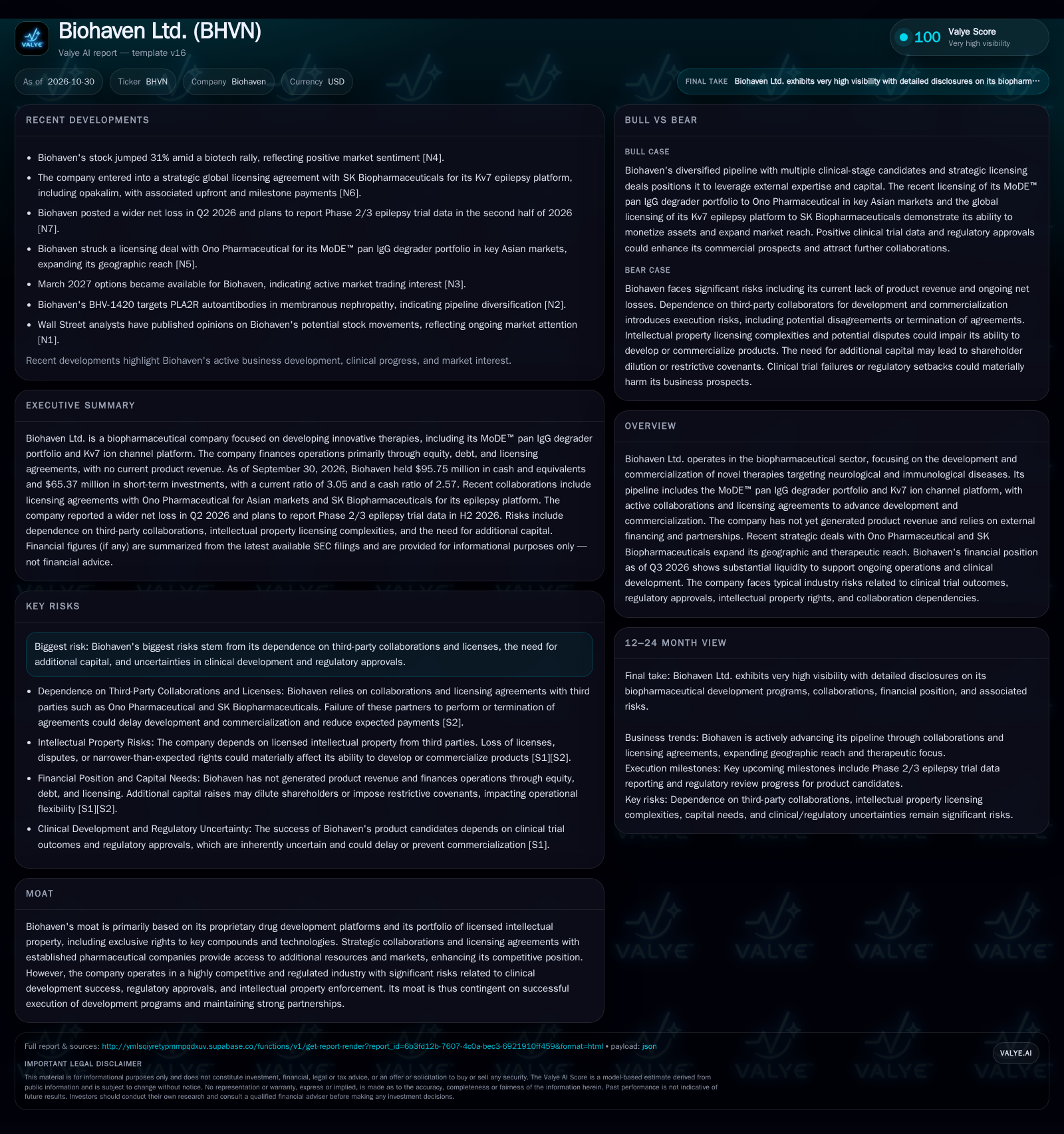
Biohaven’s recent licensing agreements with Ono Pharmaceutical and SK Biopharmaceuticals signal a maturing pipeline strategy, but ongoing net losses and a lack of product revenue keep the company reliant on external capital and partnership execution. The next clinical milestones and partner performance will determine whether Biohaven can transition from a development-stage story to a platform for recurring value creation.
Biohaven’s business model currently hinges on monetizing its intellectual property through licensing deals and collaborations, as evidenced by its recent agreements in Asia and global epilepsy markets. Execution and capital-raising risk remain high, with near-term milestones including critical Phase 2/3 epilepsy data readouts.
The next phase will reveal whether Biohaven’s pipeline and deal flow can convert into recurring value—or if execution, regulatory, or partner risks will dominate the narrative.
Recent Licensing Deals and a reported cash balance Define Biohaven’s 2026 Position
Biohaven has not yet generated product revenue, reporting a wider net loss in Q2 2026 as it continues to fund operations through a combination of equity, debt, and licensing agreements [N7] [S2]. The company’s financial snapshot as of September 30, 2026, shows $95.75 million in cash and equivalents and $65.37 million in short-term investments, resulting in a current ratio of 3.05 and a cash ratio of 2.57 [S2]. Notably, Biohaven has executed two major licensing deals in 2026: an exclusive license to Ono Pharmaceutical for its MoDE™ pan IgG degrader portfolio in key Asian markets, and a global licensing agreement with SK Biopharmaceuticals for its Kv7 epilepsy platform, including lead compound opakalim [S2] [N6]. The company plans to report Phase 2/3 epilepsy trial data in the second half of 2026, which represents a critical inflection point for both its pipeline and its monetization strategy [N7].
The timing and structure of licensing agreements also play a crucial role in Biohaven's financial stability and strategic flexibility. Upfront payments provide immediate capital infusion but are typically finite, while milestone payments depend on achieving specific clinical or regulatory benchmarks, which introduces variability and uncertainty in cash flow projections. Additionally, the geographic segmentation of licenses, such as the Asia-focused deal with Ono Pharmaceutical, may limit Biohaven’s direct influence over market dynamics and commercialization strategies in those regions. This segmentation necessitates robust partner coordination to ensure alignment on development priorities and market access strategies, which can be challenging to manage remotely and may impact the pace at which value is realized.
How Biohaven’s Asset-Light, Partnership-Driven Model Could Create Value
Biohaven’s economics are not those of a traditional commercial-stage pharmaceutical company. Instead, its business model is currently built around licensing its intellectual property to larger partners, extracting upfront payments, milestones tied to clinical and regulatory progress, and potentially royalties if products reach the market. This approach reduces the need for a large commercial infrastructure and can accelerate geographic reach, as seen in the deals with Ono Pharmaceutical and SK Biopharmaceuticals [S2] [N6].
The company’s capital needs remain high due to significant R&D expenses, especially as it advances multiple clinical programs, including the Kv7 ion channel platform and the MoDE™ pan IgG degrader portfolio [S1]. Fixed costs are primarily research-related rather than sales-driven, and while licensing deals provide episodic cash inflows, recurring revenue will only materialize if partners successfully commercialize pipeline assets. The Note Purchase Agreement, allowing for up to $600 million in senior secured notes, provides additional contingent liquidity but is tied to future sales of troriluzole and regulatory milestones [S1]. This funding structure gives Biohaven optionality but also exposes it to dilution and covenant risk if additional capital is needed before meaningful revenue is achieved.
The asset-light model inherently shifts a significant portion of commercialization risk onto partners, which can be advantageous in conserving capital but also reduces Biohaven’s control over ultimate market success and revenue generation. This dynamic creates a dependency on partner capabilities, incentives, and market conditions that are outside Biohaven’s direct influence. Furthermore, the episodic nature of milestone payments can complicate financial planning and investor expectations, as revenue streams may be lumpy and contingent on uncertain clinical outcomes. To mitigate these challenges, Biohaven’s ability to diversify its licensing portfolio across multiple assets, partners, and indications is critical, as it can smooth revenue volatility and reduce the impact of any single program’s underperformance.
Biohaven’s Niche: Platform Innovation, Global Partnerships, and IP Leverage
Biohaven’s competitive profile is defined by its proprietary development platforms (notably MoDE™ and the Kv7 ion channel platform) and its ability to structure deals with established pharmaceutical partners. Platform innovation and intellectual property exclusivity underpin its value proposition, enabling it to attract partners like Ono and SK Biopharmaceuticals who can provide regional or global commercialization muscle [S2] [N6].
However, the company faces substantial counterforces. The biopharma sector is characterized by intense competition, rapid technological evolution, and a high failure rate in clinical development. Biohaven’s dependence on licensed IP from third parties means it must also manage the risk of disputes or loss of rights, which could materially impact its programs [S1] [S2]. Peer competitors include other clinical-stage biotech firms pursuing novel ion channel modulators, protein degraders, or autoimmune therapies—many of which are also seeking partnerships or acquisitions from larger pharmaceutical companies. As such, Biohaven’s ability to maintain its IP position and execute on its partnership strategy will be critical to sustaining its competitive edge.
Maintaining a competitive edge in platform innovation requires continuous investment in research and development to stay ahead of emerging scientific advances and competitor pipelines. Biohaven’s reliance on intellectual property protection means that patent life, freedom-to-operate considerations, and the ability to defend against challenges are vital to sustaining long-term value. Moreover, the company must navigate complex regulatory environments across different jurisdictions, which can affect the timing and scope of market entry. Strategic partnerships not only provide commercialization capabilities but also access to local regulatory expertise and market intelligence, which are essential for optimizing product launch strategies and overcoming barriers to adoption in diverse healthcare systems.
Successful Epilepsy Data Could Unlock Royalty Streams and Further Deals
If Biohaven’s Phase 2/3 epilepsy data are positive in the second half of 2026, it would validate the Kv7 platform and likely trigger additional milestone payments from SK Biopharmaceuticals, while increasing the probability of future royalties if the product is commercialized [N7] [S2]. A strong clinical readout could also de-risk the broader Kv7 platform and strengthen Biohaven’s negotiating leverage for future licensing deals involving other assets or geographies.
The company’s MoDE™ pan IgG degrader portfolio, now licensed to Ono in Asia, could similarly generate substantial value if clinical progress is confirmed and regional partners move aggressively toward commercialization [S2]. Upside could be further amplified if Biohaven is able to strike additional licensing or co-development deals for its diversified pipeline, including in indications such as membranous nephropathy (BHV-1420) [N2]. Confirmation of this scenario would be evident in new or expanded licensing agreements, disclosed milestone payments, and progress toward regulatory submissions by partners.
Most Likely Trajectory: Episodic Milestones, Ongoing Losses, and Delayed Self-Sufficiency
If the Phase 2/3 epilepsy data are mixed or delayed, milestone payments could be deferred, and the company may need to pursue additional equity or debt financing—potentially at the cost of dilution or restrictive covenants. Confirmation of this scenario would come from financial reports showing continued net losses, incremental licensing income without a step-change in recurring royalties, and updates indicating clinical or regulatory hurdles have not been fully cleared.
Failure to Deliver: Clinical Setbacks or Partner Underperformance Exacerbate Capital Needs
In the adverse scenario, Biohaven’s lead clinical programs could fail to meet efficacy or safety endpoints, resulting in the loss of milestone opportunities and potentially triggering termination or renegotiation of licensing agreements. Partner underperformance—if Ono or SK Biopharmaceuticals deprioritize, delay, or exit their collaborations—would further reduce Biohaven’s pathway to monetization [S2].
The company’s dependence on third-party IP means that disputes or loss of license rights could force it to suspend or abandon key programs, compounding the negative impact. In this scenario, Biohaven’s cash runway would shorten, and it might be forced into dilutive financings or asset sales at unfavorable terms. Evidence would include failed or inconclusive clinical outcomes, public disclosure of partnership disputes, or a sharp increase in capital-raising activity under stress.
Milestones and External Triggers That Will Shape Biohaven’s 2026-2027 Narrative
Outcome and timing of Phase 2/3 epilepsy trial data; positive results would support the value of the Kv7 platform and trigger milestones [N7].
Disclosure of milestone or royalty payments from SK Biopharmaceuticals and Ono Pharmaceutical, which would signal partner execution and asset value realization [S2] [N6].
Updates on clinical progress for the MoDE™ pan IgG degrader portfolio and BHV-1420 in membranous nephropathy, including regulatory submissions or trial initiations, if disclosed [N2].
Changes in cash, short-term investments, and reported net losses in quarterly filings; a persistent decline would raise financing risk [S2].
Any announcement of new licensing agreements, co-development partnerships, or asset sales that could diversify revenue sources or extend cash runway, if disclosed.
Disclosures on partner performance or potential disputes, including early termination or renegotiation of key licensing agreements [S2].
Intellectual property updates, such as new patents, challenges, or the loss of licensed rights, as these could materially affect the pipeline’s value, if disclosed.
Disclaimer: This is research-only, informational analysis and not investment advice. It may include AI-generated interpretation and general industry context. Always verify important details using primary sources.

Comments