
CareDx at a Strategic Pivot: Transplant Diagnostics, Oncology Expansion, and the Leverage of Policy Tailwinds
CareDx’s recent profitability, reported liquidity position, and Medicare policy wins mark an inflection point for its molecular diagnostics and digital transplant solutions business. The company’s sale of its lab products division and Naveris acquisition signal a sharpened focus on high-value transplant and oncology testing, yet integration risk, payer dynamics, and market concentration remain central to long-term value creation.
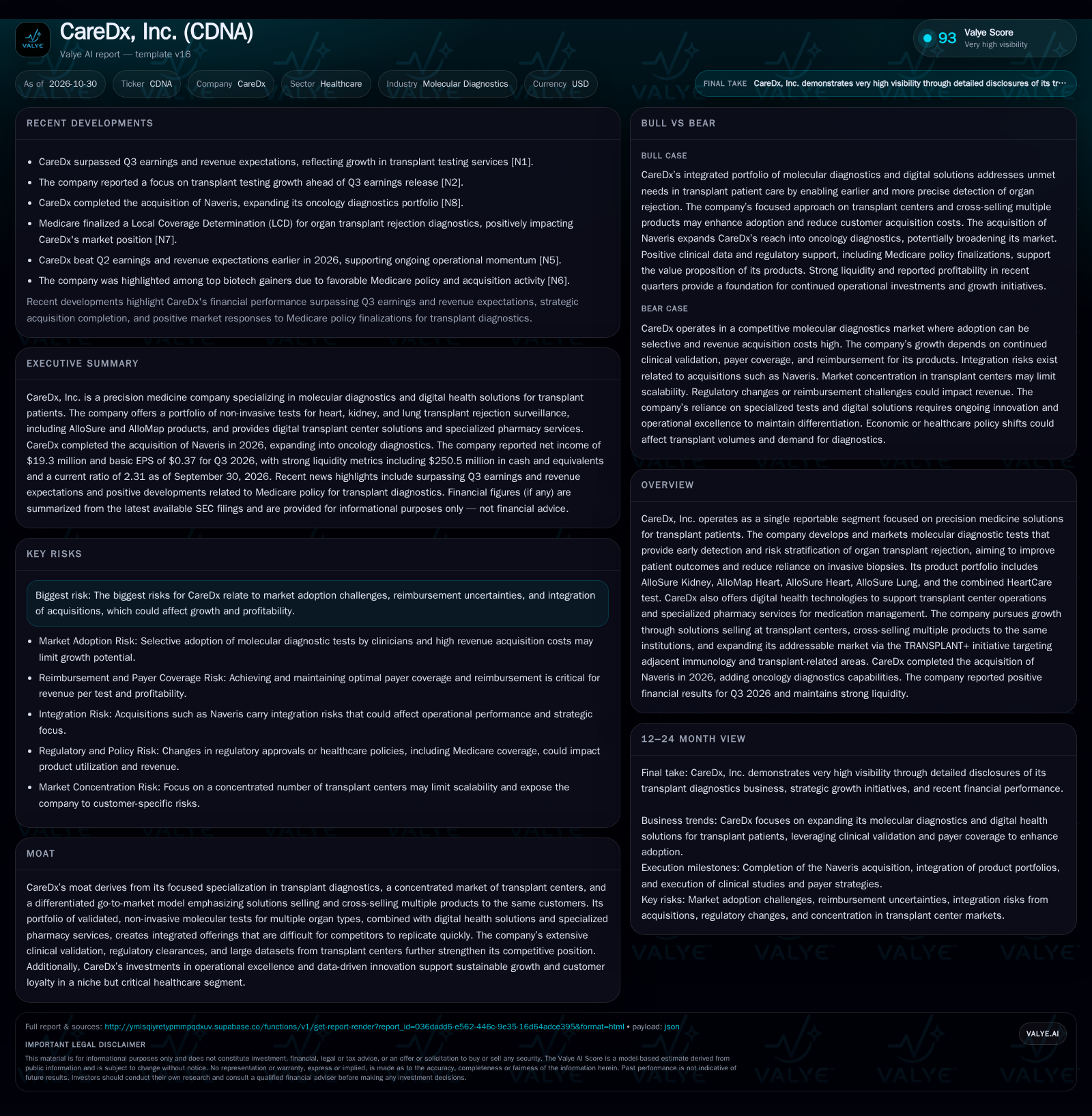
CareDx reported Q3 2026 net income of $19.3M and a cash balance of $250.5M, following the sale of its lab products business and the acquisition of Naveris. Favorable Medicare coverage for transplant diagnostics and a growing digital health footprint position the company for expanded adoption, but risks around payer policy, integration, and a concentrated customer base persist. The next phase depends on execution in transplant and adjacent oncology markets, continued payer support, and effective cross-selling across a limited set of transplant centers. [S2] [N6] [N7] [N8]
CareDx, Inc. stands at a strategic crossroads in late 2026, having achieved profitability and bolstered its balance sheet through asset divestiture, while simultaneously expanding its core transplant diagnostics and digital health offerings. The company’s Q3 results, combined with recent favorable Medicare policy decisions and the Naveris oncology acquisition, highlight a business model increasingly focused on specialized, high-value testing and software-enabled workflow solutions for transplant and oncology care. Yet, the company’s future trajectory hinges on its ability to drive adoption in a concentrated customer market, integrate new capabilities, and navigate ongoing payer and regulatory complexity.
Recent Financial and Strategic Moves Reshape CareDx’s Core Focus
[S2] This divestiture has enabled CareDx to concentrate resources on its higher-margin, higher-growth molecular diagnostics and digital health platforms for transplant and, via the Naveris acquisition, oncology testing. [S2] [N8]
The company’s Q3 performance was buoyed by favorable Medicare policy: a finalized Local Coverage Determination (LCD) for organ transplant rejection diagnostics offers increased reimbursement certainty, which is essential for test adoption and revenue predictability. [N7] [N6] The acquisition of Naveris, completed in mid-2026, brings HPV-related cancer diagnostic capabilities, broadening CareDx’s clinical footprint while introducing operational and integration complexity. [N8]
Economics of Precision Diagnostics: From Test Volume to Data-Driven Value
CareDx’s business model is predicated on the commercialization of proprietary molecular diagnostics (e.g., AlloSure, AlloMap, HeartCare) that enable early detection and risk stratification of organ transplant rejection. The economics of these tests depend on a combination of per-test reimbursement (driven by payer mix, especially Medicare), test volume (approximately 200,000 commercial tests performed in 2025), and the ability to cross-sell digital workflow and pharmacy services to a concentrated set of transplant centers. [S1]
Profitability is sensitive to reimbursement rates, fixed laboratory and R&D costs, and the marginal cost of running additional tests. As volumes increase, operating leverage improves, but the relatively small addressable market (limited by annual transplant volumes and the number of U.S. transplant centers) constrains absolute scale. The sale of the lower-margin lab products business and the addition of Naveris’ oncology testing are likely to shift the revenue mix toward higher-value, specialty diagnostics, but also introduce additional R&D and commercial investment needs.
Digital transplant solutions generate recurring revenue through software and service contracts, potentially lowering customer acquisition costs and embedding CareDx within center workflows. However, the actual contract structure (subscription, per-use, bundled) is not disclosed, and thus the degree of revenue visibility and stickiness is a function of customer integration depth and switching frictions, which may be high given the complexity of transplant center operations.
Specialization as a Double-Edged Sword: Moat Dynamics and Market Constraints
CareDx’s competitive position is underpinned by its specialization in transplant diagnostics—a niche market with high clinical stakes, significant regulatory barriers, and a limited number of key institutional customers. Its portfolio of validated, non-invasive tests and integrated digital solutions offers a differentiated value proposition compared to traditional biopsy or generic lab testing. This specialization fosters high switching costs for centers that have embedded CareDx’s workflow tools and testing protocols, but also limits the addressable market and exposes the company to customer concentration risk. [S1]
Competitors include other molecular diagnostics firms targeting organ health, larger diversified diagnostics companies, and potential entrants leveraging advances in genomics or AI. The Naveris acquisition extends CareDx’s reach into oncology, where the competitive landscape is broader and more dynamic, with established players and emerging liquid biopsy companies. Sustainable advantage in both segments depends on continued clinical validation, payer coverage, and the ability to integrate digital and molecular insights into transplant and oncology care pathways.
Catalysts for Outperformance: Policy Clarity, Digital Penetration, and Oncology Synergies
A favorable scenario for CareDx would see continued expansion of Medicare and private payer coverage for its core transplant diagnostics, driving both higher per-test reimbursement and broader test utilization. The recently finalized LCD for organ transplant rejection diagnostics is a foundational step, but further payer adoption and the potential extension to adjacent indications (e.g., cell therapy monitoring, post-transplant oncology surveillance) would be required to sustain above-market growth. [N7] [N6]
If the company successfully integrates Naveris’ oncology assets—leveraging its existing digital platform and transplant center relationships to cross-sell oncology diagnostics—CareDx could unlock new revenue streams and increase share of wallet within its institutional customer base. Evidence for this scenario would include rising test volumes in both transplant and oncology, expansion of digital contract penetration, and disclosure of multi-year or recurring revenue agreements.
Additional upside could be realized if CareDx’s large proprietary datasets enable the development of new AI-powered risk stratification tools or clinical decision support services, further embedding the company’s offerings in transplant and oncology care pathways.
Sustained Leadership in Transplant Diagnostics, but Growth Moderates as Market Matures
The most plausible medium-term outcome is that CareDx remains the leading provider of molecular diagnostics in U.S. transplant care, benefiting from stable reimbursement and incremental adoption of digital solutions. Test volume growth may slow as market penetration approaches saturation, with new growth dependent on adjacent offerings (e.g., pharmacy, oncology, cell therapy monitoring) and international expansion if pursued.
Revenue mix will likely shift toward higher-margin software and data services as more centers adopt CareDx’s digital workflow tools, but the absolute scale of the transplant market constrains overall growth. The company’s financial profile should remain solid, supported by a reported balance sheet position and operational discipline, unless integration of new acquisitions proves disruptive.
Confirmation of this scenario would come from stable or modestly growing test volumes, recurring software/service revenue (if disclosed), and consistent profitability. Signs of market maturation would include increased customer retention efforts, product bundling, and a pivot toward data-driven service development.
Adverse Policy Shifts or Integration Missteps Could Disrupt Momentum
The primary risk to CareDx’s outlook is adverse changes in payer coverage or reimbursement rates, particularly from Medicare, which would directly reduce per-test revenue and could slow adoption by transplant centers. Loss of coverage or unfavorable rate adjustments would likely lead to margin compression and pressure on R&D and commercial investment capacity.
Integration risk from the Naveris acquisition is another key vulnerability: operational disruption, cultural misalignment, or failure to achieve expected synergies in oncology testing could dilute management focus and margin profile. Additionally, if digital and pharmacy solutions fail to gain traction or sustain renewal rates, customer acquisition costs could rise and revenue visibility could erode.
Further downside could result from new competitive entrants offering lower-priced or more clinically advanced diagnostics, or from exogenous shocks that reduce transplant procedure volumes (e.g., policy changes, economic downturns, or clinical guideline shifts). Evidence of downside would include declining test volumes, reduced payer coverage, or missed integration milestones.
Milestones and Metrics That Will Define CareDx’s Strategic Value
Quarterly transplant and oncology test volumes, segmented by organ type and payer mix, would clarify adoption trends and revenue resilience.
Updates on payer coverage and reimbursement rates, especially any changes to Medicare LCDs or major private insurer contracts, will be critical for revenue visibility.
Integration progress and financial contribution from the Naveris acquisition, including test adoption rates and cross-selling into existing transplant center relationships, will help assess synergy realization.
Growth in digital transplant solution contracts—number of centers adopting, contract duration, and revenue per center (if disclosed)—would indicate the stickiness and expansion of CareDx’s digital platform.
R&D pipeline milestones, including new clinical validation data for existing or pipeline diagnostics in transplant and oncology, would support future growth and competitive differentiation.
Disclosure of recurring revenue, renewal rates, or customer churn in digital and pharmacy segments (if reported) would help gauge revenue predictability and customer retention.
Any announced partnerships or biopharma collaborations leveraging CareDx’s proprietary datasets could signal incremental value creation opportunities.
Disclaimer: This is research-only, informational analysis and not investment advice. It may include AI-generated interpretation and general industry context. Always verify important details using primary sources.

Comments