
Ecolab’s Diversification, Sustainability Ambitions, and the Crossroads of Digital Disruption
Ecolab’s Q3 2026 results underscore both its global scale and the operational complexity of serving water, hygiene, and infection prevention needs across more than 170 countries. As the company aligns its future with digital and sustainability imperatives, the challenge is to convert broad customer reach and environmental leadership into durable economic advantage—while navigating concentrated customer exposures and intensifying innovation demands.
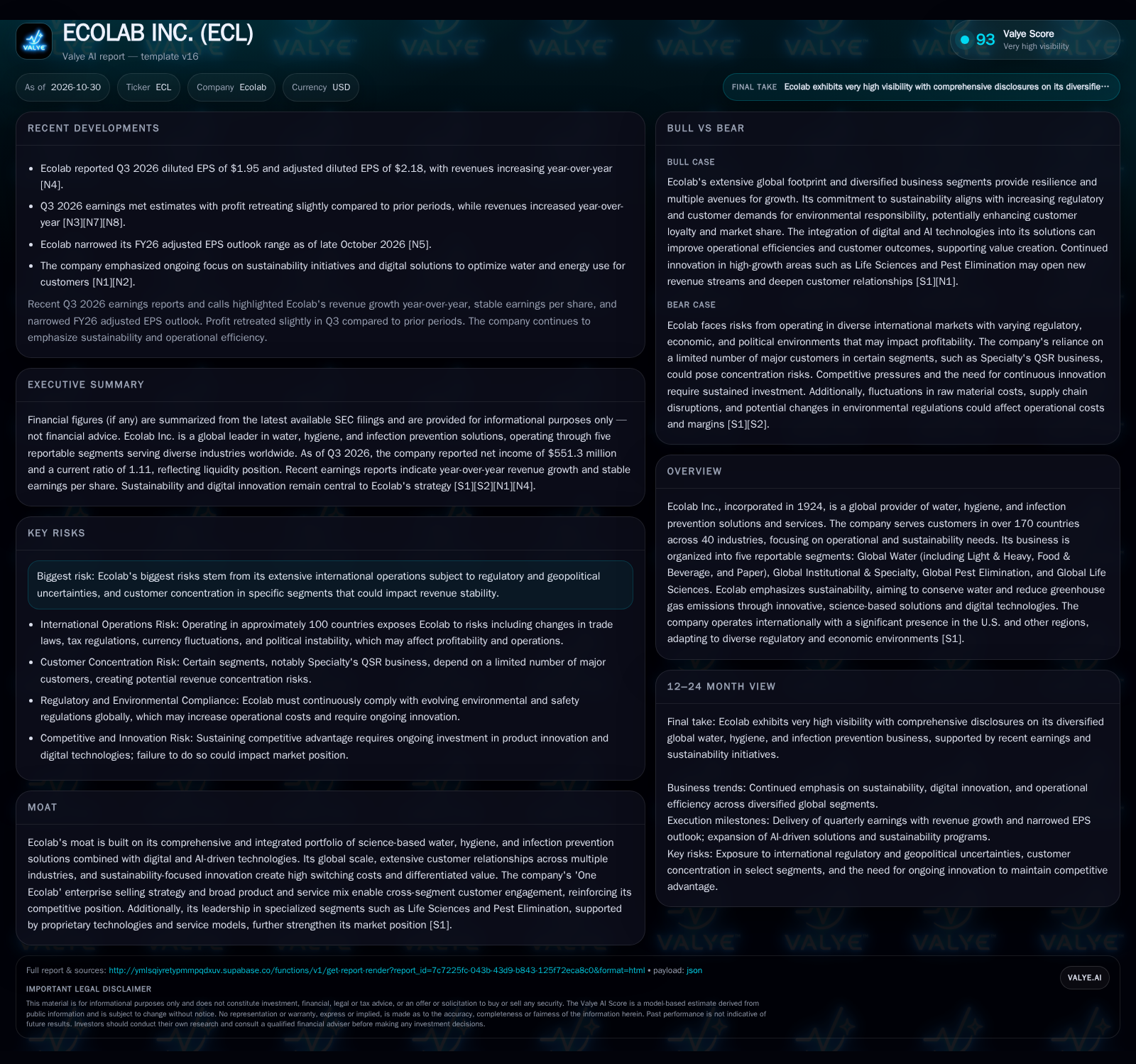
Ecolab delivered year-over-year revenue growth in Q3 2026, with diluted EPS of $1.95 and a narrowed full-year outlook, reflecting stable but pressured earnings. The company’s scale across water, hygiene, pest elimination, and life sciences enables resilience, but lower international profitability and customer concentration in select segments remain material risks. Ecolab’s push into digital, AI, and sustainability solutions could drive future margin expansion if operational leverage and customer retention improve, yet competitive and regulatory headwinds persist. [S1] [S2] [N1] [N3] [N4] [N5]
Ecolab’s latest quarter paints a picture of a company at scale—serving over 170 countries and 40 industries—yet facing the realities of margin compression, international complexity, and the need to continually reinvent its value proposition. While revenue growth persisted into Q3 2026, profit retreated slightly and management narrowed its earnings outlook for the year, signaling both discipline and caution. The core strategic question: Can Ecolab’s investments in sustainability, digital, and AI-led solutions translate its established customer base and environmental mission into lasting economic leverage, or will the structural challenges of global dispersion and customer concentration weigh on returns?
Recent Earnings, Global Reach, and Strategic Adjustments
Ecolab reported year-over-year revenue growth for Q3 2026, with diluted EPS of $1.95 and adjusted diluted EPS of $2.18, though profit declined slightly compared to prior periods. The company narrowed its FY26 adjusted EPS outlook, signaling a focus on operational discipline in the face of margin pressures and volatile input costs. Ecolab’s operations span more than 170 countries and 40 industries, yet its international businesses remain less profitable than domestic operations due to added regulatory and operational complexity. The company continues to prioritize sustainability—having helped customers conserve over 226 billion gallons of water in 2024—and is investing in digital and AI-driven solutions to optimize customer water and energy use. [S1] [S2] [N1] [N3] [N4] [N5]
How Ecolab’s Integrated Model Drives Revenue—and Where Margins Are Made or Lost
Ecolab monetizes its expertise through bundled sales of chemistry (cleaners, sanitizers, water treatment), equipment, and increasingly, digital services. The company’s 'One Ecolab' approach enables cross-selling across segments, leveraging long-standing customer relationships in sectors with high operational and regulatory burdens—such as food & beverage, hospitality, healthcare, and life sciences. Revenue is driven by a mix of direct product sales, service contracts, and technical consulting, with differentiated value stemming from embedded, recurring service relationships and integration of digital water/energy management platforms.
The economics of the business are shaped by high fixed costs (R&D, global sales/service infrastructure) and significant variable costs (raw materials, logistics, labor). Operating leverage is achievable if revenue scales faster than SG&A and R&D, but margin expansion is challenged by input cost volatility, international regulatory burdens, and the need to reinvest in innovation. Capital needs are moderate for a chemicals and services company—primarily funding working capital, technology upgrades, and select bolt-on acquisitions. The expansion of digital and AI offerings could, if successful, raise margins by embedding Ecolab more deeply into customers’ operations, reducing churn and shifting the mix toward higher-value analytics and automation.
International operations introduce both opportunity and drag: while global reach supports resilience and growth, local regulatory requirements and cost structures typically result in lower margins outside the U.S. [S1]
Differentiation Through Science, Service, and Scale—But Competitive and Regulatory Pressures Mount
Ecolab’s competitive edge is rooted in its integrated portfolio, technical service model, and global reach. High switching costs arise from the complexity and mission-critical nature of water and hygiene management in regulated industries—customers risk operational and compliance failures if they switch providers. The company’s proprietary formulations, digital analytics, and embedded service teams deepen customer stickiness, especially where hygiene, food safety, or contamination control are non-negotiable.
However, Ecolab faces persistent threats: global and regional competitors in water treatment, cleaning chemicals, and pest elimination can undercut on price or specialize in niche solutions. Digital-native entrants and industrial IoT startups are targeting the data and analytics layers, seeking to disrupt legacy service models with platform-based monitoring and automation. Regulatory changes, especially around chemical safety and environmental standards, can both help (by raising barriers to entry) and hurt (by increasing compliance costs or rendering certain solutions obsolete). Customer concentration in select segments, such as quick-service restaurants, creates vulnerability to loss of major accounts or changing procurement strategies. [S1]
Unlocking Margin Expansion Through Digital Transformation and Sustainability Leadership
If Ecolab’s investments in digital and AI-enabled solutions succeed in embedding its analytics and automation tools more deeply in customer workflows, the company could see higher retention, pricing power, and operating leverage. The most favorable scenario is one in which Ecolab’s digital water/energy management platforms become essential infrastructure for large industrial and institutional clients, driving a mix shift toward subscription-like revenues and differentiating Ecolab from pure-play chemical or hardware competitors.
Sustainability leadership may further solidify customer loyalty and open doors to new regulatory-driven demand, particularly as global water scarcity and decarbonization mandates intensify. If Ecolab can raise international margins by standardizing digital offerings and optimizing service delivery, the company could convert its global reach into improved profitability.
Evidence that would confirm this scenario includes: accelerating adoption of digital platforms, rising average revenue per customer, higher renewal rates, expanding margins in international segments, and outsized growth in Life Sciences and Pest Elimination—segments where regulatory and technical demands are greatest. Announcements of multi-year, enterprise-wide customer contracts for digital water/energy management would be especially confirmatory.
Sustained Diversification, Moderate Growth, and Margin Pressures in a Complex World
The most plausible near-term outcome is continued moderate revenue growth, supported by Ecolab’s broad industry and geographic footprint, but with persistent margin pressures from input cost volatility, international complexity, and the need for ongoing investment in innovation and compliance. The company’s diversified segment mix and embedded customer relationships should provide resilience against macroeconomic shocks or sector-specific downturns.
Profitability is likely to remain stable but not expand meaningfully unless digital and sustainability initiatives gain greater traction or international operations become more efficient. Customer concentration risks in segments like quick-service restaurants could periodically pressure results, but the breadth of Ecolab’s portfolio provides some insulation.
This scenario would be confirmed by steady, low- to mid-single-digit revenue growth, stable adjusted EPS, and incremental expansion of digital solution adoption without dramatic margin improvement. A lack of step-change in international profitability or customer churn rates would further support the base case.
Structural Margin Compression and Competitive Disruption
A less favorable outcome would see Ecolab’s margins erode due to prolonged input cost inflation, regulatory tightening, or intensified price competition—especially from digital-native or regional players. If key customers in concentrated segments shift to lower-cost alternatives or in-house solutions, revenue could decline and fixed costs become more burdensome.
Failure to demonstrate meaningful adoption or monetization of digital and AI-driven offerings would leave Ecolab exposed to commoditization risks, with limited ability to offset cost pressures through pricing or operational leverage. Geopolitical volatility, supply chain disruptions, or abrupt regulatory changes in major international markets could further compress margins and destabilize earnings.
Downside confirmation would come from negative operating leverage (costs rising faster than revenues), declining renewal rates, major customer losses, below-peer margin performance, or evidence that digital investments are not yielding improved retention or pricing power.
Signals That Will Shape Ecolab’s Next Chapter
Adoption rates and revenue mix from digital and AI-driven solutions—if disclosed, growth here would signal progress toward higher-margin, recurring business.
International segment margin trends, particularly evidence of narrowing the gap with U.S. profitability.
Customer concentration metrics in key verticals such as quick-service restaurants—a useful metric would be the share of revenue from top ten customers.
Renewal and retention rates for service contracts, especially in high-regulation sectors like Life Sciences and Institutional.
Progress toward stated sustainability goals (e.g., annual water conserved, emissions avoided) and any customer or regulatory wins tied to these metrics.
Raw material and logistics cost trends relative to revenue growth, as a gauge of margin resilience.
Disclosure of multi-year, enterprise-wide digital solution contracts or platform partnerships indicating deeper customer integration.
Quarterly updates to the FY26 EPS outlook range and management commentary on the drivers of any changes.
Disclaimer: This is research-only, informational analysis and not investment advice. It may include AI-generated interpretation and general industry context. Always verify important details using primary sources.

Comments