
Rimini Street’s Niche: Subscription ERP Support Meets AI Modernization Ambitions
Rimini Street reported $421.5 million in 2025 revenue, largely from subscription-based software support, and achieved $6.5 million in Q3 2026 net income.
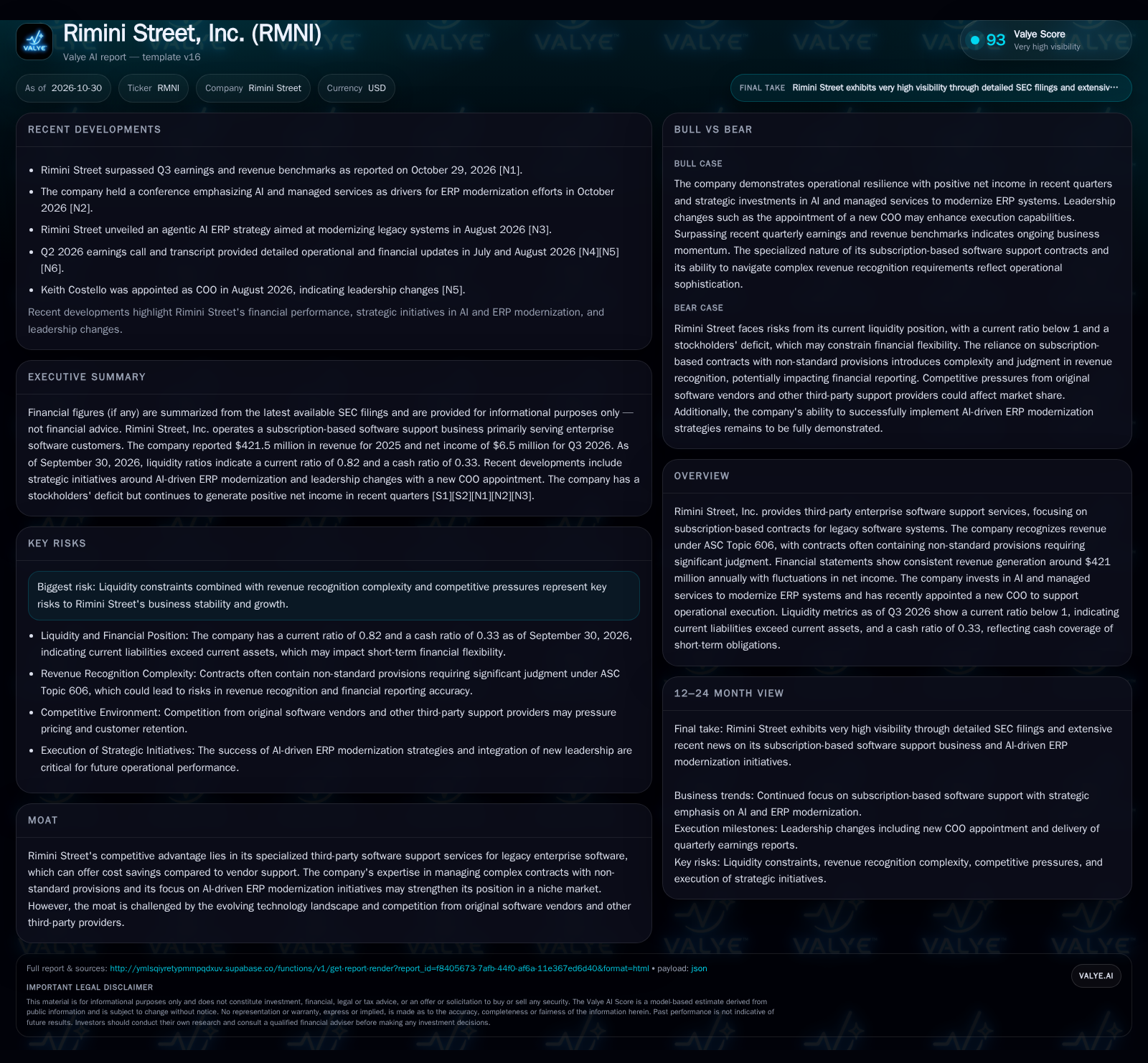
Rimini Street reported $421.5 million in 2025 revenue, largely from subscription-based software support, and achieved $6.5 million in Q3 2026 net income. The company is investing in AI-driven ERP modernization, but faces a current ratio below 1 and a stockholders’ deficit, reflecting tight liquidity. A new COO and ongoing financial execution point to operational focus, yet long-term sustainability depends on successful AI integration and navigating complex customer contracts amid competition from original vendors and third-party providers. [S1] [S2] [N1] [N2] [N3] [N5]
Rimini Street, Inc. stands at a pivotal intersection of legacy enterprise software support and the accelerating push toward AI-enabled ERP modernization. While the company continues to generate meaningful subscription-based revenue and recently posted positive net income, its liquidity profile remains a source of scrutiny. Strategic bets on agentic AI and managed services, combined with leadership changes, signal intent to reshape its value proposition. The company’s ability to convert these initiatives into sustained growth amid complex contract structures and competitive threats will define its trajectory in the evolving enterprise IT support ecosystem.
Recent Financials and Strategic Shifts Define Rimini Street’s Inflection Point
Rimini Street reported $421.5 million in revenue for 2025, with the majority coming from subscription-based software support contracts, underscoring the company’s core business in third-party maintenance for enterprise software [S1]. As of September 30, 2026, the company posted net income of $6.5 million for Q3, marking another quarter of profitability [S2]. Recent initiatives include the launch of an agentic AI ERP strategy and increased investment in managed services, with the appointment of Keith Costello as COO in August 2026 further highlighting a period of operational and strategic transition [N2] [N3] [N5].
How Subscription Economics and Contract Complexity Shape Rimini Street’s Model
Rimini Street’s business model rests on providing subscription-based support services for enterprise software, particularly for clients running legacy ERP systems. This recurring revenue stream offers a degree of visibility and predictability, but is complicated by the company’s use of non-standard contract provisions, requiring significant judgment in revenue recognition under ASC 606 [S1]. This introduces both operational complexity and potential volatility in reported results, especially as contract mix or customer behavior changes.
The company’s revenue base is influenced by the volume and nature of its contracts, as well as customer retention and renewal patterns. While industry logic suggests that scale could benefit margins—since incremental support customers may be served with relatively stable fixed costs—Rimini Street’s need for specialized technical expertise and compliance with evolving enterprise requirements keeps variable costs significant. Recent investments in AI-driven managed services could, if successful, improve operating leverage by automating routine support and expanding service breadth. However, these initiatives carry up-front investment requirements and uncertain payback periods, particularly if customer adoption is slower than anticipated.
Tight liquidity—evidenced by the sub-1 current ratio and negative stockholders’ equity—could limit Rimini Street’s flexibility to fund growth, respond to competitive pricing, or absorb shocks. The company’s ability to generate ongoing net income is a positive, but without a stronger liquidity buffer, it may be vulnerable to working capital swings or unexpected cash demands.
Navigating Between Original Vendors and Third-Party Specialists
Rimini Street’s core competitive proposition is offering lower-cost, high-touch support for legacy enterprise platforms—primarily targeting customers looking to extend the life of their ERP investments without paying premium prices for original vendor maintenance. This positions the company in a niche between original software vendors (such as SAP, Oracle) and a fragmented field of third-party support providers.
The main advantages for Rimini Street include domain expertise, the ability to handle complex and customized support scenarios, and potential cost savings for customers. Its willingness to manage non-standard contracts can be a differentiator for large enterprises with unique needs. However, original vendors retain significant power through technology updates, compliance requirements, and long-term customer relationships. If vendors accelerate end-of-support timelines or bundle new features into their own support contracts, Rimini Street could face increased churn risk.
The competitive field is also influenced by customer perceptions of risk, as enterprises may be hesitant to move mission-critical support away from the original vendor—especially for core ERP systems. Rimini Street’s push into AI and managed services could create new differentiation, but success will depend on demonstrating credible performance and integration with evolving enterprise IT architectures.
AI-Driven Modernization Unlocks New Revenue Streams and Margin Expansion
The most favorable outcome for Rimini Street is that its investments in AI and managed services catalyze a new phase of growth. If the agentic AI ERP strategy enables the company to automate a significant portion of support workloads, Rimini Street could see improved gross margins and reduced reliance on highly specialized labor. Enhanced service offerings may also allow the company to upsell existing customers and attract new enterprise clients seeking modernization without full platform migration.
Confirmation of this scenario would come from accelerating revenue growth from AI-driven managed services, disclosure of higher renewal rates or longer average contract durations, and evidence of expanding margins. Customer case studies or references demonstrating successful legacy-to-modern ERP transitions with Rimini Street’s technology would further validate the thesis.
Falsification would occur if AI initiatives fail to translate to new bookings or if cost reductions are offset by higher investment requirements or operational complexity. Rising customer churn or stagnant contract values would also undermine the upside narrative.
Incremental Evolution with Ongoing Profitability but Constrained Flexibility
The most plausible path is one of continued operational execution in the legacy support niche, with moderate growth as Rimini Street retains its core customer base and selectively wins new business. Subscription-based revenue remains the foundation, with incremental gains from managed services and AI augmenting, rather than transforming, the model. Net income remains positive, but margin expansion is limited by competitive pricing and the need to invest in new capabilities.
This scenario is confirmed by steady revenue in the $400–$450 million range, consistent quarterly profitability, and limited change in liquidity ratios. Modest growth in managed services revenue or AI-driven offerings would support the case for gradual evolution rather than rapid disruption.
If operational execution stumbles—evidenced by missed earnings, negative cash flow, or a material decline in renewal rates—the base case would be at risk. Conversely, a sharp improvement in liquidity or a step-change in margin profile would indicate a shift toward a more bullish scenario.
Liquidity Stress and Competitive Pressures Erode Customer Base
The adverse scenario unfolds if Rimini Street’s liquidity constraints intensify—whether due to unexpected cash outflows, delayed customer payments, or inability to refinance short-term obligations. This could force the company to curtail growth investments, reduce service quality, or accept unfavorable contract terms to preserve cash.
At the same time, if original vendors or aggressive third-party competitors step up their offerings, Rimini Street could face rising churn and downward pricing pressure. Complex revenue recognition requirements might also lead to restatements or regulatory scrutiny, undermining customer and investor confidence.
Evidence for this scenario would include declining net income, deteriorating current and cash ratios, negative operating cash flow, or disclosures of covenant breaches or urgent capital raises. A shrinking customer base or publicized contract losses would further confirm downside risk.
Signals That Will Test Rimini Street’s Value Proposition and Strategic Execution
Quarterly changes in renewal rates or churn among top enterprise customers, if disclosed, would indicate the durability of Rimini Street’s subscription base.
Growth rate and margin contribution from AI-driven managed services should be tracked to assess the commercial impact of recent strategic investments.
Updates on average contract duration and size would help clarify the company’s ability to secure longer-term, higher-value relationships.
Disclosures related to revenue recognition adjustments or restatements would flag operational risk tied to complex contract accounting.
Customer wins or reference accounts in AI-enabled ERP modernization would demonstrate traction for new service lines.
Public disclosures of competitive wins or losses versus original vendors would provide insight into Rimini Street’s market positioning.
Disclaimer: This is research-only, informational analysis and not investment advice. It may include AI-generated interpretation and general industry context. Always verify important details using primary sources.

Comments