
Rithm Property Trust: Navigating Regulatory Boundaries and Refinancing Risk in Mortgage-Linked Real Estate
Rithm Property Trust’s strategy hinges on specialized mortgage asset exposure while maintaining crucial regulatory exclusions. As refinancing deadlines approach and regulatory ambiguity persists, the company’s future rests on its ability to adapt investment strategies, manage leverage, and sustain distributions amid shifting market and compliance currents.
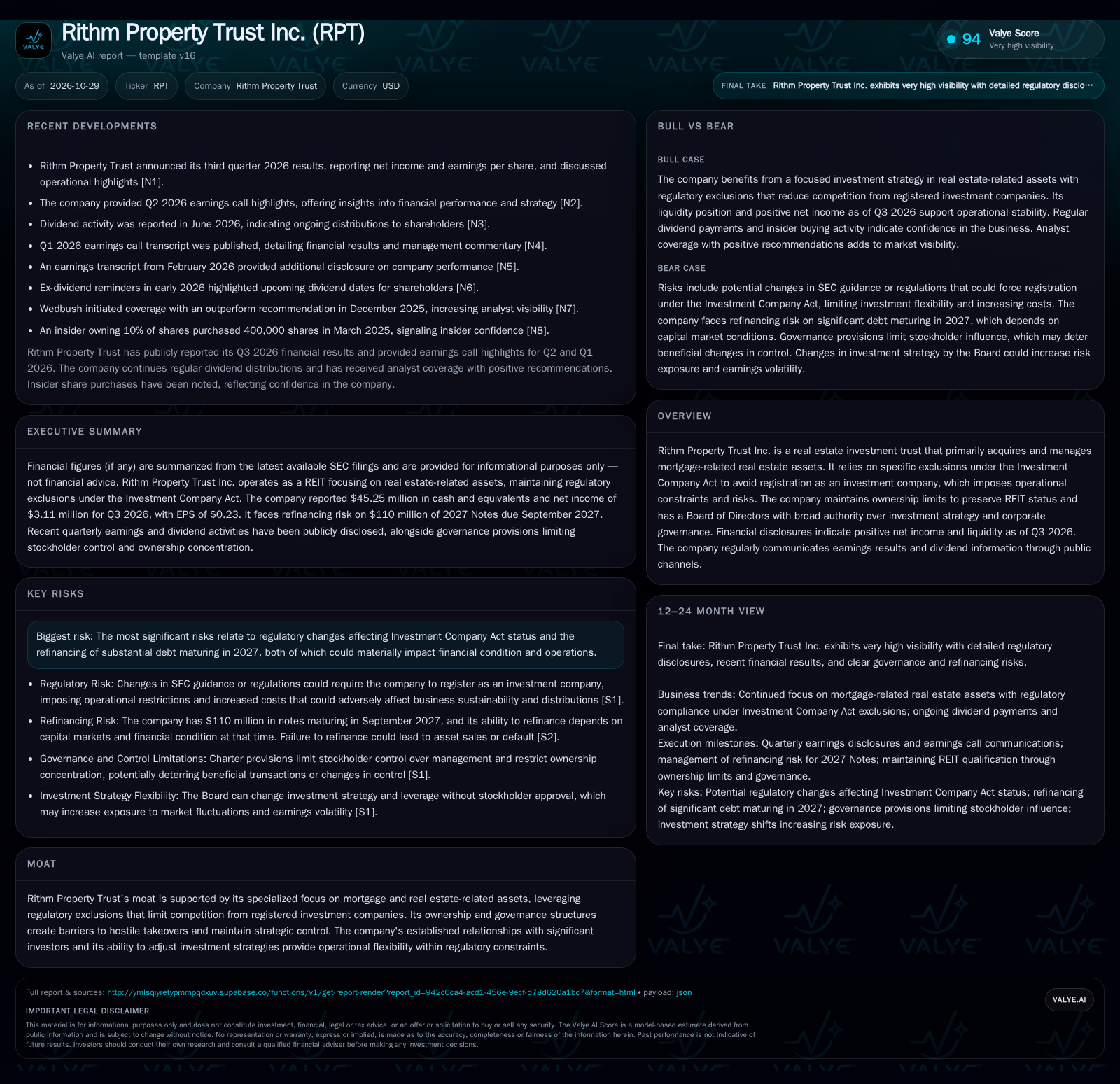
Rithm Property Trust reported Q3 2026 net income of $3.11 million and holds $45.25 million in cash, but faces a $110 million debt maturity in September 2027 and ongoing regulatory risks. Its REIT status and operational flexibility rely on maintaining Investment Company Act exclusions and prudent governance. The company’s performance will depend on capital market access, regulatory stability, and its ability to manage asset mix and leverage.
Rithm Property Trust Inc. sits at a critical intersection of real estate investment strategy, regulatory navigation, and capital market dependency. As a REIT specializing in mortgage-linked assets, Rithm’s business model is finely tuned to maintain exclusions from the Investment Company Act, which both empowers its unique portfolio construction and exposes it to regulatory risk. With a notable $110 million debt maturity looming in 2027 and a governance structure allowing rapid strategic pivots, the company’s next phase will be shaped by its ability to manage refinancing, regulatory scrutiny, and the inherent volatility of its asset base.
Recent Financials and Looming Debt Shape the Strategic Landscape
As of September 30, 2026, Rithm Property Trust reported net income of $3.11 million and basic and diluted EPS of $0.23 for the quarter, with cash and cash equivalents totaling $45.25 million [S2]. These results reflect continued operational profitability and liquidity, but the company’s capital structure is under pressure from $110 million in 2027 Notes maturing in September 2027. The ability to refinance this debt is explicitly tied to future capital market conditions and Rithm’s financial health at maturity [S2]. The cited source reports dividend-related activity; that disclosure alone does not establish dividend-policy continuity, management confidence, or a material constraint on capital flexibility. [N3]
How Rithm’s Asset Mix and Leverage Drive Earnings—and Risk
Rithm Property Trust’s economics are fundamentally shaped by its portfolio of mortgage-related assets, primarily commercial and residential mortgage loans, mortgage-backed securities, and property liens. Revenue is generated from interest income, loan repayments, and potentially property dispositions. The REIT structure mandates high payout ratios, so distributable cash flow closely tracks the net interest margin and credit performance of the underlying assets.
Fixed costs are largely comprised of management fees, servicing costs, and overhead, while variable costs are driven by asset acquisition, financing, and hedging activities. Operating leverage can be significant in positive credit and rate environments, as interest income scales faster than administrative expenses. However, declining asset values or rising defaults can quickly erode profitability, with little buffer to absorb losses given the high distribution requirements.
The company’s capital needs are episodic—driven by asset purchases, refinancing, and margin requirements. The $110 million in notes due September 2027 represents a material funding event: successful refinancing would preserve asset base and earnings power, but unfavorable market conditions could force asset sales or higher-cost debt, compressing margins and distributions.
The sensitivity of Rithm's earnings to interest rate fluctuations is a critical dimension of its business economics. Given the mortgage-linked nature of its assets, rising interest rates could increase the cost of debt refinancing and reduce the market value of fixed-rate mortgage securities, compressing net interest margins. Conversely, in a declining rate environment, prepayment risk could accelerate loan repayments, potentially forcing reinvestment at lower yields. This dynamic underscores the importance of active asset-liability management and hedging strategies to mitigate interest rate risk. Additionally, credit risk management remains paramount; deterioration in borrower creditworthiness or macroeconomic downturns could elevate non-performing assets, directly impacting distributable cash flow and necessitating more conservative leverage use.
Regulatory Exclusions as a Differentiator—But Also a Double-Edged Sword
Rithm’s competitive positioning is built on its ability to operate as a REIT under specific exclusions from the Investment Company Act (Sections 3(c)(5)(C) and 3(c)(6)), allowing it to avoid the constraints faced by registered investment companies [S1]. This regulatory status enables portfolio flexibility and limits direct competition from certain institutional investors. However, this advantage is fragile: any change in SEC guidance or enforcement could force Rithm to alter its asset mix, reduce leverage, or register as an investment company—actions that would increase costs and restrict business model flexibility.
Peers include other mortgage REITs and specialty finance companies, with differentiation hinging on asset sourcing, risk management, and cost of capital. In addition, Rithm’s governance provisions—such as ownership limits and restricted stockholder rights—create barriers to hostile takeovers and may deter activist interventions, but could also stifle beneficial change if management underperforms.
Unlocking Value Through Stable Markets and Regulatory Continuity
The most favorable scenario for Rithm occurs if capital markets remain receptive as the 2027 debt maturity approaches, enabling refinancing on attractive terms and preserving the asset base.
Evidence supporting this scenario would include successful refinancing announcements, continued positive net income and distributable cash flow, and stable or rising dividends. Confirmation could also come from management commentary reaffirming regulatory compliance and asset mix, as well as sustained or increased analyst coverage with positive outlooks.
Managing Through Uncertainty: Balancing Refinancing and Regulatory Exposure
The most plausible outcome is a period of heightened vigilance as Rithm approaches its 2027 refinancing event and monitors regulatory developments. The company may secure refinancing, but potentially at higher rates or with tighter covenants, modestly reducing net interest margins and constraining distribution growth. Meanwhile, management will likely maintain a cautious asset allocation, balancing yield generation with the need to avoid tripping regulatory thresholds.
In this scenario, net income remains positive but may fluctuate with market volatility, and dividends are maintained but could show limited growth. Evidence would include incremental updates on refinancing progress, asset mix disclosures showing continued adherence to regulatory exclusions, and stable, if unspectacular, quarterly earnings. Watch for any signals of Board-directed shifts toward higher-risk investments, as this could foreshadow greater volatility.
Regulatory Shock or Failed Refinancing Could Trigger Forced Asset Sales
If regulatory interpretations shift, Rithm could be forced to register as an investment company or rapidly alter its asset base, potentially requiring large-scale asset sales at depressed prices. Alternatively, if capital markets tighten or the company’s credit profile deteriorates, it may be unable to refinance the $110 million in notes on acceptable terms, leading to distressed dispositions or even default.
This scenario would be confirmed by adverse regulatory announcements, management disclosures about asset sales or restructuring, sharp declines in distributable cash flow, dividend cuts or suspensions, and negative analyst revisions. A spike in non-performing assets or a pronounced drop in book value would further corroborate severe business stress.
Milestones That Will Define Rithm’s Ability to Sustain Its Business Model
Progress updates on refinancing or repayment plans for the $110 million in 2027 Notes—timing, terms, and market appetite will be decisive.
Quarterly disclosures of asset mix and compliance with Investment Company Act exclusions—any drift toward non-qualifying assets would be a warning sign.
Dividend announcements and payout ratios—declines or suspensions would indicate pressure on underlying cash flows.
Management guidance or commentary regarding regulatory risk, including any changes in SEC communication or enforcement actions.
Net interest margin and credit performance trends—a useful metric would be the proportion of non-performing assets if disclosed.
Board-authorized changes to investment strategy or leverage—look for signals of increased risk-taking or defensive repositioning.
Insider transaction activity was reported in the cited source; this activity does not by itself establish insider confidence.
Disclaimer: This is research-only, informational analysis and not investment advice. It may include AI-generated interpretation and general industry context. Always verify important details using primary sources.

Comments