
TriNet’s Regulatory Exposure and SMB Value Proposition: Navigating Compliance Complexity as a Durable PEO Advantage
TriNet’s Q3 2026 results confirm continued profitability and operational scale, but the company’s future resilience will be defined by its ability to manage regulatory volatility, defend its co-employment status, and maintain SMB client loyalty amid changing labor laws.
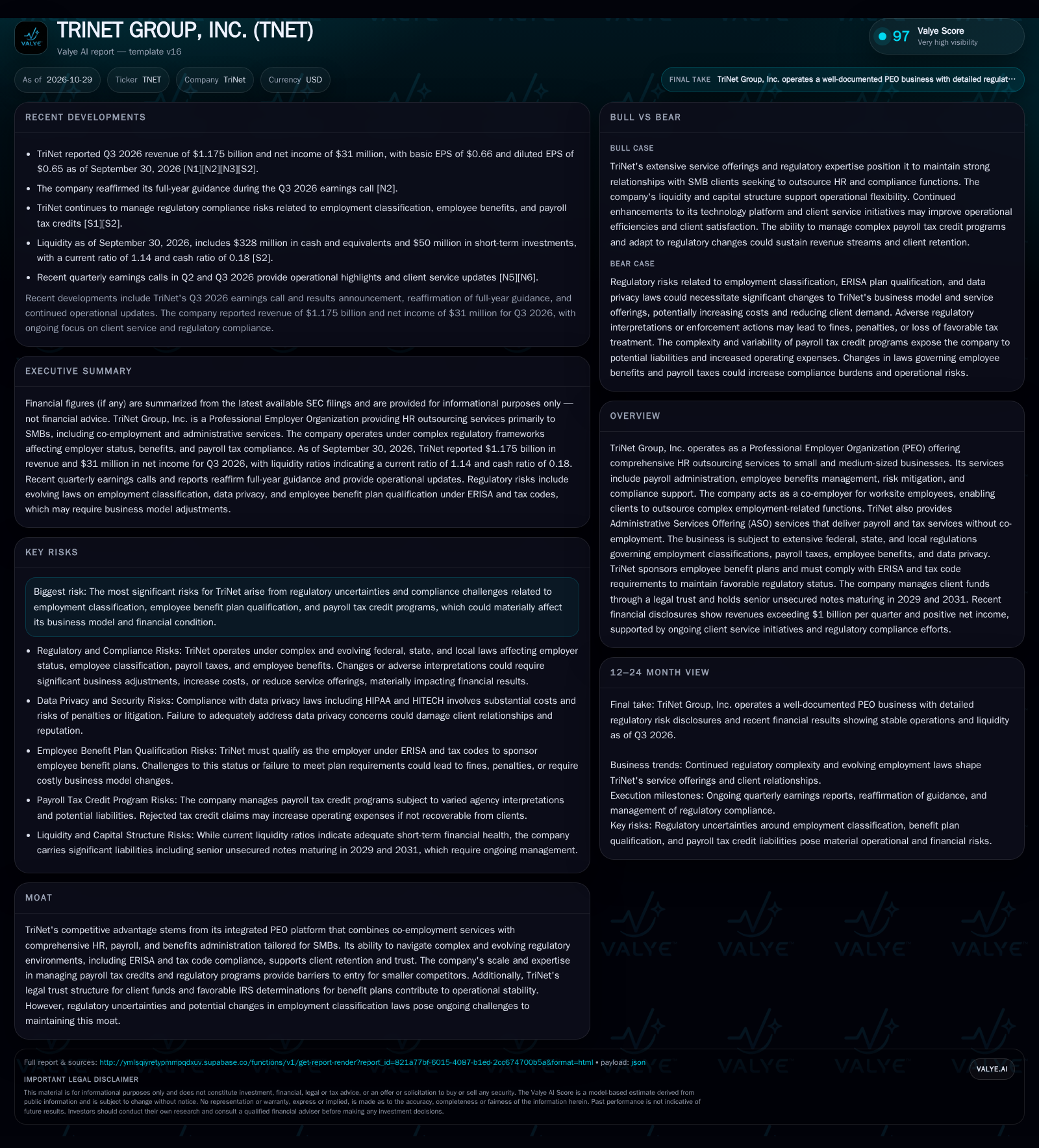
TriNet reported Q3 2026 revenue of $1.175 billion and net income of $31 million, reaffirming full-year guidance. The company’s PEO model—anchored in co-employment and comprehensive HR outsourcing for SMBs—faces material regulatory risks, especially around employment classification and benefit plan qualification. Sustained client retention and ongoing adaptation to evolving compliance requirements will determine whether TriNet’s scale and expertise remain a competitive moat or become a liability if the regulatory environment turns adverse. [N1] [N2] [S2]
TriNet Group, Inc.’s latest quarterly results illustrate a well-established PEO model with robust revenue and ongoing profitability, serving SMBs that outsource HR complexity. Yet, beneath these solid financials lies a structural tension: the company’s very business model depends on regulatory interpretations that could shift with changes in labor law, tax codes, or benefits regulation. TriNet’s future growth and margin profile will be shaped not just by operational execution, but by its ability to anticipate, adapt to, and, where possible, shape the evolving compliance landscape—a challenge that is both its moat and its Achilles’ heel.
Recent Performance and Regulatory Exposure: The Dual Lens on TriNet’s Q3 2026
TriNet reported Q3 2026 revenue of $1.175 billion and net income of $31 million, translating to basic EPS of $0.66 and diluted EPS of $0.65. The company reaffirmed its full-year guidance during the earnings call, signaling operational stability and confidence in its near-term outlook [N1] [N2] [S2]. [S2]
The business remains deeply intertwined with regulatory compliance: TriNet’s co-employment model requires favorable interpretations under ERISA and the Internal Revenue Code to sponsor tax-advantaged benefit plans, while also exposing the company to risks from changing federal, state, and local laws affecting employment classification, payroll taxes, and employee benefits [S1] [S2]. These current facts underscore a core tension: TriNet’s operational and financial success is inseparable from its ability to navigate, and potentially influence, a shifting regulatory landscape.
How TriNet Earns: Revenue Drivers, Cost Structure, and the Leverage of Scale
TriNet’s core economics are built on providing bundled HR outsourcing services to SMBs, with revenue typically derived from a combination of service fees (per worksite employee or per client), administrative fees, and, where applicable, a markup or margin on employee benefits and insurance products. The company’s PEO model leverages co-employment, allowing TriNet to aggregate employees across its client base to negotiate better rates on benefits and insurance, spreading fixed compliance, technology, and administrative costs over a larger volume of worksite employees.
Variable costs are heavily influenced by benefit plan expenses, insurance premiums, and regulatory compliance costs, while fixed costs center on platform development, regulatory/legal infrastructure, and client service. Operating leverage is achieved as incremental clients and worksite employees can be added at relatively low marginal cost, provided the regulatory model remains intact. However, the company’s exposure to payroll tax credits and regulatory programs introduces potential volatility: rejected or delayed tax credit claims can directly increase expenses or create client disputes, while adverse changes in benefit plan qualification could significantly impact margin structure and client pricing.
TriNet’s capital needs are moderate under steady-state growth, focused on technology investment and compliance infrastructure, but could escalate rapidly if regulatory changes require business model adaptation, legal defense, or requalification of benefit plans.
Defensible Scale or Regulatory Drag? TriNet’s Position Among HR Outsourcing Providers
TriNet’s competitive positioning is rooted in its integrated PEO platform, regulatory expertise, and ability to deliver comprehensive HR, payroll, and benefits administration to SMB clients—segments often lacking the in-house capacity to manage complex compliance requirements. The co-employment model, if regulatory interpretations remain favorable, creates switching frictions: client SMBs benefit from pooled risk and scale in benefits purchasing, and the administrative burden of transitioning to another provider or in-sourcing HR is significant.
However, competitive counterforces are real. Other large PEOs and ASO providers, as well as SaaS-based HR platforms and niche benefit administrators, offer alternative models—some with less regulatory complexity or different risk allocations. Technology-driven disruptors may undercut on price or offer more modular, self-service solutions. Crucially, any regulatory shift that narrows the co-employment advantage or increases compliance burdens could erode TriNet’s differentiation, leaving it competing more on price and service rather than on regulatory scale and expertise.
TriNet’s trust structure for client funds and proven ability to maintain IRS-qualified benefit plans are operational strengths, but these could become liabilities if regulatory or legal interpretations change.
When Regulatory Mastery Becomes a Moat: Pathways to Margin Expansion and Client Growth
In a favorable scenario, TriNet’s ongoing investments in compliance infrastructure, technology, and client service allow it to adapt quickly to regulatory changes, preserving its ability to sponsor tax-advantaged benefit plans and manage payroll tax credits efficiently. This would reinforce client retention, as SMBs facing increasing compliance complexity would be more likely to outsource to an established provider rather than risk in-house errors or penalties.
TriNet could also benefit from increased demand for outsourced HR solutions as employment laws and benefit regulations grow more complex, expanding its client base and worksite employee count. Operating leverage would improve as higher volumes spread fixed costs, and a stable regulatory environment would allow TriNet to negotiate better terms on benefits and insurance, boosting margins.
Evidence confirming this scenario would include sustained client growth, rising worksite employee counts, stable or expanding gross margins, and continued receipt of favorable IRS or regulatory determinations regarding benefit plan status. Regulatory developments that affirm or clarify the PEO/co-employment model would be particularly supportive.
Sustaining the Status Quo: Incremental Growth Amid Regulatory Vigilance
The most plausible path for TriNet is continued incremental growth in revenue and worksite employees, supported by ongoing demand for HR outsourcing among SMBs and gradual improvements in client service and technology. Margins remain stable, with operating leverage offset by periodic increases in compliance and legal costs as regulations evolve.
TriNet’s financial profile stays healthy, but not dramatically improved: modest revenue growth, steady profitability, and manageable capital needs. The company must continuously monitor and adapt to regulatory changes, absorbing some cost increases but not facing existential threats. Client retention remains high, but pricing power is limited by both competition and client sensitivity to fees.
Evidence for this scenario would be stable or slightly growing revenue and net income in subsequent quarters, continued reaffirmation of guidance, and no material negative regulatory or legal developments. Confirmation would also come from ongoing favorable IRS determinations and the absence of significant client churn or adverse headlines about regulatory noncompliance.
If Regulatory Headwinds Intensify: Margin Erosion, Client Attrition, and Business Model Stress
A more adverse scenario for TriNet would be triggered by unfavorable regulatory changes—such as stricter definitions of co-employment, new requirements for benefit plan qualification, or adverse tax rulings on payroll tax credits. These could force TriNet to alter its business model, reduce the scope of services, or absorb higher compliance and legal costs, compressing margins and potentially leading to client attrition.
If TriNet loses its ability to sponsor tax-advantaged benefit plans or faces significant penalties or liabilities from rejected payroll tax credits, its PEO value proposition could be materially weakened. Clients might reconsider outsourcing HR, switch to alternative providers, or demand price concessions. The company’s trust structure for client funds could also come under scrutiny, increasing reputational or operational risk.
Confirmation of this scenario would include regulatory actions challenging TriNet’s employer status, adverse IRS or DOL determinations, material increases in legal or compliance expenses, declining gross margins, or negative client growth. Significant changes to full-year guidance or restatements of prior results due to regulatory issues would be further evidence.
Milestones That Will Shape TriNet’s Resilience and Long-Term Value
Quarterly trends in worksite employee (WSE) counts and client retention rates—if disclosed—would clarify whether TriNet’s core business is expanding or facing competitive/regulatory pressure.
Gross margin evolution: sustained or improving margins would signal pricing power and operating leverage; compression may indicate rising compliance or benefit costs.
Updates on IRS or regulatory determinations regarding TriNet’s status as employer for benefit plan purposes—any adverse developments would be thesis-critical.
Material changes in the cost or recoverability of payroll tax credits, or disclosures of unrecoverable tax credit expenses, could signal rising regulatory risk.
Evidence of client churn or pricing concessions in response to regulatory changes or competitive dynamics—disclosures in earnings calls or filings would be telling.
Legal or regulatory proceedings related to co-employment, ERISA, or benefit plan qualification—new cases or adverse outcomes would directly test the business model.
Technology investment and platform enhancement updates: progress here could improve efficiency and client stickiness, while delays or underinvestment may erode competitiveness.
Any restatement of financials, changes to guidance, or sudden increases in legal/compliance expenses should be scrutinized for underlying regulatory or operational stress.
Disclaimer: This is research-only, informational analysis and not investment advice. It may include AI-generated interpretation and general industry context. Always verify important details using primary sources.

Comments