
AllianceBernstein at a Crossroad: Leadership Shift, Fee Stability, and Managing AUM Fluctuations
AllianceBernstein enters a pivotal period with a new CEO at the helm, fee-driven revenue streams anchored by a vast client base, and a recent net income dip that raises questions about operational flexibility and market sensitivity.
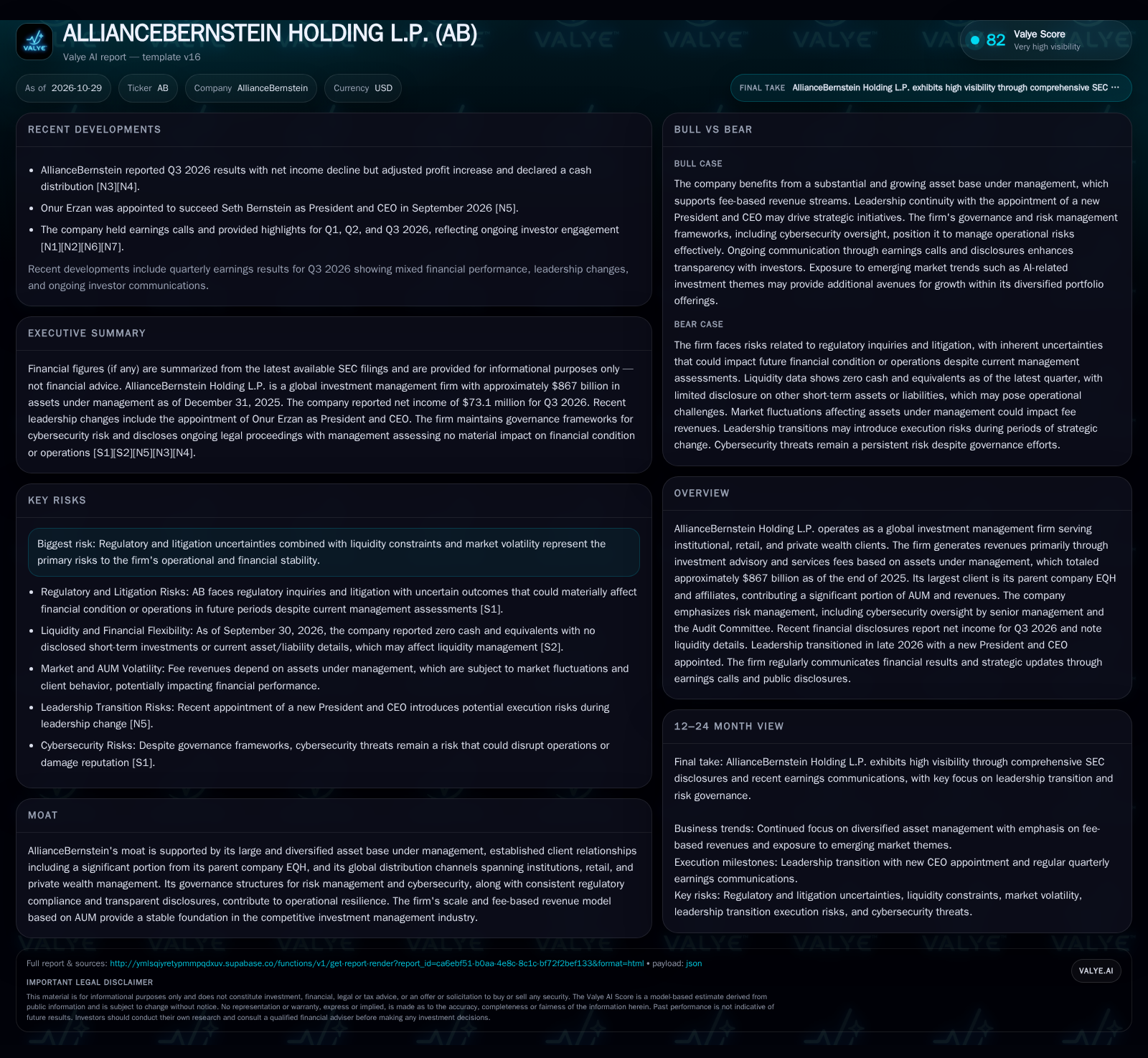
AllianceBernstein reported Q3 2026 net income of $73.1 million, with adjusted profits up but headline earnings down, reflecting margin pressures against a backdrop of $867 billion AUM. The appointment of Onur Erzan as CEO marks a leadership inflection point, while liquidity disclosures (zero cash/equivalents) introduce operational watchpoints. The firm’s high dependence on fee income from AUM—including a major client relationship with EQH—makes it sensitive to market swings and client flows, even as it seeks to capitalize on emerging investment themes.
AllianceBernstein Holding L.P. occupies a unique position in the global investment management landscape, balancing the stability of a massive asset base with the inherent volatility of market-driven revenues. The firm’s Q3 2026 results highlighted a dip in net income, even as adjusted profits improved, underscoring cost and margin dynamics at play. As the industry faces waves of regulatory, technological, and client-driven change, AllianceBernstein’s next moves will be critical to maintaining its fee-driven business model and competitive standing.
Recent Performance, Leadership Update, and Liquidity Insights Defining AB’s Current Landscape
AllianceBernstein reported net income of $73.1 million for Q3 2026, reflecting a decline in headline profits but an increase in adjusted profit—a signal that underlying operations may be more resilient than surface figures suggest [S2] [N3] [N4]. This earnings pattern points to margin pressures or non-recurring items influencing results. The firm’s AUM stood at approximately $867 billion as of December 31, 2025, anchoring its fee-driven revenue streams but also exposing it to market-driven volatility [S1]. Notably, EQH and its subsidiaries remain the largest client, representing about 16% of AUM and 4% of net revenues—a concentration that introduces client risk and potential revenue sensitivity to EQH’s asset allocation decisions [S1]. The September 2026 appointment of Onur Erzan as President and CEO marks a significant leadership transition, raising execution questions for the firm’s next strategic phase [N5]. Finally, the latest liquidity snapshot disclosed zero cash and equivalents as of September 30, 2026, with no additional short-term asset/liability data available, raising operational watchpoints regarding working capital management and day-to-day flexibility [S2].
The Impact of Fee Models and Asset Flows on AllianceBernstein’s Revenue Profile
AllianceBernstein’s core economics are built on investment advisory and service fees calculated as a percentage of AUM, with some performance-based fee components [S1]. This model provides scale benefits: higher AUM directly translates to higher gross revenue, while fixed operational costs can create operating leverage in periods of AUM expansion. However, the cost base—comprising compensation, technology, regulatory, and distribution expenses—can be sticky, particularly in a competitive talent market and with increasing compliance and cybersecurity requirements.
The firm’s client mix spans institutional, retail, and private wealth channels, each with distinct fee sensitivities and retention profiles. Institutional clients, especially EQH and its affiliates, may negotiate lower fees due to scale, and their allocation decisions can disproportionately affect revenue. Retail and private wealth segments potentially offer higher average fees and stickier assets but are more exposed to market sentiment and asset flows.
In recent years, the industry has faced fee compression, particularly for passive and index-linked products. AllianceBernstein’s ability to maintain or grow margins depends on product mix (active vs. passive, alternatives vs. traditional), ability to attract net inflows, and cost discipline. The absence of cash and equivalents in the latest disclosure could indicate aggressive capital deployment, working capital timing, or a need to draw on credit lines—factors that may increase operational risk if not carefully managed [S2].
AllianceBernstein’s Position in Global Asset Management and the Changing Moat Landscape
AllianceBernstein’s competitive position is anchored by its large and diversified AUM base, multi-channel distribution (institutional, retail, private wealth), and deep relationships with clients such as EQH [S1]. This provides some scale advantage, particularly in fixed income and multi-asset strategies, but competitors in the global asset management sector—including both traditional asset managers and newer entrants leveraging fintech, passive, and alternative strategies—are exerting pressure on fees, innovation, and client service.
The firm’s governance structures, notably around risk and cybersecurity, are robust relative to industry norms, potentially reducing operational and reputational risk [S1]. However, the industry’s low switching frictions for institutional clients and the commoditization of many investment products limit sustainable pricing power. The trend toward direct indexing, ETFs, and AI/quant-driven strategies could further erode traditional active management margins unless AllianceBernstein can differentiate through performance, service, or novel offerings.
The concentration of AUM from EQH, while providing stability, also heightens key client risk: a single asset reallocation or mandate loss could materially impact revenues. Maintaining a competitive edge may depend on expanding higher-fee strategies, deepening client relationships, and investing in technology to enhance both operational efficiency and client outcomes.
Conditions for AB to Surpass Expectations: Margin Growth, Net Asset Inflows, and Leadership Strategy
A favorable scenario for AllianceBernstein would see the new CEO, Onur Erzan, successfully executing strategic initiatives that drive net asset inflows, particularly into higher-fee and differentiated strategies such as alternatives, ESG, or AI-driven products. If the firm can capture a greater share of wallet from existing clients while attracting new mandates—especially in the institutional and private wealth channels—revenue growth could outpace industry averages.
Operating leverage would be realized if AUM rises faster than expenses, particularly if cost control initiatives or technology investments improve efficiency. Margin expansion, evidenced by sustained or rising adjusted profit margins, would confirm this scenario. Strategic clarity from leadership, successful integration of new investment themes, and positive net inflows (if disclosed) would be key confirming evidence.
Falsification would occur if reported flows remain negative, margins contract despite AUM growth, or key client relationships (such as EQH) are lost or materially downsized.
Stable Outcomes Shaped by AUM Variability Amid Fee Challenges and Leadership Transition
The most plausible trajectory is that AllianceBernstein maintains a stable AUM base with periodic fluctuations reflecting broader market conditions. Fee compression and competitive pressures may continue, offset by incremental product innovation and modest net inflows. The leadership transition to Onur Erzan is managed smoothly, with no immediate disruption to client relationships or operational stability.
Earnings and adjusted profits may remain volatile quarter-to-quarter, driven by market-driven AUM swings and the timing of performance fees. Margins are likely to be steady but under pressure, particularly if cost growth matches or exceeds revenue gains. Confirmation of this scenario would include stable or gradually shifting AUM, continued quarterly distributions, and neutral to slightly positive net flows (if disclosed), with no major regulatory or operational disruptions.
Downside Risks: Client Attrition, Asset Declines, and Liquidity Pressures Intensifying Challenges
A negative scenario emerges if equity and fixed income markets decline, driving AUM down and compressing fee revenues. If EQH or other large clients reallocate assets away from AllianceBernstein, the revenue impact could be disproportionate given client concentration [S1]. Further, if the firm is unable to offset outflows with new client wins or product launches, net asset outflows could become persistent.
Compounding these challenges, the latest disclosure of zero cash and equivalents [S2] raises concerns: if operational cash needs are not met through other sources, the firm could face liquidity constraints, potentially forcing asset sales or curtailing investments in technology, talent, or compliance. Any adverse regulatory or legal outcome—while currently assessed as unlikely to be material—could further erode potential financial flexibility.
Evidence supporting this scenario would include sustained net outflows, margin contraction, loss of key mandates (especially EQH), and disclosures of working capital or liquidity stress.
Factors That Could Challenge AllianceBernstein’s Strategic Assumptions in a Shifting Market
Quarterly net inflows or outflows by channel and product type (if disclosed) would provide direct evidence of client confidence and growth momentum.
Gross and adjusted profit margin trends—especially in the wake of the leadership transition—will signal the effectiveness of cost management and operational leverage.
Any updates on the status, size, or diversification of the EQH relationship would help gauge client concentration risk and revenue stability.
Liquidity disclosures in future filings (cash, equivalents, credit facilities, working capital) will be crucial for assessing operational flexibility.
Product mix evolution—such as the proportion of AUM in higher-fee, differentiated strategies versus commoditized products—would help test the margin resilience thesis.
Regulatory or litigation disclosures that move from “not material” to “potentially material” would shift the risk calculus.
Cybersecurity incident disclosures or operational disruptions, given the firm’s stated governance focus, could become value-relevant events.
Leadership commentary and execution milestones under Onur Erzan, particularly around strategic pivots or cost initiatives, will be important signals.
Disclaimer: This is research-only, informational analysis and not investment advice. It may include AI-generated interpretation and general industry context. Always verify important details using primary sources.

Comments