
Alphatec Holdings: Scaling Clinical Innovation in Spine Surgery Amid Cost and Execution Pressures
Alphatec Holdings has fueled robust revenue growth by expanding its surgeon base and product portfolio, but recent financial performance and rising operating costs highlight the challenge of sustaining momentum in a capital-intensive, litigation-prone sector. The company’s next phase hinges on leveraging its InformatiX platform to deepen clinical differentiation while managing litigation, capital structure, and operational complexity.
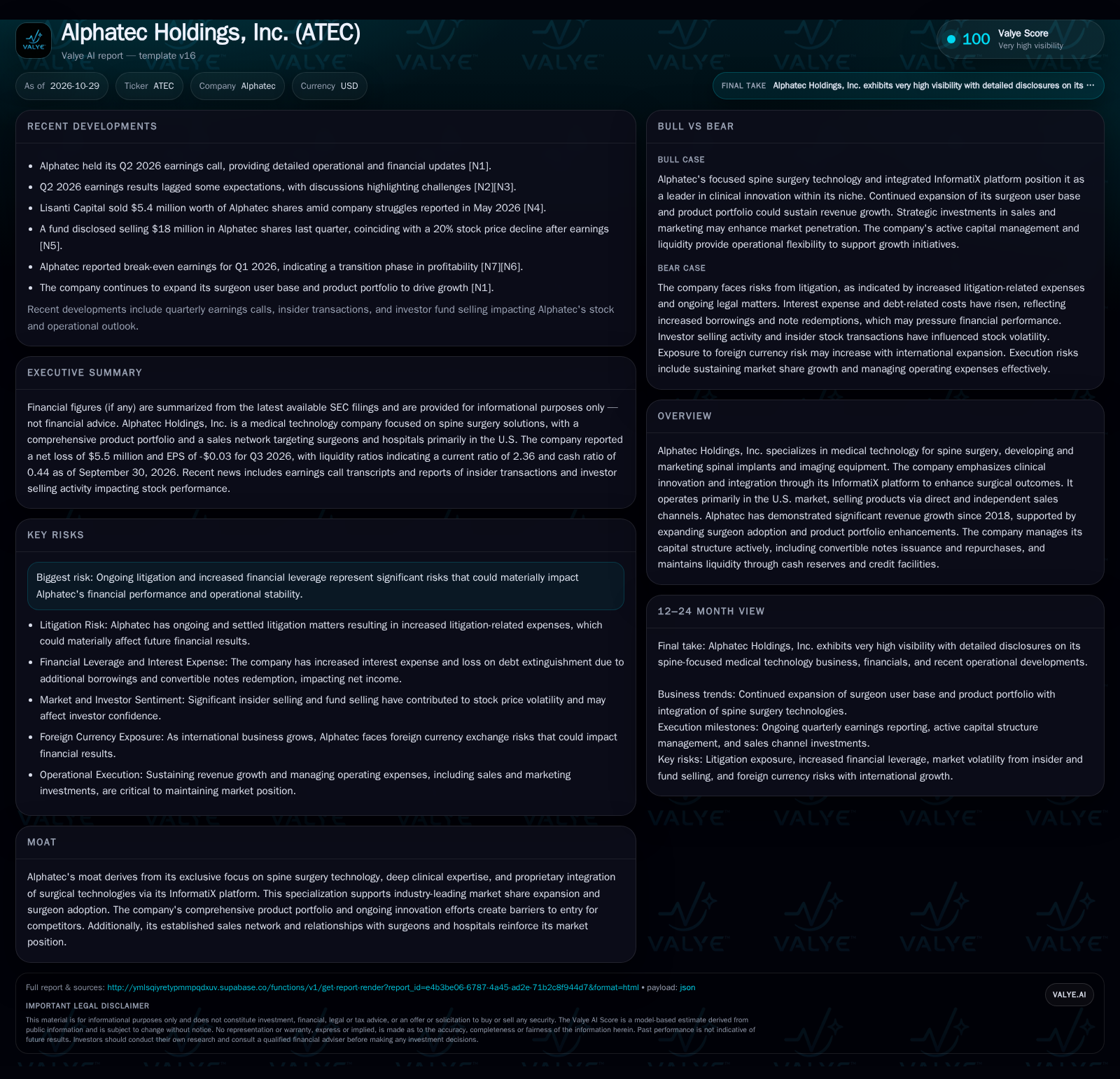
Alphatec Holdings, a spine-focused medical technology company, has achieved significant compound annual revenue growth since 2018 by expanding its surgeon user base and product lineup. Recent financials show a modest net loss for Q3 2026, and a convertible note issuance has increased leverage. The company is investing in sales and marketing while litigation and higher interest costs weigh on results. Sustaining growth will depend on continued portfolio innovation, efficient capital deployment, and navigating industry execution risks. [S2] [N1] [N2] [N3]
Alphatec Holdings has established itself as a high-growth player in the spine surgery technology market, leveraging a specialized product portfolio and direct surgeon engagement. Yet, the company’s journey from rapid expansion to sustainable profitability is complicated by a rising cost base, litigation challenges, and the realities of a capital-intensive business model. With a recent net loss and increased leverage following a major convertible note issuance, Alphatec must demonstrate that its investments in technology, sales, and surgeon relationships can drive operating leverage and defend its market position as competition and execution risks intensify. [S2] [N1] [N2]
Recent Financials Reflect Strategic Investment and Risk Exposure
Alphatec reported a net loss of $5.5 million and EPS of -$0.03 for Q3 2026, despite its track record of compound annual revenue growth since 2018. The company’s current ratio stood at 2.36 and cash ratio at 0.44 as of September 30, 2026, with $79.9 million in cash and cash equivalents. In March 2025, Alphatec issued $405 million in senior convertible notes due 2030 at a 0.75% interest rate, using proceeds for general corporate purposes and to repurchase prior notes. Operating expenses have risen, notably in sales, general and administrative (SG&A) and litigation-related areas, while research and development spending declined by 6% year-over-year in 2025. These facts underscore a tension between growth investment, rising leverage, and cost containment at a critical inflection point for the company. [S2]
How Alphatec’s Model Converts Technology and Relationships into Revenue
Alphatec’s commercial engine is built on the development and sale of spinal surgery implants, imaging devices, and integrated surgical technologies—primarily to U.S. surgeons and hospitals through a mix of direct and independent sales channels. Revenue is typically driven by procedure volumes, new surgeon adoption, and the breadth of the product portfolio. The company’s InformatiX platform aims to create differentiation by integrating imaging, planning, and execution tools, potentially enabling premium pricing and higher surgeon loyalty if clinical outcomes improve. However, the capital intensity of R&D, as well as the need for continuous sales and marketing investment, leads to high fixed costs. As such, the path to profitability is highly sensitive to scale: incremental gross profit from new users and procedures must offset the persistent SG&A and litigation expense burden. The recent convertible note issuance adds interest expense, increasing the importance of generating operating leverage from revenue growth. If Alphatec can drive sustained adoption and improve utilization per surgeon, it could achieve higher gross margins and cash flow. Conversely, further increases in litigation or restructuring costs could erode any gains from top-line expansion.
Specialization, Integration, and Barriers in the Spine Surgery Ecosystem
Alphatec’s moat is grounded in its exclusive focus on spine surgery technology, deep clinical expertise, and integration across implants and digital platforms. This specialization enables it to address complex pathologies and build strong relationships with a targeted surgeon base. The proprietary InformatiX platform, if widely adopted, could reinforce switching costs by embedding Alphatec’s ecosystem into surgical workflows. However, the market is crowded with well-capitalized orthopedic device companies and emerging digital health entrants. Large incumbents possess scale, distribution, and established clinical relationships, while new competitors may offer disruptive technologies or pricing models. The risk of technology substitution remains, especially if alternative minimally invasive or non-surgical treatments gain reimbursement traction. Additionally, hospitals and surgery centers are increasingly cost-sensitive, potentially pressuring pricing or shifting preference toward bundled or value-based procurement. Alphatec’s future advantage will depend on sustaining clinical innovation, expanding its portfolio, and demonstrating superior outcomes that justify premium positioning.
If Clinical Distinction Drives Market Share and Operating Leverage
In a favorable scenario, Alphatec’s continued investment in technology and sales enables it to further penetrate the U.S. spine surgery market, expanding its surgeon user base and increasing procedure volumes per account. Successful integration of the InformatiX platform could drive higher surgeon retention, premium pricing, and cross-selling of implants and imaging devices. If litigation costs stabilize and SG&A growth moderates, operating leverage could emerge, turning revenue growth into margin expansion and positive cash flow. Evidence that would confirm this scenario includes sustained double-digit revenue growth, declining SG&A as a percentage of revenue, reduced litigation expenses, and increased gross margins. Early signs of improved procedure outcomes, expanded hospital contracts, or positive clinical trial data supporting the efficacy of Alphatec’s integrated approach would further validate the upside case.
Growth Continues, But Execution and Cost Pressures Temper Profit Trajectory
The most plausible outcome is that Alphatec maintains above-market growth through portfolio expansion and surgeon recruitment, but faces ongoing margin pressure due to elevated SG&A, litigation, and interest expense. The company may achieve periodic break-even or modest profitability, but high fixed costs and the need for continued investment in innovation and sales infrastructure limit significant margin expansion in the near term. Evidence supporting this scenario would be continued growth in revenue and surgeon users, but with SG&A and litigation expenses remaining a material drag on operating income. Confirmation would come from quarterly reports showing incremental operating margin improvement, but not a step-change, and ongoing capital structure management to support growth initiatives. The scenario would be falsified if the company either rapidly accelerates margin expansion or suffers a sharp revenue or user contraction.
Litigation, Leverage, or Commercial Stalls Disrupt the Growth Thesis
In a negative scenario, Alphatec encounters either a major litigation setback, an inability to control rising operating expenses, or a slowdown in surgeon adoption. A significant legal loss or settlement could trigger unplanned cash outflows, erode capital reserves, and undermine investor confidence. Simultaneously, if new product launches fail to gain traction or competitors outpace Alphatec in innovation, revenue growth could stall. The increased interest burden from recent convertible notes would then amplify earnings volatility and constrain the company’s ability to invest further. Confirmation of this scenario would be a spike in litigation or restructuring costs, negative revenue or user growth, and possible downward revisions of guidance. Additional warning signs would include large-scale insider selling, loss of key sales agents, or hospital procurement shifts away from Alphatec’s portfolio.
Milestones and Metrics That Will Determine Alphatec’s Next Phase
Quarterly revenue growth rate, especially relative to spine surgery procedure volumes and market benchmarks, will indicate whether Alphatec is sustaining its share gains. [S2]
Gross margin trends and SG&A as a percentage of revenue should be monitored to assess operating leverage and efficiency improvements. [S2]
Surgeon user base expansion and average procedures per surgeon—if disclosed—would help test the effectiveness of sales and marketing investments.
Magnitude and frequency of litigation-related expenses, as further legal issues could materially impact profitability and cash flows. [S2]
Interest expense and net debt trajectory, to evaluate the company’s potential financial flexibility post-convertible note issuance. [S2]
Adoption rates and clinical outcome data for the InformatiX platform and new products, which would validate Alphatec’s differentiation claims.
Any material international revenue growth or currency-related disclosures, as foreign expansion could introduce new risks and opportunities. [S2]
Updates on restructuring or transaction-related expenses, which may signal either operational streamlining or ongoing disruption. [S2]
Disclaimer: This is research-only, informational analysis and not investment advice. It may include AI-generated interpretation and general industry context. Always verify important details using primary sources.

Comments