
W&T Offshore: Navigating Offshore Oil Economics in a Volatile Gulf Market
W&T Offshore’s operational scale and technical proficiency in the Gulf of America offer strategic advantages, but recent losses and persistent exposure to commodity price swings, regulatory scrutiny, and capital risks highlight the ongoing tension between cash flow ambitions and the realities of offshore energy production.
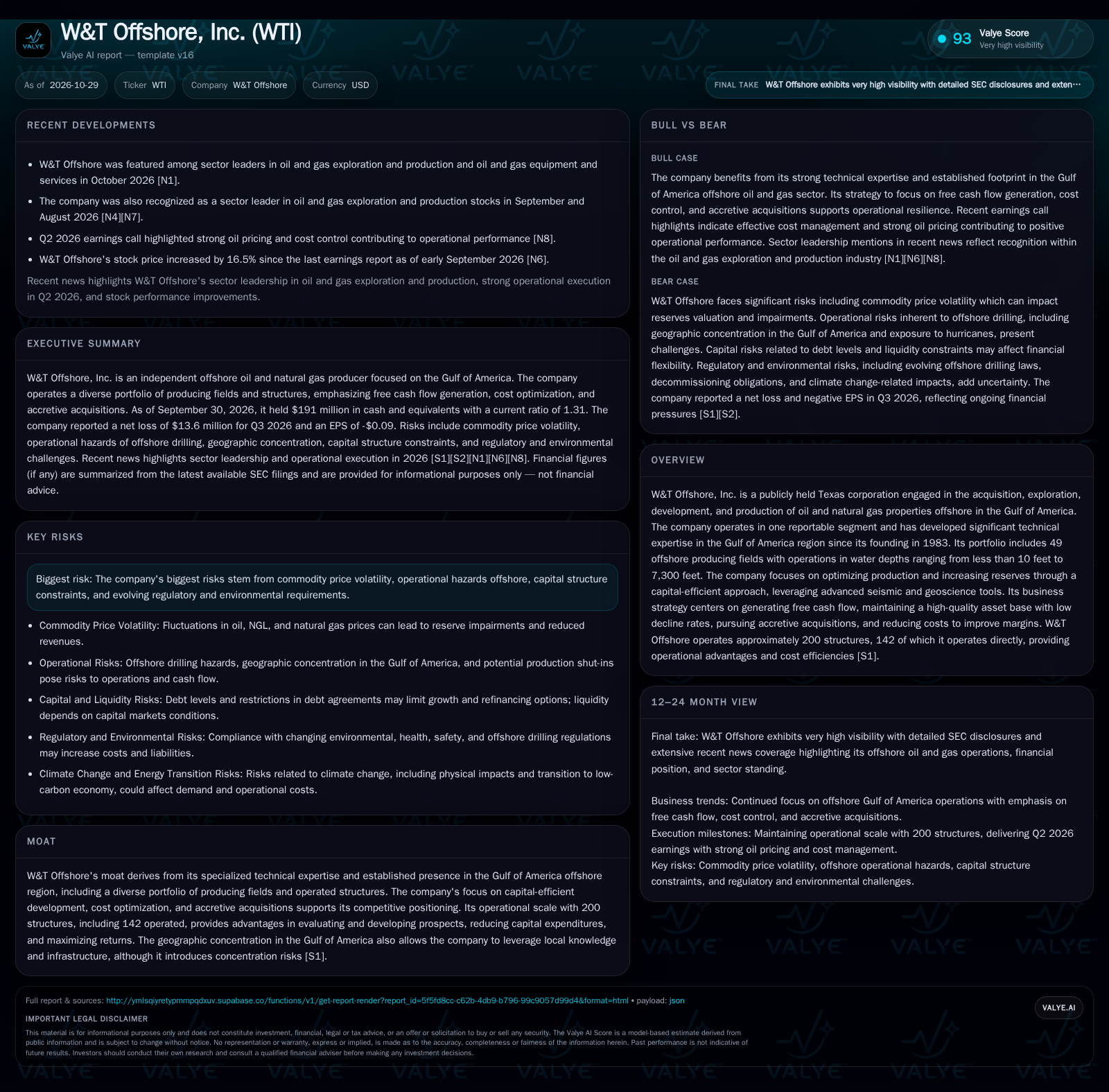
W&T Offshore operates 49 producing fields and 200 structures in the Gulf of America, leveraging technical expertise and cost controls to pursue free cash flow and accretive acquisitions. Despite a strong Q2 2026 operational performance and sector recognition, the company posted a Q3 2026 net loss and remains exposed to commodity volatility, regulatory hurdles, and capital pressures. The balance between asset quality, operational efficiency, and external risks will define its ability to deliver sustainable returns as energy markets evolve. [S1] [S2] [N6] [N8]
W&T Offshore stands as a technically proficient, asset-heavy independent oil and gas producer with deep roots in the Gulf of America. The company’s operational control over a large number of offshore structures positions it to extract value from both mature and exploratory projects, while its focus on cost optimization and free cash flow is tailored to the capital-intensive, volatile nature of offshore energy. However, a recent net loss underscores the persistent challenges of price swings, regulatory scrutiny, and capital constraints that shape the future of offshore producers. The coming quarters will test whether W&T’s scale and technical edge can consistently overcome these headwinds and deliver on its cash flow ambitions.
Recent Losses Offset Operational Gains: Where W&T Offshore Stands Now
As of September 30, 2026, W&T Offshore reported a cash balance of $191.3 million, current assets of $314.4 million, and current liabilities of $240.0 million, yielding a current ratio of 1.31 and a cash ratio of 0.8. Despite this liquidity snapshot, the company posted a net loss of $13.6 million in Q3 2026, with basic and diluted EPS of -$0.09. This loss followed a Q2 earnings period in which strong oil pricing and effective cost controls were highlighted as operational positives. Stock performance reflected some optimism, with shares gaining 16.5% post-earnings as of early September 2026. These facts illustrate a company with operational momentum but ongoing vulnerability to financial swings—particularly in the face of commodity price volatility and capital demands. [S2] [N6] [N8]
How Offshore Scale and Asset Mix Drive W&T’s Cash Flow Ambitions
W&T Offshore’s business model is built around acquiring, developing, and producing oil and natural gas assets in the Gulf of America, with a portfolio spanning conventional shelf, deep shelf, and deepwater fields. The company’s operational control over 142 of 200 structures allows for direct cost management and flexible capital allocation—key levers in a capital-intensive, high-fixed-cost environment. The economics of offshore production are characterized by high upfront investment, meaningful operating leverage, and relatively low variable costs once wells are productive.
By focusing on fields with low decline rates and leveraging advanced seismic and geoscience tools, W&T aims to maximize recovery and extend asset life, supporting its free cash flow generation mandate. However, these economics are highly sensitive to oil and gas prices; a sustained downturn can quickly erode margins and trigger impairments. The company’s strategy of pursuing accretive acquisitions is intended to bolster reserves and production without excessive exploration risk, but it also raises questions about integration costs, capital needs, and the sustainability of cash flow if commodity prices weaken or regulatory costs rise. [S1]
Technical Expertise Versus Scale: W&T’s Place in the Offshore Landscape
W&T Offshore’s competitive positioning stems from deep technical expertise and a long-established presence in the Gulf of America. Its ability to operate a large number of structures directly provides a local knowledge advantage, potentially enabling faster and more cost-effective project development compared to firms that rely on partnerships or third-party operators. This operational scale also supports lower per-unit development and operating costs, particularly in mature or low-decline fields.
However, W&T competes with both larger integrated oil companies and other independent producers, many of whom have greater financial resources, broader geographic footprints, or more diversified asset portfolios. The company’s geographic concentration exposes it to Gulf-specific risks—such as hurricanes and regulatory shifts—while the broader energy transition may drive capital and talent toward lower-carbon alternatives or onshore shale plays. The question is whether W&T’s local scale and technical edge can consistently offset these structural headwinds and preserve margin in a tightening regulatory and capital environment. [S1]
If Commodity Prices Remain Favorable and Cost Discipline Holds
The most constructive scenario for W&T Offshore involves sustained strength in oil and gas prices—supported by geopolitical constraints, OPEC discipline, or robust demand—combined with continued execution on cost control and production optimization. In this environment, the company’s low-decline, capital-efficient asset base would allow it to deliver outsized free cash flow relative to its scale. Accretive acquisitions could further expand reserves and production without materially increasing risk, especially if distressed assets become available from less-efficient operators.
Evidence that would confirm this scenario includes: a return to consistent profitability in upcoming quarters, rising operating cash flow, successful integration of new acquisitions, and stable or declining per-barrel production costs. Sector leadership mentions and positive market reactions, as seen after the Q2 2026 earnings report, would further support the bull case. [N6] [N8]
Balancing Cost Controls and Volatility in the Gulf
The most plausible trajectory for W&T Offshore is a continued focus on operational efficiency, cost management, and selective acquisitions, but with periodic setbacks tied to commodity price fluctuations or unforeseen operational events. The company’s technical expertise and portfolio of low-decline assets should provide some insulation against steep production drops, but quarterly results will likely remain volatile.
Confirmation of this scenario would come from a mix of modest positive and negative earnings quarters, stable cash balances, and incremental reserve additions from targeted acquisitions. Falsification would occur if the company consistently fails to generate free cash flow or if regulatory or environmental costs escalate faster than W&T can offset with operational improvements. [S1] [S2]
Commodity Shock or Regulatory Clampdown Could Erode Value Quickly
The adverse scenario centers on a significant drop in oil and gas prices, potentially triggered by recessionary demand destruction, accelerated energy transition policies, or a supply glut. In this context, W&T’s high fixed costs and geographic concentration would amplify downside risk, leading to cash flow deficits, possible reserve impairments, and pressure on liquidity. Additional regulatory tightening or environmental liabilities—such as decommissioning obligations or stricter offshore drilling laws—could further stress margins and capital resources.
This scenario would be confirmed by sustained negative net income, shrinking cash balances, asset impairments, or the need to raise dilutive capital. Early warning signs would include missed production targets, rising per-unit costs, or negative developments in Gulf regulatory policy. [S1] [S2]
Signals That Will Shape W&T Offshore’s Ability to Deliver Cash Flow and Growth
Consistent disclosure of realized oil and natural gas prices relative to benchmarks—would help assess pricing leverage and exposure.
Quarterly operating cash flow trends—rising or stable cash flow would support the free cash flow thesis; sustained deficits would undermine it.
Acquisition activity and integration outcomes—if disclosed; accretive deals and smooth integration would bolster the asset base.
Reserve replacement and production growth rates—sustained additions or stable production would indicate operational resilience.
Per-barrel production and operating cost trends—a useful metric would be declining or stable costs, indicating effective cost control.
Updates on regulatory or decommissioning obligations—new or escalating requirements could materially affect capital needs.
Changes in Gulf of America weather or regulatory risk environment—would influence operational continuity and cost structure.
Capital structure developments—such as new debt offerings, refinancing, or equity raises—would clarify the company’s potential financial flexibility and runway.
Disclaimer: This is research-only, informational analysis and not investment advice. It may include AI-generated interpretation and general industry context. Always verify important details using primary sources.

Comments