
Enerpac Tool Group: Industrial Tools Expansion, SFE Acquisition, and the Challenge of Diversified Growth
Enerpac Tool Group’s acquisition of SFE Group marks a strategic expansion into adjacent industrial equipment markets, but integration and end-market cyclicality pose meaningful execution challenges. With product sales outpacing service revenue and geographic diversity buffering localized shocks, the company’s next phase will hinge on realizing synergies, sustaining innovation, and managing raw material and geopolitical risks.
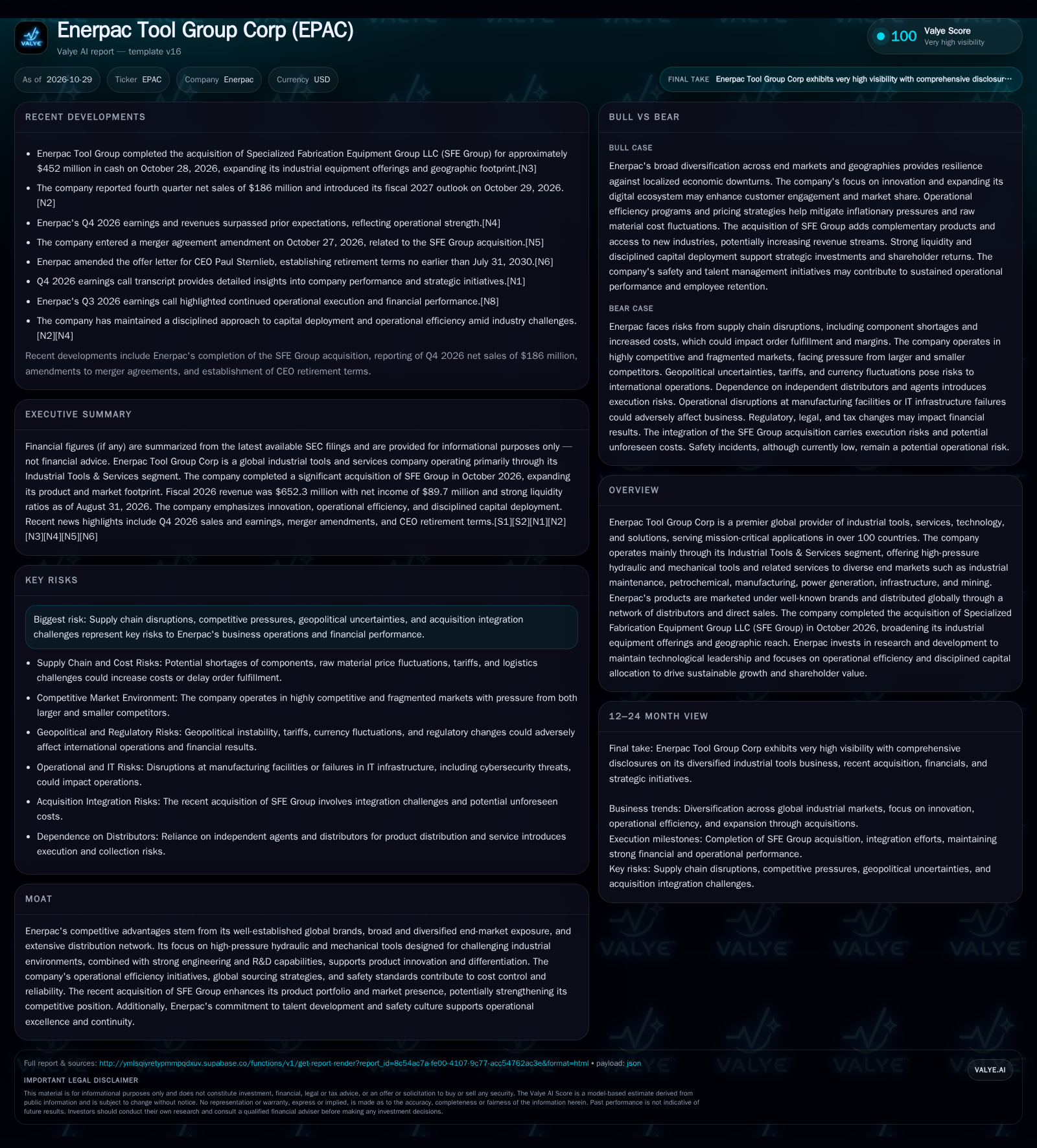
Enerpac Tool Group completed a $452M cash acquisition of SFE Group, expanding its industrial equipment portfolio and global footprint. Fiscal 2026 revenue reached $652.3M, with net income of $89.7M and a current ratio of 2.73. Product sales are driving organic growth, while service revenues have softened. Integration of SFE, managing raw material and supply chain volatility, and sustaining margin expansion will be central to the forward thesis. [S1] [N3]
Enerpac Tool Group’s recent $452 million acquisition of Specialized Fabrication Equipment Group (SFE Group) represents a significant expansion of its industrial tools platform, bringing new manufacturing capabilities and end-market exposure. While core product sales have shown organic growth, service revenues are under pressure, and the integration of SFE introduces both opportunity and risk. As Enerpac navigates raw material volatility, geopolitical uncertainty, and the operational complexity of a larger, more diversified business, its ability to drive synergies and maintain margin discipline will be key determinants of value creation over the next cycle. [S1] [N3]
Acquisition of SFE Group and Recent Financial Performance: What’s Changed
Enerpac Tool Group completed the acquisition of SFE Group on October 28, 2026, for approximately $452 million in cash plus restricted stock units, marking a substantial expansion into fabrication, welding, and specialized maintenance tools. SFE brings five manufacturing sites across the US, France, and the UK, and serves diverse sectors including aerospace, semiconductor, and data centers. This move extends Enerpac’s reach beyond its traditional high-pressure hydraulic and mechanical tools business, potentially accelerating growth and cross-selling opportunities. [N3]
For fiscal 2026, Enerpac reported revenue of $652.3 million and net income of $89.7 million, with a current ratio of 2.73 and cash and equivalents of $174.7 million as of August 31, 2026. Product sales, especially in the Americas and power generation, drove organic growth, while service revenue declined both in Q3 and over the nine-month period ending May 31, 2026. The company’s order backlog rose to $81 million from $54 million a year earlier, suggesting robust demand but also highlighting the importance of execution as the business scales. [S1] [S2]
How Enerpac Generates Cash: Product and Service Mix, Margin Mechanics, and Capital Allocation
Enerpac’s core economics revolve around the sale of branded, high-pressure hydraulic and mechanical tools, complemented by services such as tool rental, maintenance, and manpower. Historically, the company’s product sales have exhibited higher margins and greater scalability than its service operations, which are more labor-intensive and sensitive to end-market activity swings. In the most recent periods, organic product sales grew by 5–8% year-over-year, while organic service sales declined by 8–18% depending on the quarter, underscoring the volatility inherent in the service segment and the importance of product-driven growth. [S2]
The SFE acquisition increases Enerpac’s exposure to specialized fabrication and welding equipment, which may carry different margin profiles and working capital needs compared to traditional tools. Manufacturing is primarily light assembly, enabling relatively flexible cost structures, but global sourcing and tariffs introduce margin volatility. Enerpac’s capital allocation strategy emphasizes organic growth, margin expansion, and targeted M&A, with R&D spend at $15 million in fiscal 2026 supporting innovation. The company’s ability to realize cost and revenue synergies from SFE—while managing integration costs and potential duplications—will be a key determinant of future operating leverage.
Competitive Advantages and the Evolving Industrial Tools Landscape
Enerpac’s competitive position is underpinned by its portfolio of established brands, global distribution footprint, and breadth across end markets. The company’s focus on mission-critical, high-pressure tooling and its reputation for reliability and safety (as evidenced by a TCIR of 0.68, top quartile for machinery manufacturing) provide some insulation from low-cost entrants. However, the industrial tools market remains highly fragmented, with competition from both large diversified industrials and niche regional players.
The addition of SFE Group may enhance Enerpac’s differentiation by offering a wider suite of fabrication and welding solutions, potentially deepening relationships with customers in sectors where specialized equipment and service are valued. However, integration challenges, the need to harmonize go-to-market strategies, and the risk of customer overlap or brand dilution present real execution hurdles. Technology substitution—such as the shift toward more automated or digital solutions—could also challenge legacy product lines if Enerpac does not keep pace with innovation.
Synergy Realization and Product Innovation Drive Outperformance
If Enerpac successfully integrates SFE Group, captures meaningful revenue and cost synergies, and leverages its expanded product suite to win new contracts in high-growth verticals (e.g., semiconductor, data centers, and aerospace), the combined business could see both higher growth and margin expansion. Effective cross-selling, improved manufacturing efficiency, and further penetration of emerging markets could all contribute to above-trend performance. Sustained R&D investment and the rollout of digitally enabled or data-driven tool solutions may also unlock new recurring-revenue streams or enhance customer retention.
Evidence that would confirm this scenario includes an acceleration in consolidated revenue growth above historical mid-single-digit rates, visible margin expansion (particularly at the gross and operating levels), positive commentary on SFE integration progress, and rising order backlogs from new customer segments. A declining ratio of integration costs to realized synergies would further validate outperformance.
Scaling with Discipline: Steady Growth, Margin Management, and Integration Headwinds
The most plausible scenario is that Enerpac delivers moderate revenue growth driven by its diversified product base and global reach, offset by the drag from softer service revenues and the near-term costs of integrating SFE. The order backlog supports steady demand, and the company’s light-assembly manufacturing model provides some resilience to volume fluctuations. However, raw material price swings, tariffs, and currency volatility are likely to persist, requiring ongoing pricing and productivity actions to preserve margins.
Integration of SFE proceeds with manageable disruption, but revenue and cost synergies materialize gradually rather than immediately. The company maintains its focus on organic innovation and operational efficiency, but the pace of digital transformation and new product adoption is incremental. Confirmation would come from sustained mid-single-digit revenue growth, relatively stable operating margins, and neutral-to-positive updates on SFE integration and backlog trends.
Integration Complexity, Supply Chain Shocks, and Service Demand Slump
A negative scenario could unfold if SFE integration proves more complex or costly than anticipated—leading to operational disruption, customer attrition, or unexpected expenses. Simultaneously, renewed supply chain shocks (component shortages, freight disruptions), raw material inflation, or adverse tariff developments could compress margins and impair order fulfillment. A protracted downturn in key end markets—such as oil & gas, infrastructure, or manufacturing—would further pressure both product and service revenues.
This scenario would be confirmed by rising integration costs, slippage in synergy realization, margin contraction despite pricing actions, and declining order backlogs. Negative surprises in accounts receivable collections, higher-than-expected attrition among SFE employees, or unanticipated legal or regulatory exposures would also point to downside outcomes.
Testing the Enerpac Thesis: Integration, Margin, and End-Market Health
Progress on integration of SFE Group—measured by synergy capture, cost realization, and retention of key talent—would help test the thesis.
Trends in consolidated gross and operating margins, especially as SFE’s economics are absorbed, will indicate whether margin expansion is achievable.
Order backlog growth or contraction, and the composition of backlog by end market, will signal demand momentum and diversification benefits.
Organic growth rates for product versus service revenues would clarify the sustainability of the current product-led expansion.
Updates on raw material cost inflation, tariff impacts, and pricing actions would reveal the company’s ability to defend margins.
R&D pipeline developments and the adoption rate of digitally enabled or value-added tool solutions, if disclosed, would provide evidence of innovation traction.
Attrition or retention rates among SFE Group’s employees and major customers would indicate integration effectiveness.
A useful metric would be recurring revenue or contract renewal rates in newly acquired business lines, if disclosed.
Disclaimer: This is research-only, informational analysis and not investment advice. It may include AI-generated interpretation and general industry context. Always verify important details using primary sources.

Comments