
AGNC Investment Corp.: Managing Leverage and Rate Volatility to Preserve High-Yield Dividends
AGNC’s active management of its $97 billion Agency RMBS portfolio and sophisticated hedging strategies underpin its pursuit of high monthly dividends, but recent net losses highlight the acute sensitivity to interest rate shocks and leverage risks.
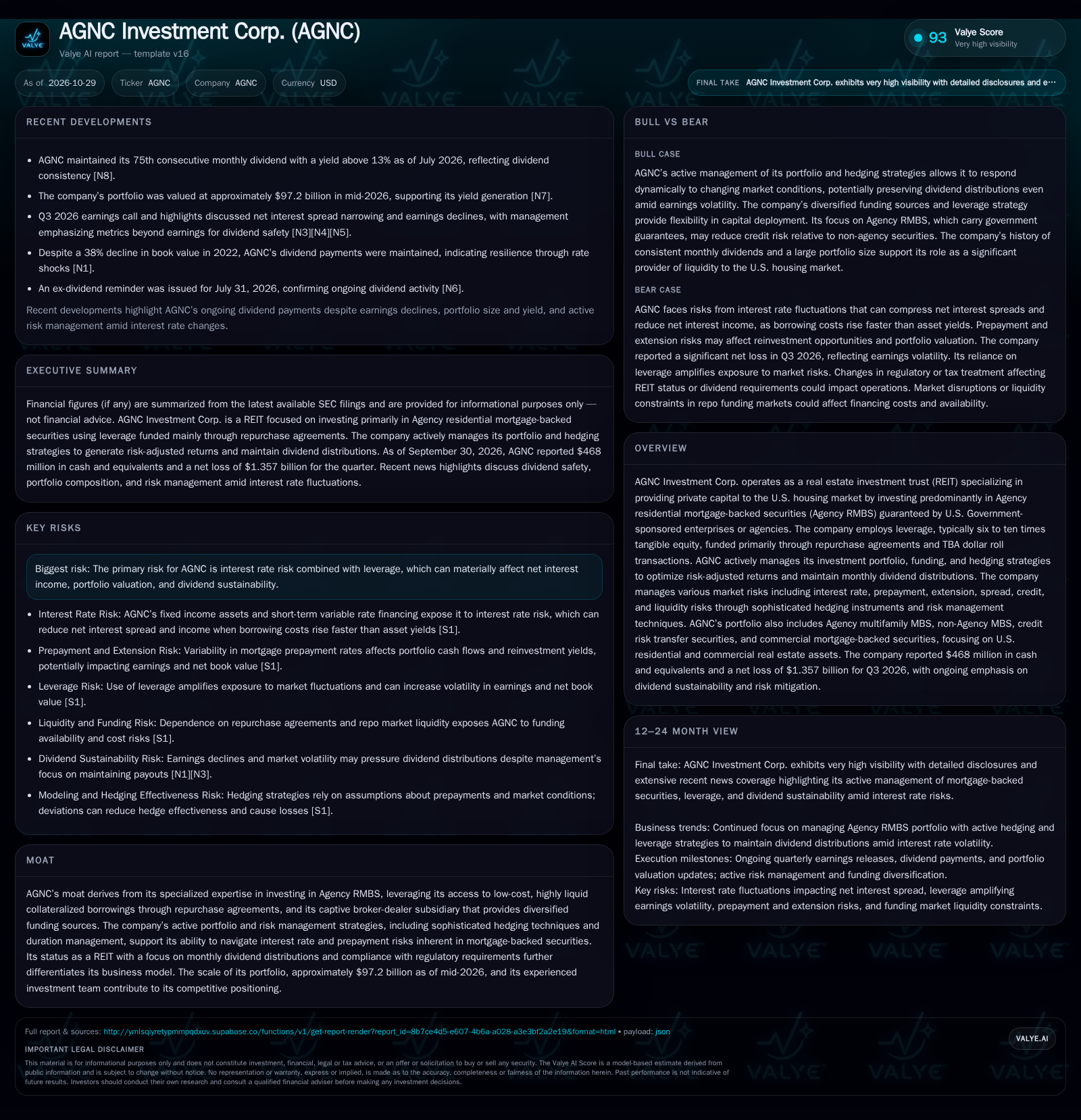
AGNC Investment Corp. remains one of the largest Agency RMBS-focused REITs, with a $97.2 billion portfolio and a 75-month streak of high-yield monthly dividends. The sustainability of AGNC’s dividend hinges on its ability to dynamically manage spreads, funding costs, and prepayment risks in a challenging macro environment.
AGNC Investment Corp. stands as a bellwether for the Agency mortgage REIT sector, balancing the pursuit of high-yield monthly dividends with the inherent volatility of leveraged fixed-income investing. Despite a $97.2 billion portfolio and a remarkable 75-month run of uninterrupted dividends, AGNC’s recent $1.357 billion quarterly net loss illustrates the acute challenges posed by interest rate swings and leverage.
Recent Performance Underscores Dividend Consistency Amid Volatility
AGNC reported a net loss of $1.357 billion for Q3 2026, with basic and diluted EPS of -$1.17, reflecting the volatility inherent in its leveraged Agency RMBS strategy [S2]. The company’s portfolio stood at approximately $97.2 billion in mid-2026, predominantly composed of Agency securities [N7]. Despite this earnings setback, AGNC has maintained a monthly dividend for 75 consecutive months, with yields exceeding 13% as of July 2026 [N8] [N6]. This record of dividend consistency, even through episodes of significant book value declines—such as a 38% drop in 2022—demonstrates the firm's commitment to income distribution, though it also raises the stakes for risk management in turbulent rate environments.
How AGNC’s Leverage and Funding Shape Income Generation
AGNC’s core business model centers on investing in Agency RMBS, which are backed by U.S. Government-sponsored entities, and funding these positions primarily through repurchase agreements (repo) and TBA dollar roll transactions [S1]. The company typically employs leverage of six to ten times tangible equity, magnifying both the net interest income generated from the spread between asset yields and funding costs, and the associated risks. The spread—net of hedging costs—serves as the primary driver of distributable income. Because Agency RMBS generally offer modest yields, leverage is essential to achieving target returns and sustaining high dividend payouts.
This approach introduces significant sensitivity to changes in short-term interest rates, repo funding costs, and the shape of the yield curve. When borrowing costs rise faster than the yields on the underlying RMBS, net interest spreads compress, potentially eroding income available for dividends. The company reported cash and liquidity metrics for the period; these figures do not by themselves establish operating runway, investment capacity, financial flexibility, or financing capacity. [S2]
The interplay between leverage and funding not only amplifies returns but also intensifies sensitivity to market dislocations. For instance, the reliance on short-term repo funding exposes AGNC to rollover risk, where sudden spikes in repo rates or reductions in available financing can force rapid deleveraging or asset sales at depressed prices. This dynamic creates a feedback loop: increased market stress can raise funding costs, compress net interest spreads, and impair the ability to maintain dividend levels.
Additionally, prepayment risk introduces complexity to the income profile, as accelerated mortgage prepayments can shorten the expected life of Agency RMBS, reducing interest income and forcing reinvestment at potentially lower yields. Conversely, extension risk—where prepayments slow unexpectedly—can expose the portfolio to duration mismatches if funding costs rise while asset yields remain fixed. AGNC’s hedging strategies aim to balance these opposing risks, but the effectiveness depends on accurate prepayment modeling and timely portfolio adjustments. A useful metric would be the correlation between prepayment speed assumptions and realized portfolio cash flows, which would help test the robustness of the firm’s risk management framework.
Scale, Funding Access, and Risk Management as Differentiators
AGNC’s competitive position is rooted in its scale, expertise in Agency RMBS, and access to diverse, low-cost funding. Its $97.2 billion portfolio places it among the largest players in the sector, enabling operational efficiencies and bargaining power with repo counterparties [N7]. The company’s captive broker-dealer subsidiary allows direct access to various repo markets, supporting funding flexibility and cost management [S1].
In a market where competitors include other Agency-focused mortgage REITs, large asset managers, and banks, AGNC’s emphasis on active risk management and sophisticated hedging is a critical differentiator. The use of interest rate swaps, swaptions, Treasury securities, and futures to manage duration and convexity risk, combined with dynamic portfolio rebalancing, seeks to counteract the adverse effects of rate shocks and prepayment variability. However, this sophistication does not immunize AGNC from sector-wide risks—especially when macro conditions drive rapid changes in funding costs or mortgage prepayment speeds. Alternative income vehicles, such as non-Agency MBS, credit risk transfer securities, and commercial mortgage-backed securities, offer some diversification but do not fully offset the core exposure to Agency RMBS dynamics.
If Interest Rate Stability Returns, Dividend Sustainability Could Strengthen
A favorable scenario for AGNC hinges on a period of relative interest rate stability or gradual declines in short-term rates, which would support wider net interest spreads and reduce funding pressure. In this environment, the company’s active hedging and portfolio management could allow it to capture higher yields on new RMBS investments while locking in lower funding costs. Reduced prepayment volatility would further enhance predictability of cash flows and portfolio valuations.
Conversely, if rate volatility persists or funding markets tighten, the upside scenario would be challenged.
In a stable or declining rate environment, AGNC’s ability to lock in favorable spreads could be enhanced by the natural convexity of Agency RMBS, which tend to increase in value as rates fall. Furthermore, stable funding costs would reduce the need for costly hedges, improving net yields.
Moreover, improvements in market liquidity and repo market functioning would facilitate more efficient capital deployment and risk transfer. Enhanced liquidity conditions would allow AGNC to adjust portfolio duration and convexity exposures more responsively, optimizing risk-return trade-offs. This environment could also enable the firm to capitalize on relative value opportunities across Agency RMBS sectors or coupon classes, further bolstering income generation. However, the realization of these benefits remains contingent on macroeconomic stability and the absence of disruptive regulatory changes affecting mortgage finance markets or funding channels.
Active Management Offsets But Does Not Eliminate Earnings Volatility
The most plausible outcome is that AGNC continues to actively manage its portfolio, leverage, and hedges to navigate a choppy macro environment marked by periodic interest rate swings. Net interest income and tangible book value are likely to remain volatile, with periods of spread compression and episodic earnings losses offset by recoveries when funding conditions improve or asset yields reprice higher.
The company’s focus on risk metrics beyond GAAP earnings—such as portfolio duration, leverage ratios, and core earnings power—remains central to its messaging and investor communications [N3]. Evidence supporting this scenario would include stable or modestly fluctuating dividends, periodic net losses or gains, and management commentary emphasizing risk management and portfolio adjustment as primary tools for value preservation.
Downside: Prolonged Rate Volatility and Funding Stress Could Pressure Dividends
In a downside scenario, persistent or worsening interest rate volatility could lead to sustained net interest spread compression, further eroding distributable income and tangible book value. If repo funding markets become more expensive or less accessible, AGNC may face higher financing costs or constraints on leverage, potentially forcing asset sales or portfolio deleveraging at unfavorable prices.
Prepayment and extension risk could further complicate portfolio management, as unexpected changes in mortgage prepayment speeds may disrupt cash flow timing and reinvestment opportunities. If these pressures persist, AGNC’s ability to maintain its monthly dividend could come under strain, especially if risk mitigation strategies prove less effective than modeled. While the company’s history shows resilience through past rate shocks, there is no guarantee that future macro conditions will allow for similar outcomes.
Key Watchpoints for AGNC’s Next Phase
Quarterly net interest income and spread trends, which directly impact distributable earnings and dividend capacity.
Movement in tangible book value per share as a proxy for risk management effectiveness and capital preservation.
Reported leverage ratios and changes in funding mix, which signal risk appetite and funding stability.
Portfolio duration and convexity disclosures, revealing interest rate positioning and hedging effectiveness.
Prepayment and extension risk commentary in quarterly filings or earnings calls, as these affect cash flow predictability.
Stock price discount or premium to book value, reflecting market confidence in the business model and risk profile.
Any regulatory or market developments affecting repo funding availability or the broader mortgage REIT sector.
Disclaimer: This is research-only, informational analysis and not investment advice. It may include AI-generated interpretation and general industry context. Always verify important details using primary sources.

Comments