
Southside Bancshares: Deposit Trends, Margin Shifts, and Market Position in Texas
Southside Bancshares’ recent margin and earnings gains reflect strong interest rate management and a diversified loan book—but deposit outflows and increased reliance on wholesale funding introduce cost and risk pressures that could reshape the bank’s earnings profile. The next phase hinges on deposit stabilization, credit quality, and the sustainability of noninterest income in a competitive Texas banking landscape.
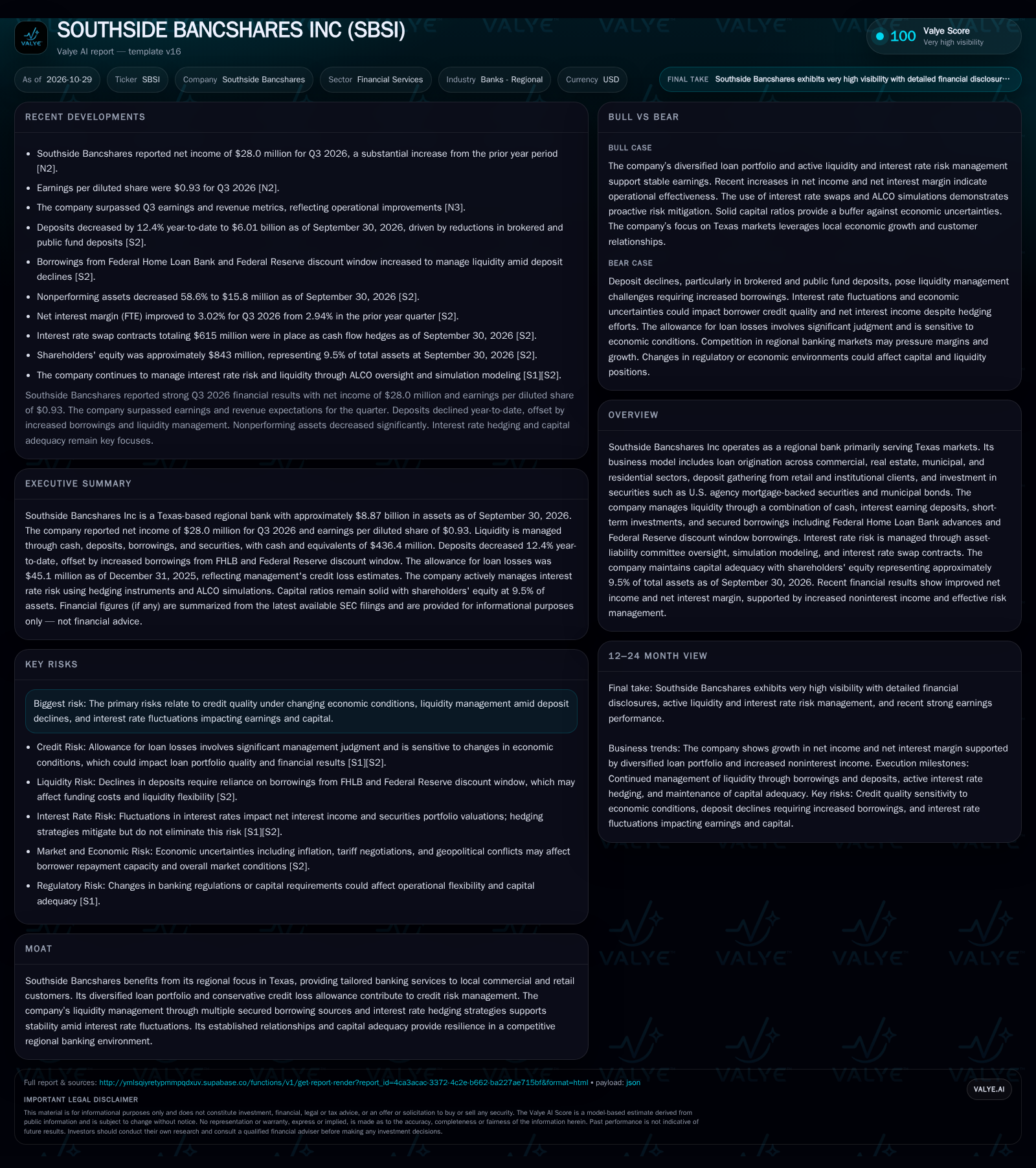
Southside Bancshares posted a sharp earnings rebound in Q3 2026, with net income of $28.0 million and net interest margin improvement to 3.02%, despite a 12.4% year-to-date decline in deposits. The bank offset lost funding with increased FHLB and Federal Reserve borrowings, while nonperforming assets fell and capital ratios remained solid. The outlook now depends on managing funding costs, safeguarding credit quality, and leveraging its Texas footprint for growth as competition and macroeconomic risks persist. [S2] [N2] [N3]
Southside Bancshares, a Texas-centric regional bank, delivered a notable earnings turnaround in Q3 2026, propelled by margin expansion and improved credit metrics. However, the sharp 12.4% drop in deposits—especially in brokered and public funds—has forced the bank to lean more heavily on wholesale funding sources, introducing new cost and risk dynamics. As the competitive landscape in Texas banking intensifies and macroeconomic uncertainties persist, the company’s ability to stabilize its funding base, maintain credit quality, and exploit its regional strengths will be central to its future performance and valuation.
Recent Performance: Margin Gains Offset by Deposit Outflows and Funding Shifts
Southside Bancshares reported Q3 2026 net income of $28.0 million, a notable increase over the prior year, supported by both higher net interest income and a rise in noninterest income streams [S2] [N2]. The bank’s net interest margin (FTE) improved to 3.02% from 2.94% in the prior-year quarter, indicating more effective management of asset yields relative to funding costs [S2]. However, total deposits fell 12.4% year-to-date to $6.01 billion as of September 30, 2026, mostly due to reductions in brokered and public fund deposits—a development that prompted Southside to increase its use of Federal Home Loan Bank (FHLB) advances and Federal Reserve discount window borrowings to manage liquidity [S2]. Nonperforming assets improved materially, dropping to $15.8 million (0.18% of total assets), down from $38.2 million at year-end 2025 [S2]. Shareholders’ equity remained robust at $843 million, or 9.5% of total assets [S2].
How Southside Bancshares Makes Money: Spread Income, Funding Mix, and Noninterest Levers
Southside’s core earnings engine is traditional spread banking: earning interest on a diversified loan portfolio—including commercial, commercial real estate, municipal, and residential loans—while managing the cost of deposits and other funding sources. The improvement in net interest margin to 3.02% highlights the bank’s ability to price loans and securities above its funding costs, but the shift in deposit mix is material. As retail and core deposits typically represent lower-cost, more stable funding, the recent decline in these sources and the increased reliance on FHLB and Federal Reserve borrowings may raise overall funding costs and reduce margin flexibility if wholesale rates rise or if competition for core deposits intensifies.
Noninterest income has become a more prominent earnings driver, helping to offset margin compression and volatility from asset-liability mismatches. However, these sources—often including fees, service charges, and possibly securities gains—can be sensitive to economic cycles and competitive pressures. Operating leverage is present, but regional banks like Southside face a largely fixed cost base in the short run, making top-line growth or deposit recovery crucial for further earnings expansion.
Capital requirements are a persistent consideration. With equity at 9.5% of assets, Southside maintains a solid regulatory cushion, supporting both lending growth and resilience to credit shocks. However, increased use of secured borrowings may require additional collateral management and could constrain flexibility during periods of stress.
Texas Banking Landscape and Southside’s Relative Strengths—and Exposures
Southside Bancshares’ regional focus in Texas offers both opportunity and risk. On the positive side, local banking relationships, knowledge of the market, and brand recognition can foster customer loyalty and cross-sell potential. The diversified loan book reduces concentration risk, especially with exposure to municipal and commercial real estate lending. The sharp reduction in nonperforming assets suggests improved underwriting or successful workout strategies, bolstering Southside’s credit reputation.
However, the competitive environment is intense. Regional peers, community banks, and larger national banks all vie for deposits and lending opportunities, often through aggressive pricing or digital offerings. The outflow of brokered and public deposits may suggest either increased competition for institutional funds, or a strategic repositioning by Southside in response to margin pressures. Substitutes for traditional banking—including fintechs and non-bank lenders—add another layer of challenge, especially as technology adoption accelerates in the Texas market.
Interest rate risk remains a core challenge. Southside’s use of swap contracts and ALCO modeling demonstrates sophistication in risk management, but rising or volatile rates can still affect funding costs, loan demand, and securities valuations. The ability to defend or rebuild core deposit relationships will be critical to maintaining competitive advantage.
If Deposit Flows Stabilize, Margin Expansion and Credit Quality Fuel Earnings Upside
The most favorable outcome for Southside Bancshares would see a stabilization or recovery in core deposits, reducing reliance on higher-cost wholesale funding. This could occur if retail customer acquisition efforts succeed, local economic conditions remain favorable, or if competition for institutional deposits abates. In this scenario, the bank could defend or even expand its net interest margin, particularly if it continues to price loans effectively and manage asset duration against interest rate movements.
Continued improvement in credit quality—evidenced by further declines in nonperforming assets or stable loan loss provisions—would support lower credit costs and free up capital for growth or shareholder returns. Enhanced noninterest income, possibly through expanded fee-based services, could further diversify earnings and reduce sensitivity to rate cycles.
Evidence supporting this scenario would include a reversal or flattening of deposit outflows, rising retail deposit balances, stable or expanding net interest margin, and low or declining nonperforming asset and charge-off rates. Additional cues would be management commentary on successful deposit gathering campaigns or new product launches targeting core deposit growth.
Most Likely Trajectory: Margin Pressures and Funding Mix Weigh on Steady but Moderate Earnings
The most plausible path forward is one where Southside Bancshares maintains moderate earnings growth, but faces ongoing headwinds from a less favorable funding mix. If deposit outflows persist or only partially recover, the bank may have to continue relying on FHLB and Fed borrowings, raising its cost of funds and potentially squeezing margins—especially if wholesale rates remain elevated. Net interest margin could plateau or contract modestly, depending on the pace of loan repricing and competitive pressures on lending rates.
Credit quality appears stable for now, with nonperforming assets at low levels, but remains exposed to broader economic volatility. Any deterioration in the Texas commercial real estate or municipal sectors could quickly reverse recent gains. Noninterest income may offer some buffer, but is unlikely to fully offset pressure on spread income if funding costs rise further.
Confirmation of this scenario would include continued but slower earnings growth, a stable or slightly declining net interest margin, gradual increases in wholesale funding balances, and stable but closely watched credit metrics. Management communications may emphasize cautious optimism and ongoing efforts to rebuild deposit relationships.
Adverse Outcomes: Wholesale Funding Reliance and Credit Deterioration Trigger Earnings Compression
The risk case for Southside Bancshares centers on a continued or accelerated decline in core and retail deposits, forcing even greater reliance on more expensive and potentially volatile wholesale funding. If competition for deposits intensifies or if market rates rise further, the bank’s net interest margin could compress sharply, eroding profitability. In extreme scenarios, constrained access to wholesale markets or collateral requirements could create liquidity stress.
A simultaneous deterioration in credit quality—possibly triggered by a downturn in Texas commercial real estate or municipal finance—could drive up loan loss provisions and nonperforming assets, further pressuring earnings and potentially capital ratios. Under such circumstances, the bank could be forced to curtail lending or asset growth, raising the risk of negative operating leverage.
Evidence for this scenario would include accelerating deposit outflows, sharp increases in FHLB/Fed borrowings, declining or negative net interest margin trends, rising nonperforming assets, and upward revisions to loan loss reserves. Regulatory scrutiny or negative management commentary on funding or credit trends would further support a downside thesis.
Next Moves That Will Define Southside Bancshares’ Trajectory
Sustained trends in retail and core deposit balances—if disclosed—will clarify whether funding outflows are stabilizing or worsening in the coming quarters.
The proportion of total funding sourced from FHLB advances and Federal Reserve borrowings versus deposits will indicate the durability and cost of the bank’s funding model.
Net interest margin progression, especially in relation to changes in wholesale funding costs and loan yields, will reveal whether recent margin gains are sustainable.
Nonperforming asset levels and trends in charge-offs or loan loss provisions will test the resilience of credit quality amid evolving economic conditions.
Commentary or disclosures on competitive pressures in the Texas market, including any changes in pricing, product offerings, or digital banking initiatives, would provide insight into market positioning.
Any new regulatory or capital adequacy disclosures, especially regarding liquidity coverage or stress testing, could signal emerging concerns or strengths.
Growth or stability in noninterest income streams—if broken out—will help assess earnings diversification and sensitivity to rate cycles.
Disclaimer: This is research-only, informational analysis and not investment advice. It may include AI-generated interpretation and general industry context. Always verify important details using primary sources.

Comments