
Axalta Coating Systems: Merger Ambitions, Margin Pressures, and the Next Phase of Coatings Consolidation
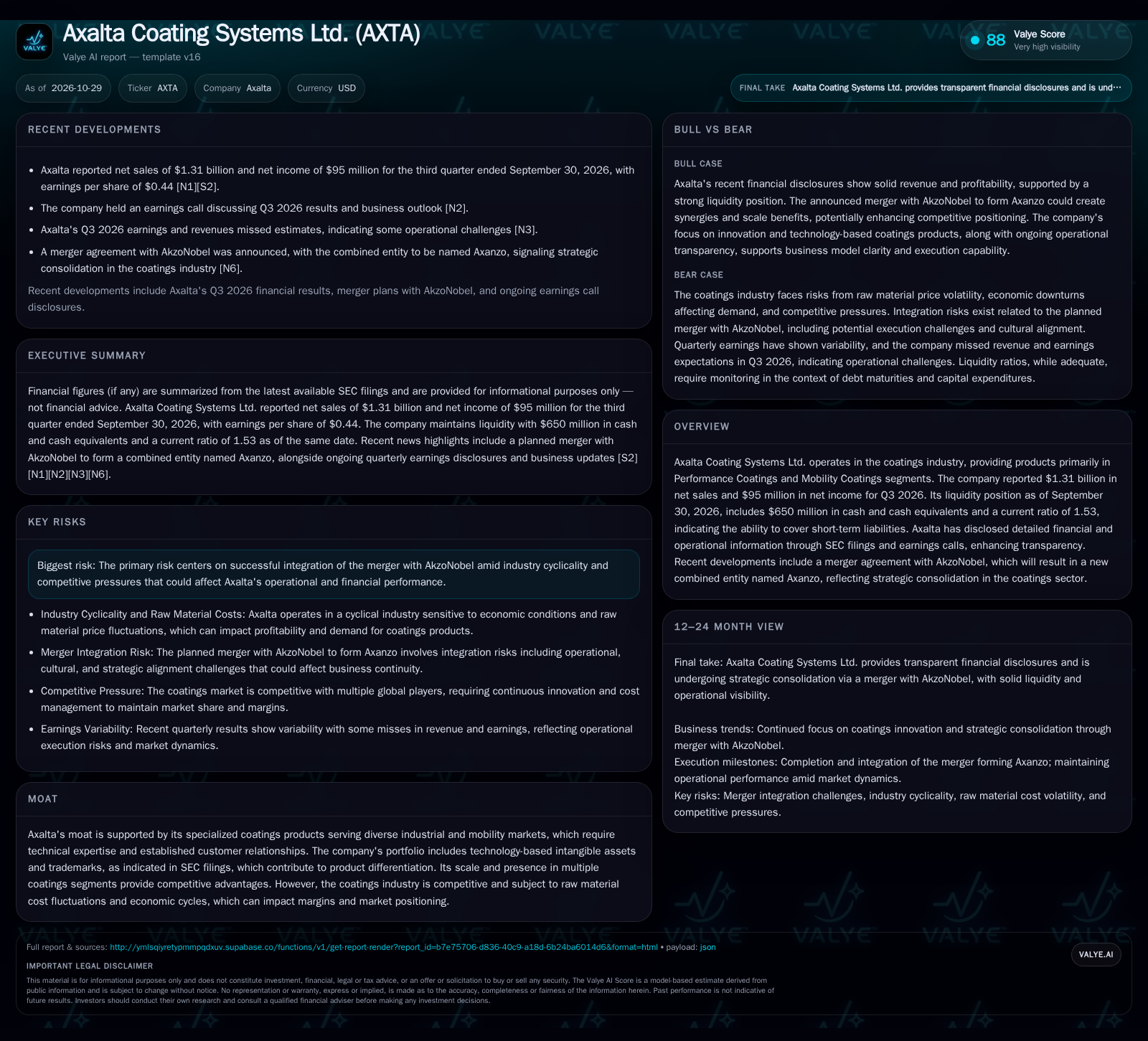
Axalta closed Q3 2026 with $1.31 billion in net sales and $95 million in net income, supported by $650 million in cash.
Axalta closed Q3 2026 with $1.31 billion in net sales and $95 million in net income, supported by $650 million in cash. Despite this, both revenue and earnings missed expectations, highlighting operational headwinds. The proposed merger with AkzoNobel to form Axanzo introduces major integration and competitive questions. Investors should focus on margin sustainability, merger execution, and the company’s ability to withstand raw material volatility and industry cyclicality as the coatings sector consolidates further. [S2] [N1] [N3] [N6]
The coming quarters will test Axalta’s ability to sustain margins, execute on strategic consolidation, and defend its position as the coatings sector continues to evolve. [S2] [N1] [N3] [N6]
Recent Results, Missed Estimates, and a Major Merger on the Horizon
Axalta reported net sales of $1.31 billion and net income of $95 million for the third quarter ended September 30, 2026, translating to $0.44 in earnings per share. Despite these figures, both revenue and earnings fell short of analyst estimates, signaling that the company is contending with operational challenges or market headwinds. The company reported cash and liquidity metrics for the period; these figures do not by themselves establish operating runway, investment capacity, financial flexibility, or financing capacity. The most consequential development is the announced merger with AkzoNobel, which will create a new entity called Axanzo. This merger represents a significant shift in Axalta’s strategic trajectory and could alter the competitive dynamics in the global coatings market. [S2] [N1] [N3] [N6]
How Axalta’s Business Model Absorbs Volatility and Scales Margins
Axalta’s core economics stem from the sale of coatings across its Performance Coatings and Mobility Coatings segments. These products are typically priced based on technical performance, durability, and application-specific requirements, with pricing power often constrained by the commoditized nature of many end-markets and the volatility of raw material inputs. Volumes are driven by industrial production cycles, automotive demand, and aftermarket trends, all of which are sensitive to macroeconomic swings.
The business is characterized by a mix of fixed and variable costs: manufacturing assets and R&D are relatively fixed, enabling operating leverage in upcycles, while raw materials (resins, pigments, solvents) are a highly variable and sometimes volatile input. This means margins can expand rapidly during periods of stable or declining input costs and healthy end-market demand, but compress sharply during downturns or when raw material prices spike.
Given the sensitivity of Axalta’s margins to raw material costs, an important strategic focus is the company’s ability to implement effective hedging or long-term procurement contracts. While such mechanisms can reduce input cost volatility, they also introduce potential opportunity costs if market prices decline. The balance between flexibility and cost certainty is crucial, especially in a sector where raw materials can represent a significant portion of total costs. Additionally, technological innovation in formulations that reduce reliance on expensive or volatile inputs could provide a competitive edge and margin stability over time.
Another layer of complexity arises from regional differences in raw material availability and regulatory environments. Axalta’s global footprint means that supply chain disruptions or localized cost pressures can have uneven impacts across geographies, affecting consolidated margins. The company’s ability to optimize production and sourcing on a regional basis, while maintaining consistent quality and service levels, will influence its resilience to external shocks. Moreover, investments in digital manufacturing and supply chain analytics may enhance responsiveness and cost control in volatile markets.
Axalta’s Competitive Edge: Scale, Portfolio Breadth, and the Race Against Substitution
In the coatings industry, competitive advantage is often derived from a combination of scale, customer relationships, technical expertise, and product breadth. Axalta serves a broad array of end-markets, from industrial OEMs to automotive refinish, which provides some diversification against sector-specific downturns.
However, the sector is intensely competitive, with global players regularly vying for market share through pricing, technology upgrades, and customer service. Product differentiation is possible via proprietary formulations or application processes, but customer switching costs are typically moderate, especially for high-volume, less specialized coatings. Substitution risk exists both from new entrants offering lower-cost alternatives and from technological advances such as powder coatings or eco-friendly solutions that could erode traditional product demand.
The planned merger with AkzoNobel may improve Axalta’s scale and product portfolio, potentially unlocking procurement synergies and cross-selling opportunities. Yet, the integration process could disrupt customer relationships or create internal distractions, offering an opening for competitors to poach accounts or accelerate innovation. The sector’s cyclicality and raw material exposure mean that even large players cannot rest on their laurels.
In addition to scale and portfolio breadth, Axalta’s competitive positioning depends on its capacity to innovate in environmentally sustainable coatings. Regulatory trends and customer preferences are increasingly favoring low-VOC (volatile organic compounds) and eco-friendly solutions, which require ongoing R&D investment and adaptation of manufacturing processes. Failure to keep pace with these trends could result in loss of market share to more agile competitors or new entrants specializing in green technologies. Conversely, successfully integrating sustainability into product development and marketing may create differentiation and pricing leverage in select segments.
If Integration Delivers: Pathways to Margin Expansion and Market Share Gains
A successful integration with AkzoNobel could create a coatings powerhouse with enhanced economies of scale, broader geographic reach, and a deeper product suite. Synergies may arise from consolidated procurement of raw materials, rationalized manufacturing footprints, and shared R&D, driving margin expansion and freeing up capital for growth initiatives.
The combined entity could also wield greater pricing power in select niches, especially where technical differentiation or regulatory compliance creates barriers to entry. If Axanzo can cross-sell products effectively, retain key customers, and avoid major post-merger disruptions, it could capture incremental market share from smaller or less integrated rivals.
Evidence that would confirm this scenario includes sequential improvement in operating margins, realization of stated cost synergies, customer retention rates holding steady or improving post-merger, and positive commentary on integration progress in management disclosures.
Consolidation Brings Incremental Benefits—But Old Headwinds Persist
The most plausible scenario is that Axalta and AkzoNobel’s merger achieves some, but not all, of its intended synergies. Cost rationalization and procurement efficiencies may help offset ongoing raw material price volatility and the normal ebb and flow of end-market demand. However, the coatings market remains cyclical, and the combined entity will likely continue to face pricing pressure and margin variability tied to global economic conditions.
Integration complexity could result in temporary operational inefficiencies, and customer attrition may offset some revenue gains. The merged company’s broader portfolio and scale should provide resilience, but not immunity, from structural industry risks. Over time, modest improvements in profitability and cash generation are plausible, but the company will need to demonstrate consistent execution to avoid value erosion.
Confirmation would come from stable or slightly improving gross and operating margins, steady free cash flow generation, and the absence of major integration setbacks in quarterly results and management commentary.
Integration Stumbles and Cost Shocks Could Erode Profitability
The key downside risk is a failure to execute on the AkzoNobel merger: cultural mismatches, operational disruptions, or delayed synergy realization could drive up integration costs and distract management from core operations. In parallel, a spike in raw material costs—without the ability to pass through price increases—could compress margins and reduce cash flow.
Competitive responses, such as aggressive pricing from rivals or customer defections during the integration period, could exacerbate revenue pressure. If the combined entity’s debt burden rises due to integration expenses or restructuring, potential financial flexibility could be further constrained.
Downside confirmation would be evident in declining margins, negative free cash flow, customer loss disclosures, integration delays, or unexpected impairments related to the merger.
What Will Reveal Axalta’s Real Trajectory as Axanzo Emerges?
Progress updates and quantified synergy targets related to the AkzoNobel merger—especially cost savings, integration timelines, and restructuring expenses.
Quarterly gross and operating margin trends, to gauge the impact of raw material costs and the success of cost containment.
Customer retention rates, if disclosed, particularly in core Performance and Mobility Coatings segments, to identify potential churn during integration.
Any changes in the company’s leverage or debt profile, especially if integration or restructuring requires new financing.
Volume trends across key end-markets (automotive, industrial OEM, refinish), as a proxy for underlying demand and competitive positioning.
Management commentary on competitive responses and market share shifts as the merged entity takes shape.
Disclaimer: This is research-only, informational analysis and not investment advice. It may include AI-generated interpretation and general industry context. Always verify important details using primary sources.

Comments