
Belden Inc.: Strategic Acquisitions, Profitability Pressure, and the Search for Sustainable Infrastructure Growth
Belden’s recent revenue expansion, driven by acquisitions and a diversified portfolio in infrastructure and automation, is offset by mounting profitability headwinds and a heavier debt load. The company’s ability to translate top-line momentum into durable earnings and cash flow will depend on pricing power, integration discipline, and its response to intensifying competitive dynamics.
Belden’s Q3 2026 results show strong revenue growth and ongoing strategic investment, but profitability is under pressure due to rising costs and interest expense. The core question: Can Belden convert scale and acquisitions into sustainable margin expansion in a competitive, evolving infrastructure market? [S2] [N4] [N6]
Belden Inc. stands at a critical juncture: Its recent expansion through acquisitions and organic growth in Smart Infrastructure and Automation Solutions has fueled top-line gains, but persistent cost pressures and higher interest expense have resulted in a net loss for Q3 2026. The central question for investors is whether Belden can achieve meaningful margin improvement and cash flow generation in the face of mounting competitive and financial headwinds. [S2] [N4] [N6]
Mounting Revenues Meet Margin Pressure in Belden’s Latest Quarter
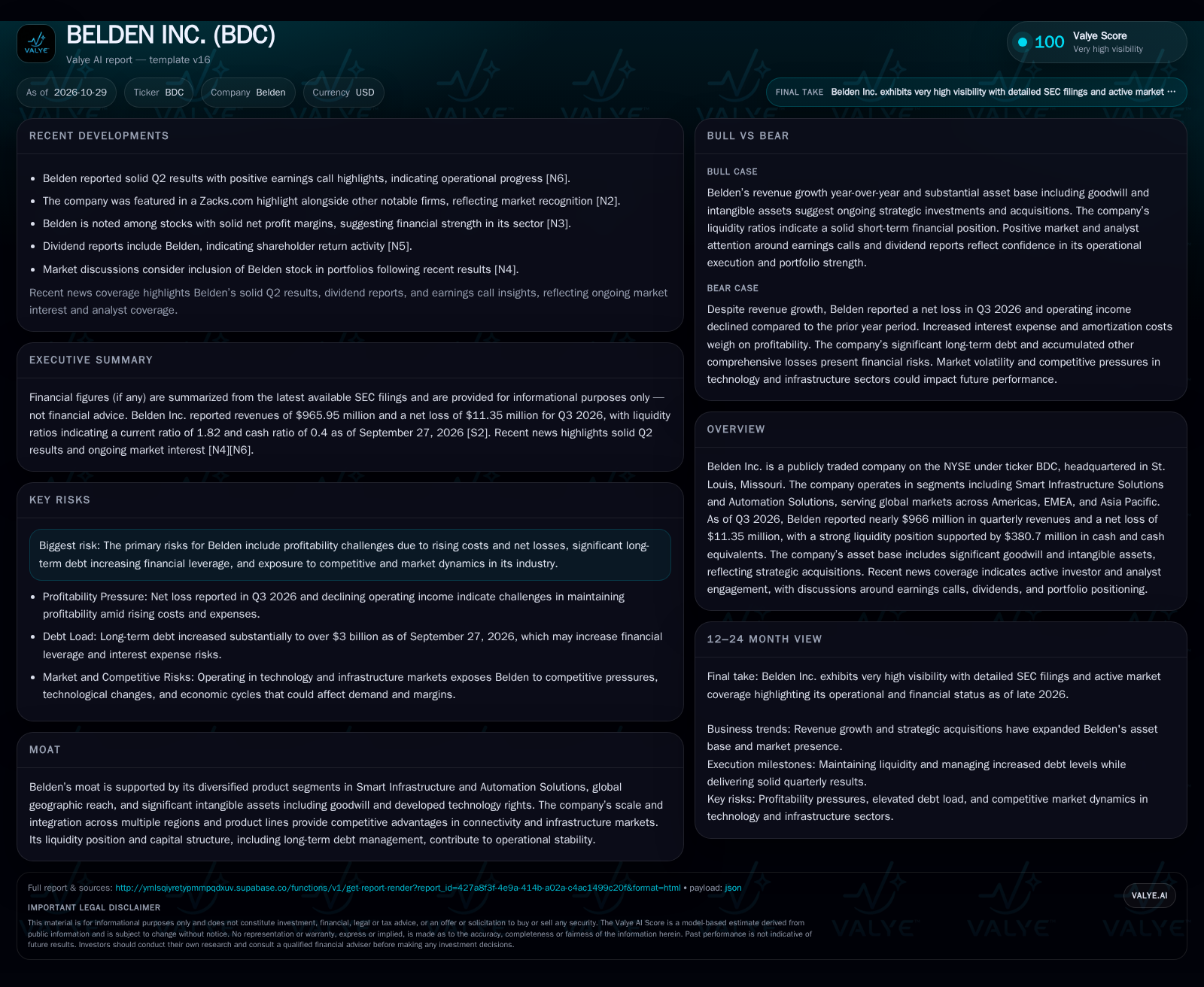
Belden reported revenues of $965.95 million for Q3 2026, marking continued year-over-year growth and pushing year-to-date revenues to $2.41 billion, up from $1.99 billion in the prior year period. However, these gains were overshadowed by a net loss of $11.35 million for the quarter and a decline in operating income to $193.98 million for the first nine months, down from $228.15 million in 2025. The company’s liquidity remains notable, with $380.7 million in cash and a current ratio of 1.82 as of September 27, 2026. The company reported cash and liquidity metrics for the period; these figures do not by themselves establish operating runway, investment capacity, financial flexibility, or financing capacity. These facts spotlight the central tension: Belden is growing, but at the cost of profitability, and its balance sheet is increasingly shaped by acquisition-related assets. [S2]
How Belden’s Operating Model Turns Scale into Earnings—Or Doesn’t
Belden’s revenue generation is rooted in its dual focus on Smart Infrastructure Solutions and Automation Solutions, serving diverse industrial and communications end markets. In theory, these segments should provide a mix of recurring and project-based revenues, with potential for operating leverage as scale increases. However, the reported net loss and declining operating margins suggest that recent growth has not translated into improved profitability. Rising interest expense—likely a result of debt-financed acquisitions—and increased amortization of intangibles are eroding earnings, while integration costs may be further weighing on margins.
The company’s business model is capital intensive, with a significant portion of its asset base tied up in goodwill and intangibles, pointing to a roll-up or consolidation strategy. While this can accelerate market penetration and product breadth, it also raises the stakes for successful integration and synergy capture. Pricing power could be limited by competitive pressures and the commoditization risk inherent in some connectivity and automation products. The true test for Belden will be whether it can extract higher margins from its expanded platform, manage cost escalation, and avoid impairment charges as it seeks to convert scale into sustainable free cash flow.
Competitive Dynamics in Infrastructure Connectivity: Scale, Substitution, and Integration Risks
Belden’s competitive positioning draws on its global footprint, breadth of product offerings, and established customer relationships across industrial, enterprise, and data center markets. Its diversification across Smart Infrastructure and Automation Solutions provides some resilience against sector-specific downturns. However, the company operates in intensely competitive markets, facing pressure from both global conglomerates and specialized connectivity or automation firms. Barriers to entry can be moderate, with technical requirements and long sales cycles providing some customer stickiness, but product commoditization and rapid technological change can erode pricing power.
The sharp increase in goodwill and intangibles signals a reliance on acquisitions to maintain growth and market share. This creates both opportunity—through expanded solution sets and cross-selling—and risk, as integration missteps or cultural mismatches can undermine anticipated synergies. Substitution risk is present as customers consider alternative networking, wireless, or cloud-based solutions that could bypass traditional wired infrastructure. Belden’s ability to innovate, maintain cost discipline, and deliver value-added integration will determine whether it can sustain its current competitive advantages.
Unlocking Margin Expansion Through Integration and Value-Added Solutions
In a favorable scenario, Belden’s recent acquisitions are successfully integrated, leading to cost synergies, streamlined operations, and the development of higher-margin, value-added solutions. If the company can leverage its expanded platform to deepen customer relationships—particularly in sectors with complex infrastructure needs—it may be able to command premium pricing or lock in recurring service and software revenues. The combination of organic innovation and cross-selling from acquired entities could drive both top-line and margin expansion.
Evidence confirming this scenario would include a sustained rebound in operating income and net margins, explicit disclosures of realized acquisition synergies, and improved free cash flow despite higher interest and amortization expenses. Additional signals would be stable or rising gross margins and a decline in integration-related one-time costs. Conversely, if operating income remains stagnant or declines further, or if impairment charges begin to materialize, this upside thesis would be weakened.
Acquisition-Driven Growth Meets Margin Stagnation
The most plausible near-term trajectory is one in which Belden continues to grow revenues through a combination of organic initiatives and bolt-on acquisitions, while operating margins remain under pressure from integration costs, elevated interest expense, and competitive pricing.
Confirmation of this base case would be continued revenue growth with flat or modestly declining operating margins, ongoing increases in goodwill and intangibles, and periodic restructuring or integration charges. If Belden can stabilize margins and demonstrate cost discipline, it may gradually restore investor confidence, but transformative margin expansion appears unlikely without a step-change in integration efficiency or product mix.
When Acquisition Risks Materialize: Impairments, Cash Flow Strain, and Competitive Losses
In a negative scenario, Belden’s acquisition-driven strategy fails to deliver anticipated synergies, resulting in persistent margin compression, rising integration expenses, and eventual goodwill or intangible asset impairments. If competitive pressures intensify—whether through price wars, technological disruption, or customer defections—the company could experience revenue stagnation or contraction, exacerbating fixed cost absorption issues.
Warning signs would include further declines in operating income, the emergence of large impairment charges, negative free cash flow, and rising net debt levels. Additional red flags would be customer losses in key segments, loss of major contracts, or the need to divest underperforming units to shore up liquidity. Such developments would challenge Belden’s ability to service its debt and could force a strategic retrenchment.
Milestones That Will Shape Belden’s Margin and Integration Trajectory
Quarterly operating income and net margin trends—improvement or further deterioration will be a direct barometer of integration and pricing success.
Disclosures or commentary on realized acquisition synergies, including cost savings or cross-selling uptake, if provided.
Changes in goodwill and intangible asset balances—sudden increases or the announcement of impairments would signal integration or performance issues.
Gross margin movement, particularly in the Smart Infrastructure and Automation Solutions segments, if disclosed.
Net debt levels and interest expense trends, as further increases could limit strategic flexibility.
Free cash flow generation versus reported net income, revealing the true cash economics of the business.
Customer retention rates or new contract wins in core verticals—a useful metric if disclosed.
Any restructuring, divestiture, or cost-cutting announcements aimed at restoring profitability or addressing underperforming assets.
Disclaimer: This is research-only, informational analysis and not investment advice. It may include AI-generated interpretation and general industry context. Always verify important details using primary sources.

Comments