
Brandywine Realty Trust: Navigating Office Real Estate Headwinds with Tenant Diversity and Strategic Geography
Brandywine Realty Trust’s diversified office and mixed-use portfolio, anchored in Philadelphia and Austin, is weathering macroeconomic pressures from inflation, high interest rates, and remote work trends.
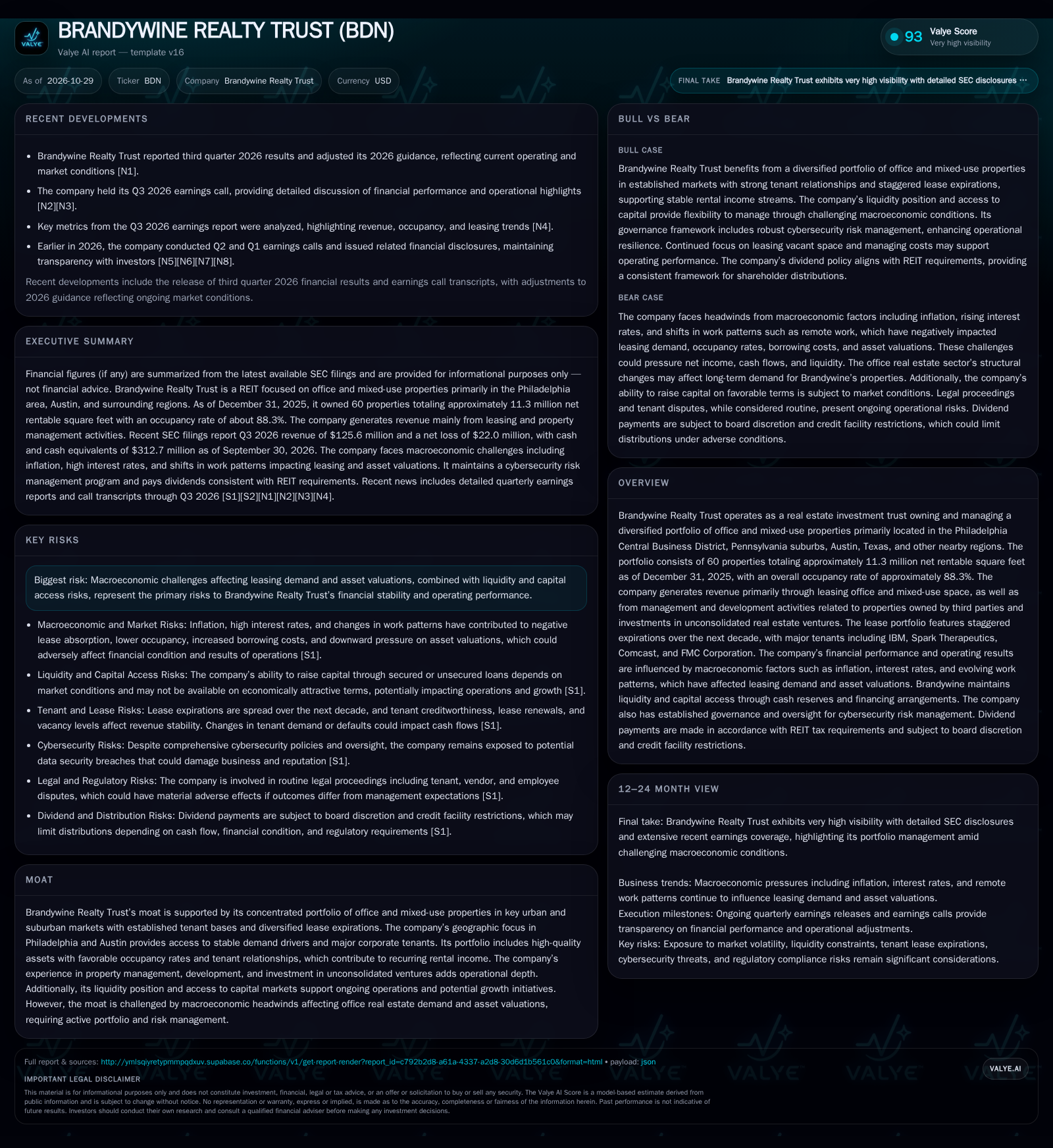
Brandywine Realty Trust owns and manages 60 office and mixed-use properties across key urban and suburban markets, with an 88.3% occupancy rate as of December 2025. The company reported $125.6 million in Q3 2026 revenue but posted a net loss, reflecting persistent macroeconomic and sector-specific pressures. [S1] [S2]
Brandywine Realty Trust, a longstanding office and mixed-use REIT, faces a market in flux as hybrid work, elevated interest rates, and shifting tenant needs reshape the urban office landscape. The company’s sizable presence in Philadelphia and Austin, along with its diversified tenant base and staggered lease maturities, provide stability amid uncertainty. The coming quarters will test whether these defenses are enough to offset structural and cyclical pressures.
Recent Results Highlight Persistent Profitability and Occupancy Pressure
Brandywine Realty Trust reported Q3 2026 revenue of $125.6 million, but posted a net loss of $22.0 million for the period, equating to -$0.13 per share. The company reported cash and liquidity metrics for the period; these figures do not by themselves establish operating runway, investment capacity, financial flexibility, or financing capacity. The company’s 60-property portfolio, totaling 11.3 million square feet, maintained an overall occupancy of 88.3% at year-end 2025, with occupancy rates sharply higher in the Philadelphia CBD (94.7%) and lagging in Austin (73.9%) [S1] [S2].
Major tenants are diversified, with no single tenant accounting for more than 5.2% of annualized rents, and the lease maturity schedule is spread across the next decade, mitigating near-term rollover risk. Macroeconomic headwinds—especially inflation, high interest rates, and remote work—continue to weigh on leasing demand, asset values, and borrowing costs [S1].
REIT Economics: Leasing Revenue, Operating Leverage, and Capital Structure Dynamics
Brandywine's core revenue stream is derived from leasing office and mixed-use space, supplemented by property management and development fees, and income from unconsolidated real estate ventures. The economics of the business are characterized by high fixed costs, particularly property-level operating expenses and debt service, which create significant operating leverage. This means that small changes in occupancy rates or rent levels can have an outsized impact on net income.
In periods of strong demand, this leverage can drive margin expansion as incremental revenues fall largely to the bottom line. Conversely, in the current environment, reduced leasing velocity and pressure on market rents—especially in challenged submarkets like Austin—amplify earnings volatility. Capital requirements remain substantial, as ongoing property maintenance, tenant improvements, and leasing commissions are necessary to retain and attract tenants. The REIT model also obligates Brandywine to distribute a significant portion of taxable income as dividends, limiting retained cash and heightening the importance of external financing for growth or major repositioning projects.
[S2]
Geographic Concentration and Tenant Diversity Shape Competitive Resilience
Brandywine’s competitive positioning derives from its concentration in established urban and suburban markets—most notably the Philadelphia Central Business District and Pennsylvania suburbs, as well as Austin, Texas. The Philadelphia market, where Brandywine enjoys occupancy rates near 95%, offers relative stability due to entrenched corporate and institutional demand. In contrast, the Austin market, with occupancy below 75%, is more exposed to tech sector volatility and the broader national trend of remote work.
Tenant diversity is a key advantage: the REIT’s largest tenant accounts for just 5.2% of base rents, and its roster includes blue-chip names such as IBM, Spark Therapeutics, Comcast, and FMC Corporation. This reduces single-tenant risk and supports cash flow visibility. Compared to more concentrated or less geographically diversified office REITs, Brandywine’s staggered lease maturities and tenant mix provide some insulation against localized shocks or specific industry downturns.
However, the broader competitive landscape is shifting, with alternative work arrangements and flexible office providers capturing incremental demand. Substitution risk from coworking and remote/hybrid work models is significant, especially in less supply-constrained or more commoditized markets. The question is whether Brandywine’s focus on high-quality assets and established tenant relationships can offset these secular headwinds.
Recovery in Leasing Demand and Asset Values Could Unlock Operating Leverage
A favorable scenario for Brandywine would involve stabilization and gradual recovery in office leasing demand, particularly in urban cores like Philadelphia. If employers increasingly require in-office presence or hybrid models settle at higher physical occupancy, vacancy rates could decline, supporting rent growth and reducing the need for costly concessions.
Because Brandywine’s cost structure is largely fixed, even modest increases in occupancy or rent per square foot would drive disproportionate gains in net operating income and cash flow.
Confirmation of this scenario would include a sustained uptick in leasing velocity, higher renewal rates, narrowing spreads between asking and effective rents, and improved net income or FFO (funds from operations) margins. Asset values would likely stabilize or recover, supporting refinancing flexibility and potential NAV growth. Evidence of tenant expansions, pre-leasing of upcoming vacancies, or positive rent roll-ups would further validate this upside.
Portfolio Stability Amid Sector Headwinds Likely to Define the Next Phase
The most plausible near-term outcome is continued portfolio stability, with moderate occupancy declines offset by staggered lease expirations and tenant diversity. Philadelphia is likely to remain a source of relative strength, while Austin and other secondary markets may see further pressure as tenants downsize or delay new commitments.
Revenue and cash flow are expected to remain resilient but under pressure, with net income modestly negative or near break-even as the company manages through lease rollovers, elevated interest costs, and subdued rent growth. Dividend payments are likely to persist but may be adjusted to reflect taxable income and liquidity needs, subject to board and credit facility restrictions.
Evidence supporting the base scenario would include occupancy remaining in the mid-to-high 80% range, stable or gradually declining rent rolls, and maintenance of current cash balances or financing capacity. Falsifying this scenario would require either a sharp, broad-based drop in occupancy or a material deterioration in tenant credit quality resulting in outsized lease defaults.
Prolonged Weakness in Office Demand Could Force Asset Sales or Dividend Cuts
A more adverse scenario envisions a sustained downturn in office demand, driven by further entrenchment of remote work, economic recession, or a wave of tenant bankruptcies and non-renewals. In this case, occupancy could fall materially below current levels, especially in more vulnerable submarkets like Austin.
Brandywine could be forced to sell assets at depressed valuations, cut or suspend dividends, or seek dilutive equity or debt financing under unfavorable terms.
Confirmation of this downside would include a rapid drop in occupancy to the low 80% range or below, a spike in sublease availability, sharp increases in tenant incentives/concessions, and negative trends in same-property NOI. Early warning signs would be a rise in lease defaults, failed refinancing efforts, or asset sales at steep discounts to prior valuations.
Testing the Thesis: Portfolio Resilience, Demand Signals, and Capital Flexibility
Quarterly occupancy trends by geographic segment—especially in Austin and Pennsylvania suburbs—would help gauge the pace of leasing recovery or further weakness.
Renewal and new leasing velocity, if disclosed, will indicate tenant appetite and pricing power in the current environment.
Net operating income (NOI) and funds from operations (FFO) margins should be tracked for signs of margin stabilization or further compression.
Cash and equivalents, plus undrawn credit facility capacity, will reveal the company’s ability to weather extended market stress.
Dividend declarations and payout ratios will test Brandywine’s balance between REIT distribution requirements and liquidity preservation.
Tenant concentration and credit quality metrics—such as rent exposure to at-risk industry sectors—would help assess cash flow stability.
Asset sales activity, including realized pricing versus book value, will provide insight into market liquidity and Brandywine’s capital management flexibility.
Disclaimer: This is research-only, informational analysis and not investment advice. It may include AI-generated interpretation and general industry context. Always verify important details using primary sources.

Comments