
Federal Signal’s Strategic Expansion: Acquisitions, Product Diversification, and the Next Chapter in Safety and Environmental Solutions
Federal Signal’s Q3 2026 results show robust profitability and liquidity, underpinned by an increased EPS outlook and ongoing acquisition activity. The company’s strategic focus on specialized safety and environmental products positions it to capitalize on municipal and industrial spending cycles, but integration risks and competitive pressures remain central to the forward thesis.
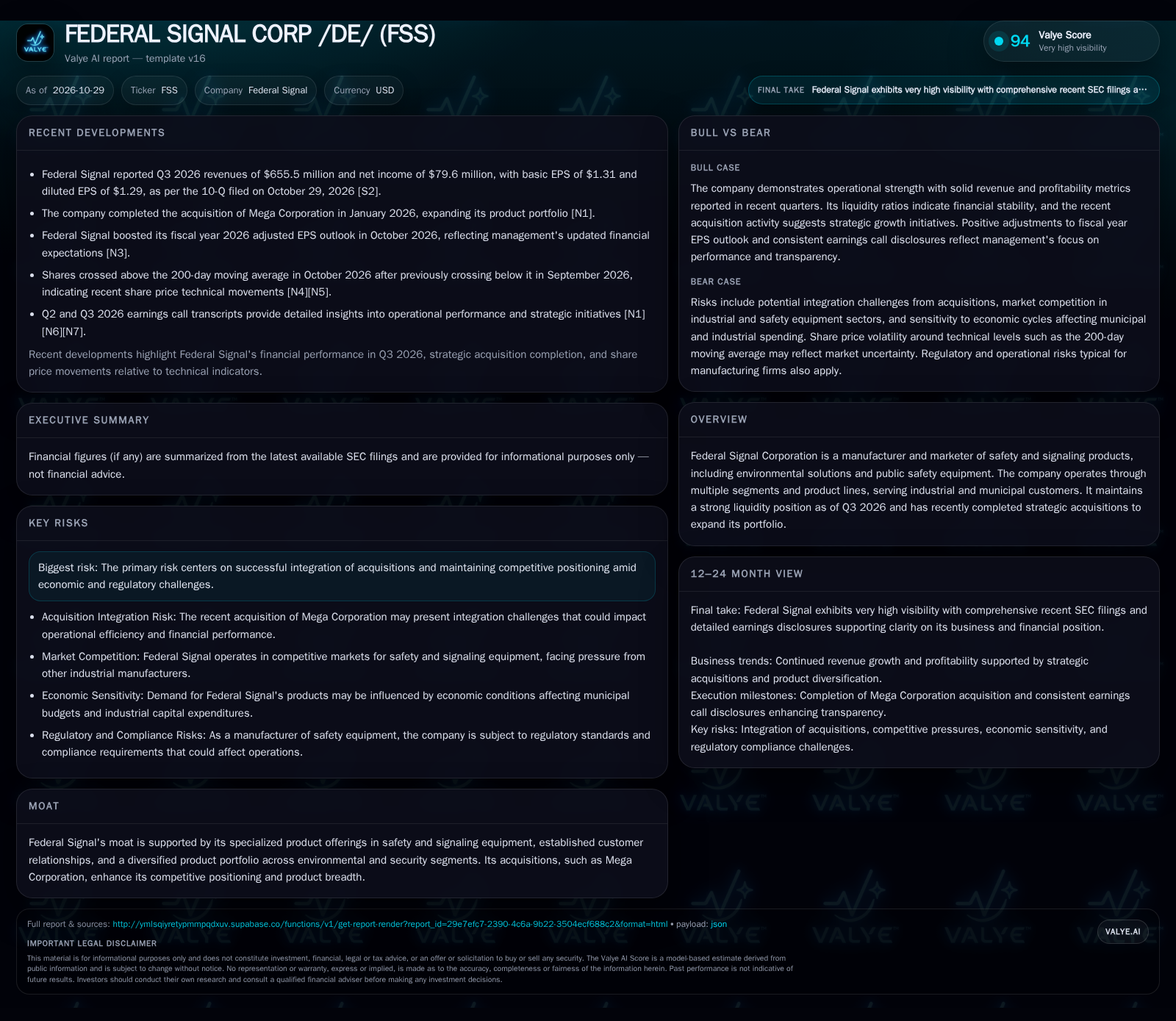
Federal Signal delivered strong Q3 2026 results with $655.5 million in revenue, $79.6 million in net income, and raised its full-year adjusted EPS outlook. Management continues to pursue growth via acquisitions and product diversification, but faces ongoing integration and market competition risks.
Federal Signal Corporation’s recent quarterly performance cements its standing as a leader in safety and environmental solutions, with Q3 2026 results featuring strong revenue growth and profitability. However, with the company actively integrating recent acquisitions and navigating shifting market dynamics, its next phase will depend on execution, competitive differentiation, and the resilience of end-market demand.
Recent Financials and Strategic Moves Redefine Federal Signal’s Trajectory
Federal Signal reported Q3 2026 revenues of $655.5 million and net income of $79.6 million, translating to basic EPS of $1.31 and diluted EPS of $1.29 [S2]. These figures reflect a continuation of the company’s established profitability and operational scale.
Management raised the fiscal year 2026 adjusted EPS outlook in October 2026, indicating greater earnings confidence for the remainder of the year [N3]. This upward revision suggests improved visibility into demand, cost structure, or synergies from recent acquisitions.
The company reported cash and liquidity metrics for the period; these figures do not by themselves establish operating runway, investment capacity, financial flexibility, or financing capacity. [S2]
Recent acquisition activity, including the addition of Mega Corporation, points to an ongoing strategy of portfolio expansion and product diversification, with the intention of reinforcing Federal Signal’s position in core and adjacent markets.
How Federal Signal’s Model Converts Specialized Products into Profits
Federal Signal generates revenue primarily through the manufacture and sale of specialized safety, signaling, and environmental solutions. Its customer base spans municipalities, industrial operators, and public entities, which tend to purchase high-value, mission-critical equipment such as industrial signaling systems, emergency vehicles, and environmental maintenance products.
The business model is characterized by a mix of project-based sales (e.g., large orders from municipalities) and recurring demand from maintenance, upgrades, and compliance-driven replacements. Pricing power can be modestly supported by regulatory standards and the mission-critical nature of the products, but the company still faces price competition from other industrial suppliers.
Fixed costs are significant due to manufacturing and R&D requirements, but scale and product customization allow for margin capture, especially as the company leverages shared platforms and components across product lines. Operating leverage is achievable when revenue growth outpaces incremental fixed costs, particularly following successful integration of acquisitions.
The interplay between fixed and variable costs in Federal Signal's manufacturing operations also warrants deeper consideration. Given the capital-intensive nature of production and R&D, the company benefits from economies of scale, but only if volume growth is sufficient to dilute fixed overhead. Conversely, if demand fluctuates or integration challenges delay volume ramp-up, fixed costs may weigh more heavily on margins. Additionally, the extent to which the company can leverage modular product designs or platform commonality across different product lines could enhance operating leverage by reducing incremental costs associated with new product introductions or customization.
Defensible Niches, but Intense Rivalry and Substitution Risks Persist
Federal Signal’s core competitive advantages stem from product specialization, established customer relationships (especially with municipalities and industrial buyers), and a diversified product portfolio spanning both environmental and safety/security segments.
The company operates in markets characterized by high regulatory and technical standards, which can create barriers to entry and foster customer stickiness. However, these markets are also crowded with both large diversified industrials and focused niche players, all vying for municipal contracts and industrial upgrade cycles.
Product breadth and the ability to bundle solutions may provide some insulation from price-based competition, but cost pressures and the risk of commoditization in certain segments remain. Substitution risk is present, particularly as technology evolves—municipalities, for example, could shift budget priorities or adopt alternative technologies for signaling, warning, or environmental maintenance.
Recent acquisitions aim to expand the product suite and deepen customer integration, but the durability of these advantages will depend on successful integration, ongoing innovation, and the company’s ability to remain relevant as customer needs shift.
Acquisition Synergies and Product Innovation Drive Outperformance
A favorable scenario for Federal Signal would involve seamless integration of recent acquisitions, enabling the company to realize cross-selling opportunities, drive cost synergies, and introduce new products that address evolving customer requirements.
If end-market demand remains healthy—supported by infrastructure spending cycles, regulatory mandates, or industrial capital investment—Federal Signal could see sustained top-line growth and margin expansion. Effective execution on R&D and product launches, particularly in areas with higher regulatory or technical barriers, could further entrench customer relationships and justify premium pricing.
Evidence supporting this scenario would include above-trend revenue growth, improving operating margins, successful new product introductions, and public disclosure of cost or revenue synergies from acquisitions. Additional upward revisions to guidance or accelerated contract wins in newly acquired segments would further confirm the thesis.
Sustained Growth Amid Cyclical Swings and Integration Efforts
The most plausible near-term outcome is continued steady revenue and profit growth, punctuated by periodic swings due to municipal budget cycles, industrial project timing, and the integration of acquired businesses.
Federal Signal is likely to maintain its current market share and product positioning, benefitting from its established brand and customer relationships. Margins may show gradual improvement if integration efforts proceed smoothly and cost discipline is maintained. However, competitive pressures and input cost volatility could periodically weigh on profitability.
Confirmation would come from stable or incrementally improving quarterly results, consistent cash generation, and management reiterating or slightly raising forward guidance. On the other hand, delays in integration, unexpected cost overruns, or signs of municipal spending pullbacks would challenge this outlook.
Integration Hurdles and Weak End-Markets Erode Momentum
The primary downside risk lies in the company’s ability to integrate recent acquisitions without operational disruption or margin dilution. Failure to realize anticipated synergies, or unexpected complexity in merging systems and cultures, could lead to cost overruns and distract management from core operations.
A downturn in municipal or industrial spending—whether from macroeconomic weakness, shifting budget priorities, or policy changes—could compress revenue, especially given the company’s exposure to project-based orders. Competitive pressures could intensify if rivals pursue aggressive pricing or technological differentiation.
Evidence of this scenario would include declining or stagnant revenues, margin compression, negative revisions to forward guidance, or public acknowledgment of integration setbacks. Missed contract wins or customer losses in core segments would further validate a deteriorating outlook.
Testing the Federal Signal Thesis: What Will Matter Most in the Next Phase
Quarterly revenue and margin trends by segment, particularly Environmental Solutions and Safety and Security Systems, if disclosed, to assess the relative health of core businesses.
Progress on the integration of recent acquisitions, including cost synergy realization, retention of key personnel, and cross-selling success.
Evidence of new product launches or expansions into adjacent verticals, as well as uptake of these offerings by existing and new customers.
Municipal and industrial customer order patterns, including contract win rates, backlog development (if disclosed), and project pipeline visibility.
Updates to management's forward EPS guidance and commentary on demand outlook during earnings calls.
Competitive developments—such as new product introductions, pricing shifts, or technological advances—from relevant industrial and safety equipment peers.
Capital allocation decisions, including further acquisitions, investments in capacity or R&D, and any changes in working capital requirements.
Any notable regulatory changes or compliance events that could affect product standards, market access, or cost structure.
Disclaimer: This is research-only, informational analysis and not investment advice. It may include AI-generated interpretation and general industry context. Always verify important details using primary sources.

Comments