
Hammer Technology’s Fintech Pivot: Proprietary Platform Versus Persistent Financial Strain
Hammer Technology Holdings Corp. has completed its exit from telecom and now bets on HammerPay, a compliance-focused digital payments platform for developing markets.
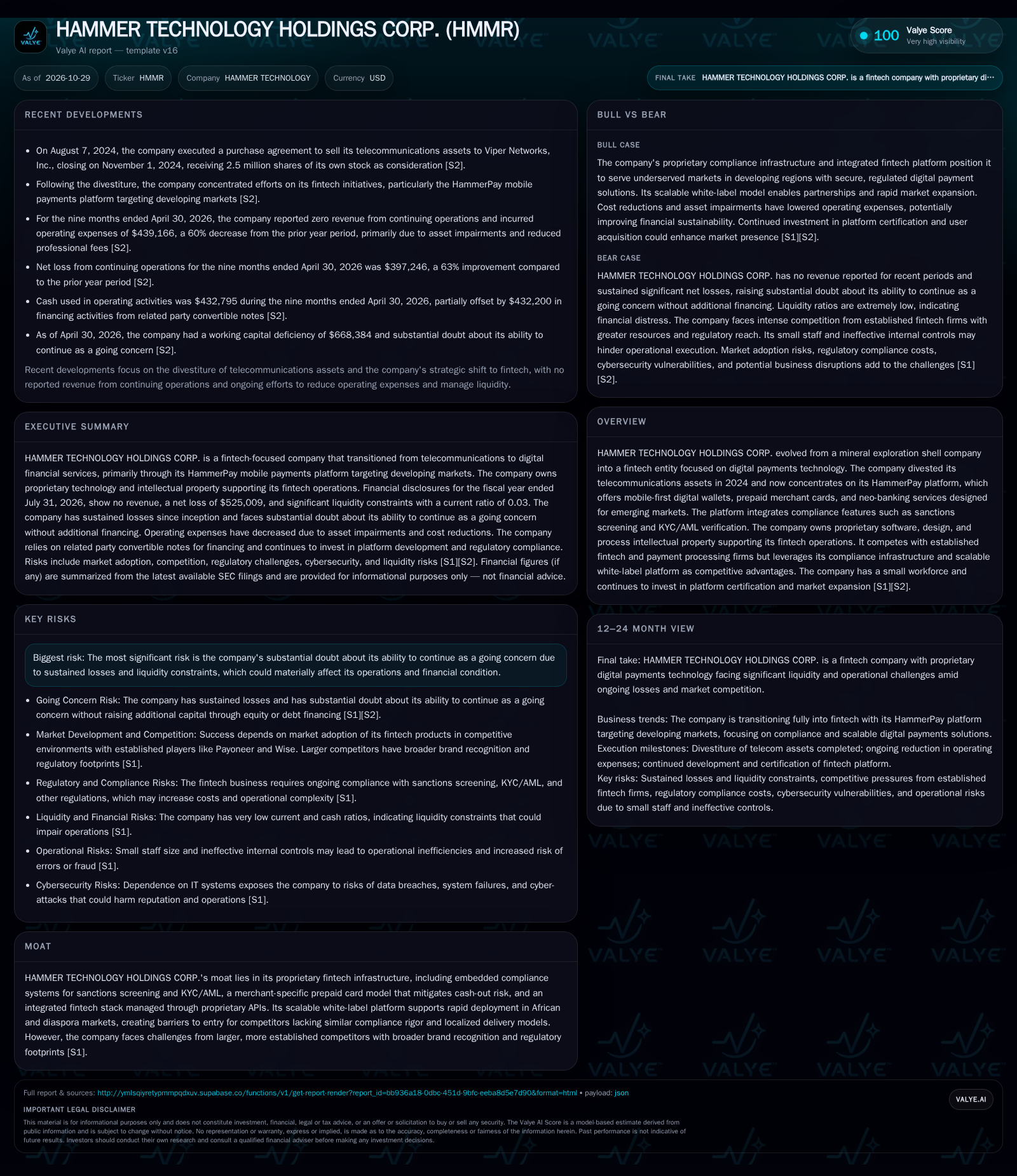
Hammer Technology Holdings Corp. is now a pure-play fintech operator focused on its HammerPay platform for digital payments in emerging markets. Despite a proprietary compliance stack and a scalable white-label model, the company reported zero revenue for the year ended July 2026, a net loss of $525,009, and a critical liquidity deficit. Survival depends on securing outside financing and achieving initial commercial traction in a crowded, compliance-intensive market. [S1] [S2]
Hammer Technology Holdings Corp. has undergone a dramatic transformation, shedding its legacy telecom business to emerge as a fintech hopeful centered on HammerPay, a digital payments platform designed for emerging markets. Despite owning proprietary technology and focusing on embedded compliance features, the company enters this new phase with no revenue, ongoing net losses, and a precarious liquidity position. The big question is whether Hammer’s technical assets and strategic focus can overcome severe funding and competitive headwinds before financial realities force a pivot—or an exit.
From Telecom Exit to Fintech Gamble: Hammer’s Latest Milestones
Hammer Technology Holdings Corp. completed the sale of its telecommunications assets in late 2024, fully pivoting to fintech with the HammerPay platform as its core offering [S1] [S2]. [S1] Hammer has reduced its operating expenses—primarily through asset impairments and lower professional fees—yet it continues to rely on related party convertible notes to fund ongoing operations [S2]. Substantial doubt remains about its ability to continue as a going concern without new capital, underscoring the urgency of commercializing its fintech assets or securing outside investment [S1] [S2].
Unit Economics and Scalability: The Roadblocks Ahead
HammerPay’s business model is centered on digital wallets, merchant prepaid cards, and neo-banking services, all underpinned by proprietary compliance tools like sanctions screening and KYC/AML verification [S1]. In principle, digital payments platforms can achieve high operating leverage: core software and compliance systems are fixed-cost investments, while incremental transaction and user acquisition costs should scale favorably with volume. However, Hammer’s lack of revenue to date suggests either slow user adoption, incomplete commercial rollout, or regulatory bottlenecks.
The company’s white-label approach is designed to attract partners in African and diaspora markets, enabling faster geographic expansion without the need for direct end-user acquisition in every market. If adopted, this model could reduce customer acquisition costs and allow Hammer to monetize through licensing, transaction fees, or revenue-sharing arrangements. However, the upfront costs of certification, compliance, and local licensing remain significant, and the company’s current cash position is insufficient to fund a sustained go-to-market push.
Hammer’s ongoing reliance on related party convertible notes for funding highlights the absence of internally generated cash flow. Until meaningful recurring revenue is established, the company faces a capital-intensive uphill climb with little margin for operational missteps [S2].
Can Proprietary Compliance Tech Offset Scale Disadvantages?
Hammer faces formidable competitors including global payment processors and fintech platforms such as Payoneer, Wise, Stripe Treasury, and Marqeta [S1]. These incumbents benefit from established regulatory relationships, broad brand recognition, and the ability to cross-subsidize new market entries. Hammer’s pitch centers on its proprietary compliance infrastructure—offering embedded sanctions screening and KYC/AML tools—and its merchant-specific prepaid card model designed to mitigate cash-out risk [S1].
While this compliance-first architecture could appeal to partners operating in high-risk or underbanked markets, it is not yet proven that such differentiation is sufficient to overcome the scale, trust, and integration advantages of larger players. Furthermore, Hammer’s small staff and acknowledged internal control weaknesses may hamper its ability to rapidly adapt to evolving compliance regimes or execute complex B2B partnerships.
The question is whether Hammer can carve out a defensible niche by targeting overlooked or underserved segments, or whether it will be outcompeted before achieving critical mass.
What a Breakout Would Require: Early Adopter Partnerships and Transaction Growth
The most optimistic scenario for Hammer involves successfully leveraging its compliance stack and white-label platform to secure partnerships with regional banks, remittance providers, or local fintechs in African or diaspora markets. These early adopters would pilot HammerPay for digital wallet issuance, cross-border payments, or merchant card solutions, providing the first streams of recurring transaction revenue.
If initial deployments validate Hammer’s compliance and integration claims, the company could see rapid scaling through additional white-label partnerships, creating operating leverage and improving cash flow. Confirmation would come from disclosed customer wins, platform transaction volume growth, and the first instances of recognized revenue in filings. Evidence of follow-on investments or third-party financing (beyond related party notes) would further support the credibility of the growth path.
To falsify this upside, a continued absence of revenue, lack of named partners, or inability to demonstrate user adoption in target markets would indicate that the product is not gaining commercial traction.
A Waiting Game: Platform Development Outpaces Commercialization
The most plausible near-term outcome is slow, incremental progress on platform certification and compliance readiness, but continued difficulty in securing anchor partners or initial user bases. Hammer may expend remaining resources on regulatory approvals, UI/UX enhancements, and pilot integrations, but without sufficient funds to drive aggressive business development or marketing.
In this scenario, Hammer continues to report negligible or zero revenue, relies on additional convertible note financings or small equity raises, and remains in a holding pattern. Any partnerships or pilot projects are likely to be small-scale, with minimal impact on financials. Confirmation would come from continued operating losses, absence of revenue in future filings, and lack of meaningful user or transaction metrics.
A deviation from this scenario would be signaled by a material capital raise, a disclosed major partnership, or a shift in reported financials indicating revenue generation.
Liquidity Crunch and Strategic Alternatives: Risks of a Forced Pivot
The adverse scenario is defined by Hammer’s inability to secure new outside funding before its limited cash resources are exhausted. With a current ratio of 0.03 and minimal cash on hand, the window for operational runway is exceedingly narrow [S1]. If additional financing—whether from related parties or external investors—does not materialize, Hammer could be forced to suspend operations, sell off its IP assets, or pursue a distressed sale or merger.
Other downside triggers include regulatory setbacks, a cybersecurity incident, or a material adverse event impacting its small team. Confirmation would be a going concern qualification in future filings, public disclosures of IP sales, or a sharp reduction in reported headcount or ongoing operations.
A reversal of this scenario would require a successful capital raise, evidence of revenue generation, or a strategic partnership that materially improves Hammer’s financial position.
Crucial Developments That Will Determine HammerPay’s Viability
Disclosure of initial commercial partnerships or pilot programs using the HammerPay platform—especially with regional banks, fintechs, or remittance players in target markets.
First instances of recognized revenue or transaction volumes reported in SEC filings.
Evidence of successful platform certifications, regulatory approvals, or new licensing wins in core geographies.
Material third-party capital raises or new financing arrangements that extend operational runway beyond related party convertible notes.
Platform user growth metrics or merchant adoption rates, if disclosed.
Improvements in operating expense efficiency and a clear path toward positive gross margins, as indicated by future filings.
Strengthening of internal controls or expansion of the full-time team to support compliance and business development.
Any indications of IP asset sales, strategic alternatives, or public statements regarding a change in business direction.
Disclaimer: This is research-only, informational analysis and not investment advice. It may include AI-generated interpretation and general industry context. Always verify important details using primary sources.

Comments