
Terex: Capital Deployment Accelerates as Profitability Exceeds Expectations, but Cyclical Forces Loom
Terex’s recent outperformance and a $500 million share buyback signal management’s confidence in its multi-billion-dollar industrial platform.
Its fortunes remain tightly linked to cyclical construction and infrastructure demand, with competitive pressures from larger peers shaping future margins and share.
Terex Corporation’s latest quarter delivered both a beat on profit and revenue and a bold move in capital deployment, as management announced a $500 million share repurchase program. These developments suggest confidence in the company’s earnings power and balance sheet stability, even as the industrial equipment sector faces persistent economic and competitive headwinds.
Recent Outperformance and Capital Deployment Shape Terex’s Near-Term Narrative
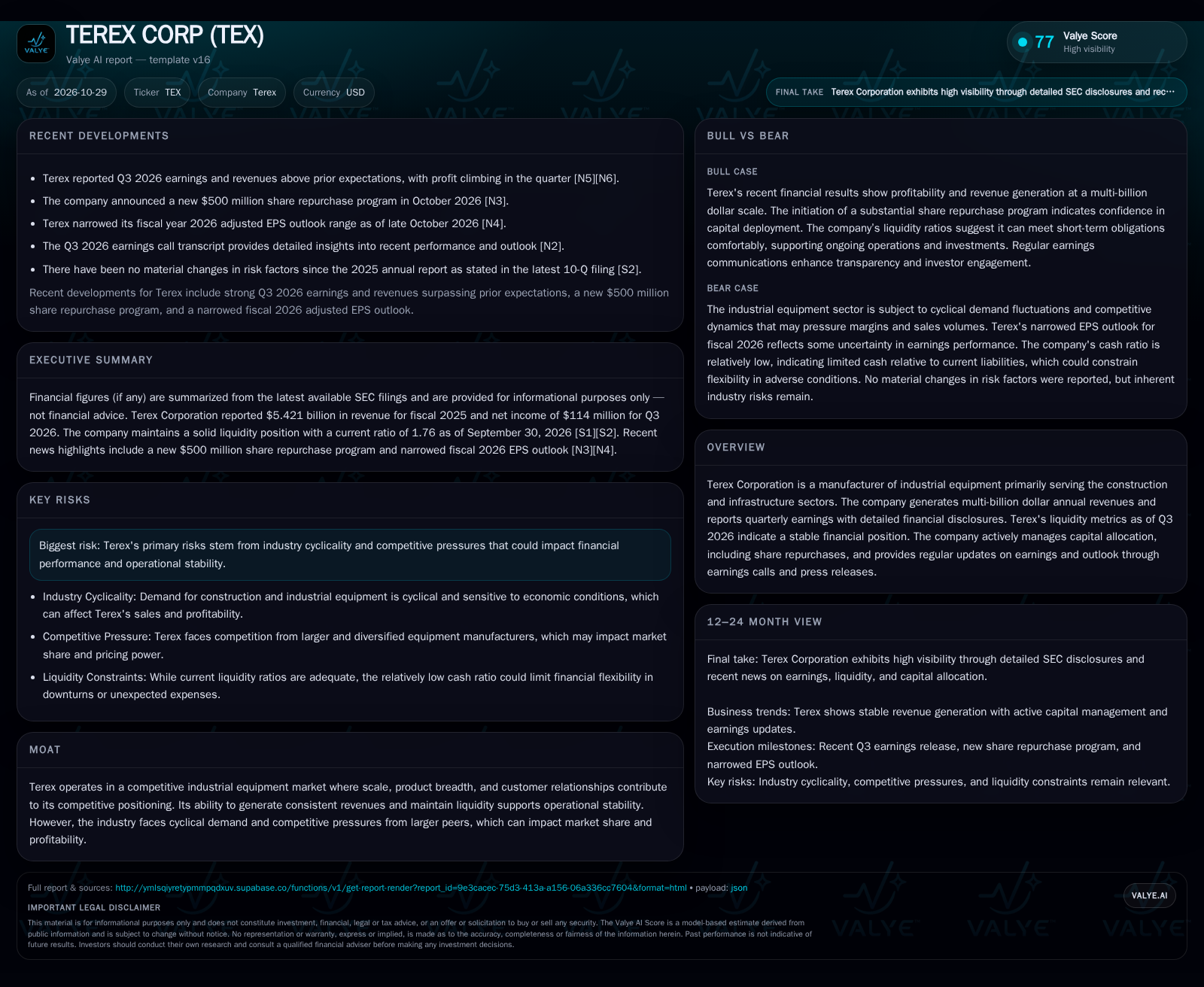
Terex’s Q3 2026 results stood out, with net income of $114 million and basic EPS of $1.01, both exceeding prior expectations [S2] [N5] [N6]. This operational strength was complemented by the announcement of a new $500 million share repurchase program in October 2026, which marks a significant capital allocation decision [N3]. The company reported cash and liquidity metrics for the period; these figures do not by themselves establish operating runway, investment capacity, financial flexibility, or financing capacity. [S2] Terex also narrowed its fiscal 2026 adjusted EPS outlook, suggesting management’s attempt to balance optimism from recent momentum with a prudent view of forward risk [N4]. These facts collectively point to a company operating with confidence, but still facing the realities of cyclical demand and a competitive industrial landscape.
How Terex’s Revenue Model and Cost Structure Play Out Over the Cycle
Terex’s business model hinges on manufacturing and selling heavy equipment for construction and infrastructure, markets that are inherently cyclical and capital-intensive. Revenue is typically volume-driven, with pricing power constrained by the presence of large, diversified competitors and the commoditization of many product lines. Periods of elevated construction activity can drive robust order intake and factory utilization, enhancing operating leverage as fixed manufacturing costs are spread over greater output. Conversely, downturns can quickly erode margins, as overhead becomes harder to absorb and competitive pricing pressures intensify.
The company’s multi-billion-dollar annual revenue base ($5.421 billion in FY25 [S1]) allows for scale efficiencies in procurement, R&D, and distribution, but also necessitates substantial working capital. [S2] Capital deployment—such as the new $500 million buyback—suggests management sees excess capital, but also introduces the tradeoff between returning cash to shareholders and preserving optionality for downturns or strategic investments.
A critical element influencing Terex’s profitability throughout the cycle is its ability to manage cost structure flexibility. Given the capital-intensive nature of heavy equipment manufacturing, fixed costs such as plant overhead, depreciation, and salaried labor represent a significant portion of total expenses. In periods of demand contraction, the challenge lies in scaling down these fixed costs without impairing operational readiness for an eventual rebound. The company’s success in implementing variable cost controls, such as adjusting raw material procurement or temporary workforce utilization, would help sustain margins during downturns. Additionally, supply chain efficiency and inventory management become pivotal in mitigating working capital strain, especially when order volumes fluctuate widely.
Another dimension to consider is the impact of product mix on revenue and margin volatility. Terex’s portfolio spans multiple equipment categories with differing demand sensitivities and margin profiles. For instance, specialized or higher-technology products may command premium pricing and exhibit less cyclical volatility compared to commoditized offerings. A strategic emphasis on expanding higher-margin segments or aftermarket services could provide a buffer against cyclical swings. However, this requires ongoing investment in R&D and market development, which must be balanced against capital return initiatives. Monitoring shifts in product mix and associated margin contribution would provide insight into the company’s evolving resilience to industry cycles.
Competitive Dynamics: Scale, Breadth, and the Shadow of Larger Rivals
Terex competes in a global industrial equipment sector marked by intense rivalry, especially from larger, more diversified manufacturers. Its competitive position is built on product breadth, customer relationships, and the ability to serve multiple end-markets, but it lacks the absolute scale and integrated service ecosystems of the industry’s largest players. This limits pricing power and increases vulnerability to aggressive discounting or innovation cycles led by better-capitalized peers.
Switching costs for customers in construction and infrastructure are moderate—while some equipment may be specified or integrated into project workflows, buyers typically have alternatives and negotiate on price and service. Product reliability, dealer support, and residual value are important, but not always sufficient to prevent share erosion when market conditions tighten. Technology substitution (such as electrification or automation) could reshape competitive dynamics if Terex cannot keep pace with innovation, particularly as customer preferences evolve and regulatory requirements tighten.
Sustained Demand and Margin Expansion Could Drive Outperformance
If global construction and infrastructure spending remains robust and Terex successfully executes on operational improvements, the company could benefit from sustained high utilization, positive operating leverage, and incremental margin expansion. Evidence for this scenario would include continued beats on earnings and revenue expectations, backlog growth (if disclosed), and upward revisions to guidance.
Additional upside could come from effective product innovation, expansion into new geographic markets, or targeted M&A that adds higher-margin offerings or service revenue streams. Confirmation would be visible through improved gross and operating margins, increased R&D investment with visible returns, or a rising share of aftermarket or recurring revenue. This scenario would be falsified if demand softens unexpectedly or if input cost inflation outpaces pricing gains, compressing margins despite healthy top-line trends.
Most Likely: Stable Execution, Cyclical Moderation, and Active Capital Return
The most plausible outcome is that Terex continues to execute steadily, maintaining profitability and modest growth as end-market demand normalizes after recent strength. Management’s narrowing of the FY26 adjusted EPS outlook suggests a focus on delivering within a defined range, reflecting both recent operational outperformance and a recognition of cyclical realities [N4].
Under this scenario, the share repurchase program proceeds as planned, supporting EPS and potentially share price, but does not fundamentally alter the company’s exposure to industry cycles or competitive pressure. Capital allocation remains balanced between shareholder returns and investment in product development or incremental capacity. This outlook would be confirmed by stable margins, consistent cash flow generation, and absence of material risk factor changes. It would be challenged if a sharp downturn in construction/infrastructure demand or a competitive shock triggered a significant earnings or liquidity shortfall.
Cyclical Downturn or Liquidity Stress Could Force Strategic Retrenchment
A severe downturn could force the company to curtail or suspend the share repurchase program, delay capex or product launches, and rely on external financing to bridge working capital needs. Competitive pressures could intensify as rivals vie for a shrinking pool of orders, leading to further price erosion. Evidence of this scenario would include negative revisions to guidance, deteriorating current and cash ratios, and management commentary signaling cost-cutting or restructuring. This risk would be mitigated if Terex demonstrates the ability to flex its cost structure rapidly and maintain access to external liquidity.
Milestones That Will Define Terex’s Resilience and Capital Return Thesis
Quarterly trends in order intake and backlog (if disclosed) to gauge forward demand and revenue visibility.
Progress and pace of the $500 million share repurchase program, including impact on share count and capital allocation flexibility.
Gross and operating margin trajectory, especially in the face of potential input cost inflation or competitive pricing pressure.
Any material change in risk factors disclosed in future SEC filings, particularly relating to industry cyclicality or competitive threats.
New product launches, technology partnerships, or M&A activity that could alter the company’s margin profile or competitive positioning.
Trends in geographic or customer segment mix, which could signal either diversification or rising concentration risk.
Management guidance revisions and commentary on end-market trends, especially regarding infrastructure stimulus or regulatory drivers.
Disclaimer: This is research-only, informational analysis and not investment advice. It may include AI-generated interpretation and general industry context. Always verify important details using primary sources.

Comments