
Group 1 Automotive: Expansion, Leverage, and the Challenge of Integration in a Shifting Auto Retail Landscape
Group 1 Automotive’s $1.3 billion Hennessy acquisition sharpens its U.S. dealership focus, but rising leverage, U.K. headwinds, and the evolving global auto supply chain test the durability of its multi-market model.
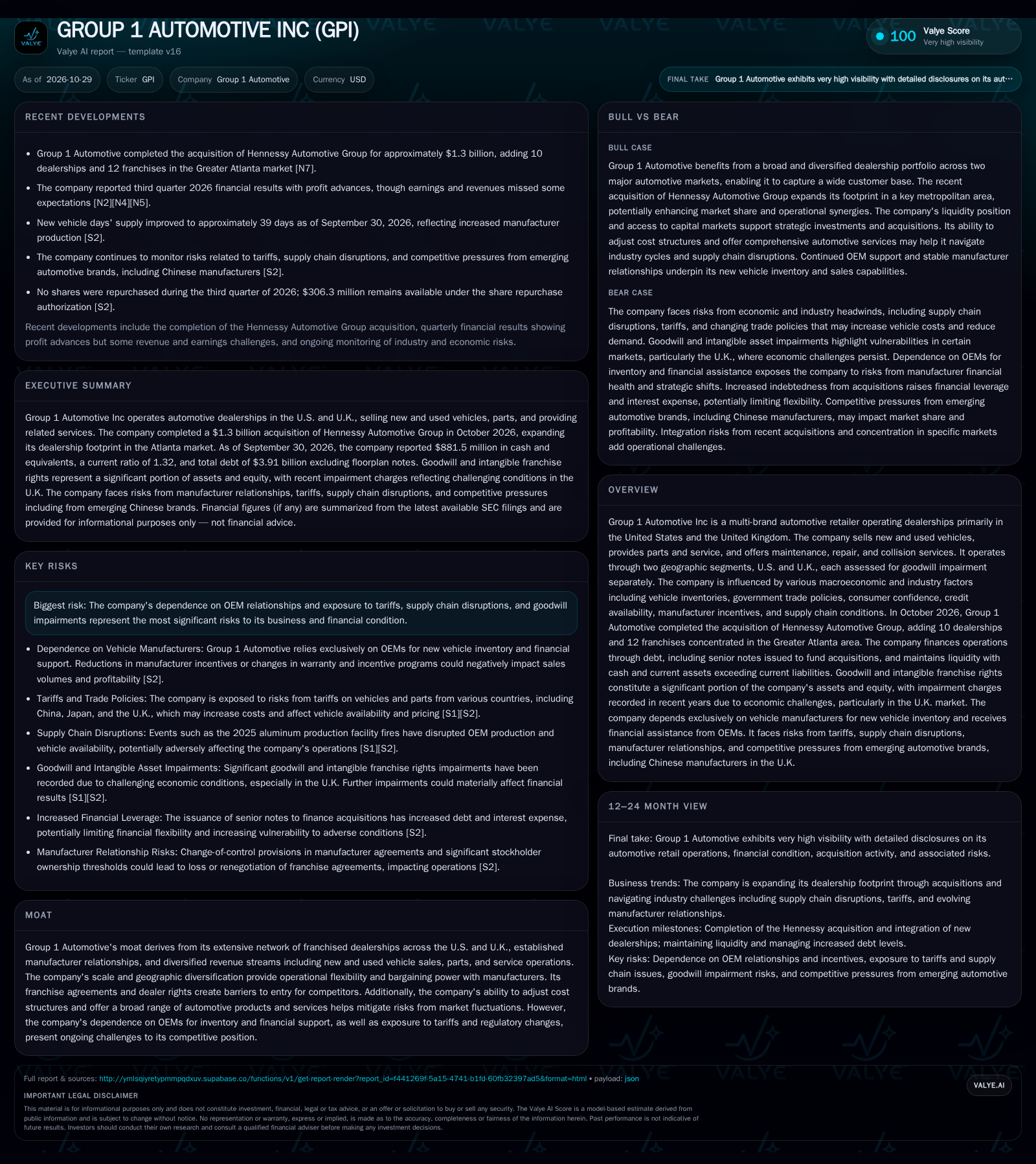
Group 1 Automotive recently acquired Hennessy Automotive Group, concentrating more dealerships in Atlanta and increasing total debt. While new vehicle supply has improved and profits advanced in Q3 2026, earnings missed some expectations. The company’s exposure to OEM incentives, tariffs, and integration risks—especially amid U.K. economic pressures and growing Chinese competition—could shape the next phase of its strategy and financial performance. [S2] [N2] [N7]
Group 1 Automotive’s recent $1.3 billion acquisition of Hennessy Automotive Group marks a pivotal expansion in the Atlanta market, increasing both its dealership count and exposure to regional dynamics. While the company’s Q3 2026 results showed profit growth, they also revealed shortfalls relative to some expectations, highlighting the complexity of scaling amid shifting macroeconomic and industry factors. With leverage up, integration risks rising, and the U.K. segment under pressure from impairments and new entrants, the next 12-24 months will test whether Group 1’s diversified dealership model can deliver sustainable value through cycles of supply, demand, and evolving competition. [S2] [N2] [N7]
Atlanta Acquisition, Debt Load, and U.K. Strains Define the Latest Chapter
Group 1 Automotive closed its $1.3 billion acquisition of Hennessy Automotive Group in October 2026, adding 10 dealerships and 12 franchises in the Greater Atlanta market. This move deepens the company’s presence in a single metropolitan area, raising both the prospect of market share gains and the risk of geographic concentration. To finance the deal, Group 1 issued $1.25 billion in senior notes, pushing total debt (excluding floorplan notes) to $3.91 billion and increasing annual interest expense by approximately $80 million. The company reported cash and liquidity metrics for the period; these figures do not by themselves establish operating runway, investment capacity, financial flexibility, or financing capacity. Meanwhile, the U.K. segment remains a pressure point: significant goodwill and intangible asset impairments, totaling over $180 million in 2025, underscore ongoing economic challenges in that market. [S2] [N7]
How Scale, Mix, and Manufacturer Reliance Shape Group 1’s Profit Engine
Group 1 Automotive derives revenue primarily from new and used vehicle sales, complemented by higher-margin parts, service, and collision repair operations. The business is capital-intensive, requiring substantial inventory financing (floorplan notes) and ongoing investment in dealership facilities, technology, and working capital. The recent Hennessy acquisition amplifies fixed costs and debt service, heightening the need for integration synergies and sustained sales throughput to preserve margin and return on capital.
Variable costs are influenced heavily by OEM incentives and support, which affect both gross margins on new vehicle sales and cash flow via floorplan interest assistance and advertising subsidies. Any reduction in these supports, or a shift in OEM channel priorities, could quickly squeeze dealership-level profitability. Parts and service operations generally provide steadier, higher-margin revenue, but are sensitive to the installed vehicle base, consumer discretionary spending, and shifts in vehicle technology (notably, the transition to electric vehicles, which require less frequent traditional maintenance).
The debt-funded Hennessy deal increases leverage and interest burden, raising the company’s break-even point and exposing it to greater downside risk if volumes or margins slip. Operating leverage is present but not unbounded: cost-cutting efforts, such as the 2026 U.S. SG&A reduction, can offset some cyclical pressure, but large fixed costs and goodwill-heavy balance sheets leave less room for maneuver if market conditions deteriorate. [S2]
Dealer Scale, Franchise Rights, and the Rising Tide of New Entrants
Group 1’s competitive position is anchored by its scale—spanning over 145 U.S. and 104 U.K. dealerships—and its established relationships with a range of major OEMs. Franchise agreements and dealer rights provide some local exclusivity and create regulatory and financial barriers to entry, particularly in the U.S. However, geographic diversification is becoming less pronounced with the Atlanta-centric Hennessy acquisition, increasing exposure to regional economic swings and competitive intensity.
In the U.K., Group 1 is expanding its brand portfolio by partnering with emerging Chinese automakers (e.g., Geely, Chery/Omoda & Jaecoo), aiming to capture share as Chinese brands gain traction and as EV adoption accelerates. This strategy could diversify risk and tap new growth pools, but also introduces execution risk and uncertainty regarding long-term brand strength and consumer acceptance.
Competitive threats are intensifying: digital retail models, direct-to-consumer sales (particularly for EVs), and aggressive pricing from new entrants (notably Chinese brands) are putting pressure on traditional dealership economics. The company’s reliance on OEMs for inventory and incentives remains a structural vulnerability—any change in manufacturer strategy, such as a pivot toward direct sales or reduced support, could erode Group 1’s bargaining power and profitability. [S2]
What a Successful Integration and OEM Tailwind Could Unlock
If Group 1 rapidly integrates Hennessy Automotive Group, achieving cost and operational synergies while leveraging Atlanta’s strong auto market fundamentals, it could drive above-average growth in both top-line and operating income. Continued improvement in new vehicle supply—currently at 39 days, up from 46 days at year-end 2025—would support higher sales velocity, while robust OEM incentives and stable or improving consumer credit could further boost throughput and gross profit per unit.
In the U.K., effective expansion with Chinese brands and successful navigation of new emissions and EV standards could help offset macroeconomic headwinds and impairments, positioning Group 1 as a first-mover in the fast-growing affordable EV segment. If parts and service revenue remain resilient, and the company maintains access to low-cost debt or refinances at favorable terms, cash flow could support further strategic acquisitions or shareholder returns.
Confirmation of this scenario would come from above-peer sales growth in Atlanta, visible synergy realization (e.g., lower SG&A as a percentage of sales), improved margin trends in the U.K., and evidence of growing parts/service attachment rates on new Chinese-brand vehicles. Disclosure of new OEM agreements or expanded partnership terms would also support the upside narrative. [S2] [N7]
Mixed Signals: Navigating Debt, Macro Shocks, and Margin Management
The most plausible near-term outcome is that Group 1 sees steady but unexceptional growth, with the Hennessy acquisition providing incremental revenue and scale but integration costs and Atlanta market competition tempering margin expansion. Debt service will absorb a larger share of operating cash flow, and goodwill/intangible balances will remain elevated, with periodic impairment risk—especially if U.K. economic growth lags or EV adoption outpaces the company’s ability to adapt its service model.
OEM incentives and support are likely to remain broadly intact but could fluctuate with supply chain disruptions, trade negotiations (notably U.S.-Mexico and U.K.-EU tariffs), and changes in manufacturer channel strategy. Parts and service revenue may offset some cyclicality in new vehicle sales, but margin pressure could persist if labor or input costs rise or if digital/direct-to-consumer competition accelerates.
Failure to show synergy capture or persistent underperformance in the U.K. would challenge even this moderate trajectory. [S2]
Integration Stumbles, OEM Disruption, and Margin Compression Risks
A more adverse scenario would see the Hennessy acquisition running into significant integration problems—such as higher-than-expected costs, talent attrition, or local market saturation—undermining the anticipated synergies and dragging on consolidated margins. If OEM incentives are reduced, or if a major manufacturer changes its retail channel model (e.g., greater use of direct sales or reduced dealer support), Group 1 could face rapid deterioration in new vehicle margins.
In the U.K., further economic weakness or regulatory changes (e.g., stricter Euro 7 emissions standards or anti-modification rules) could trigger additional goodwill or franchise right impairments and squeeze profitability. Rising competition from Chinese and other new entrants may erode market share or force aggressive discounting. Elevated leverage and interest expense would amplify the financial impact of any operational shortfall, potentially constraining investment in digital capabilities or new brand partnerships.
Confirmation would include negative Atlanta sales or margin trends, missed synergy targets, further impairment charges in the U.K., rising interest coverage ratios, and/or disclosure of adverse OEM contract changes. Material declines in parts and service revenue or loss of key franchises would further validate the downside. [S2] [N7]
Milestones That Will Reveal Group 1’s Ability to Scale and Adapt
Progress on integrating the Hennessy acquisition—measured by cost synergies, SG&A as a percentage of sales, and Atlanta market share movement—would help clarify the deal’s value.
Trends in new vehicle days’ supply and inventory turnover, especially relative to peers, will indicate whether supply chain normalization is translating into sales velocity and margin stabilization. [S2]
Disclosure of OEM incentive levels, floorplan support, and any changes in manufacturer relationships or contract terms would test the resilience of the business model (if disclosed).
Parts and service revenue growth, especially attachment rates for new brands and EVs, would signal the durability of high-margin aftersales economics.
Further impairments to goodwill or intangible franchise rights—particularly in the U.K.—would indicate ongoing economic and regulatory pressure.
Debt service coverage and interest expense trends, including refinancing activity or covenant compliance, will determine potential financial flexibility as leverage rises.
Updates on expansion with Chinese brands, including sales volumes and consumer adoption in U.K. dealerships, will show whether Group 1 can capture new growth pools.
Any material shift in U.S. or U.K. trade policy or tariffs that impacts vehicle and parts pricing should be monitored for margin and demand implications.
Disclaimer: This is research-only, informational analysis and not investment advice. It may include AI-generated interpretation and general industry context. Always verify important details using primary sources.

Comments