
Albany International’s Strategic Evolution: Aerospace Momentum, Industrial Cyclicality, and Margin Trajectory Insights
A 34% revenue surge and new aerospace contract highlight Albany International’s deepening push into engineered composites, but exposure to industrial cycles and margin volatility remain central to the thesis. The company’s potential financial flexibility and differentiated product capabilities frame both its growth prospects and its vulnerability to sector headwinds.
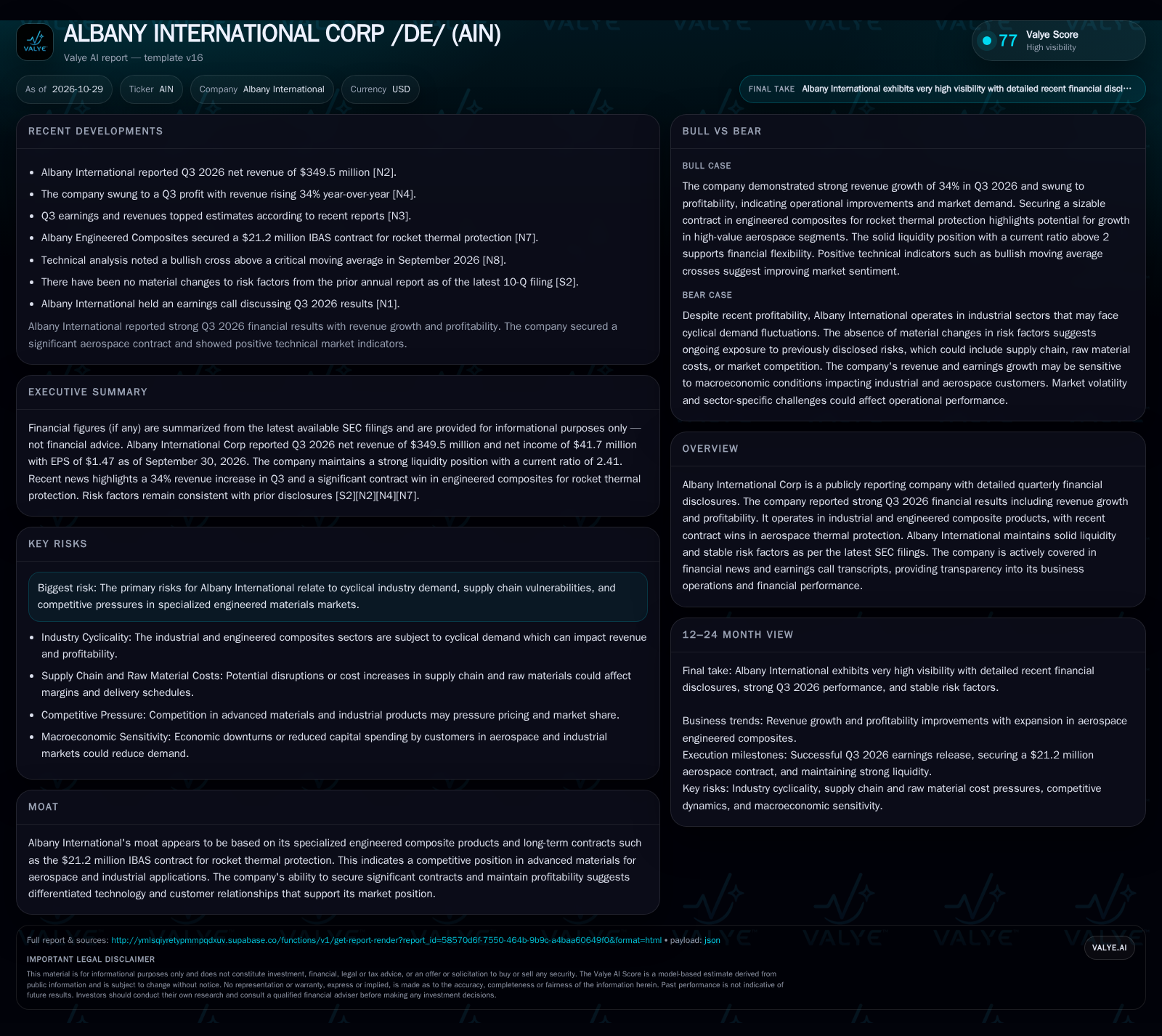
Albany International posted a 34% year-over-year revenue jump and returned to profitability in Q3 2026, driven in part by engineered composites and a $21.2 million aerospace contract. The company’s ability to leverage technical differentiation and secure recurring or high-value contracts will likely dictate future margin expansion and resilience. [S2] [N2] [N4] [N7]
Albany International’s Q3 2026 results represent a pivotal moment: a 34% jump in revenue, a return to profitability, and a high-profile $21.2 million aerospace contract all signal operational momentum and growing traction in engineered composites. Yet, beneath these headline achievements, the company’s core exposure to cyclical industrial demand and the challenge of translating technical differentiation into durable, high-margin contracts remain central to the investment debate. The next phase will test whether Albany’s specialized capabilities in composites can consistently drive growth and margin expansion, or if macro and sector-specific headwinds will reassert themselves as primary constraints.
Recent Financial Results and Strategic Advances Provide Context
Albany International reported Q3 2026 net revenue of $349.5 million, representing a 34% increase year-over-year, alongside a swing to net profit of $41.7 million and basic EPS of $1.47 [S2] [N2] [N4]. This surge is notable given the company’s historical exposure to industrial cyclicality and signals renewed demand or successful execution in key segments.
A $21.2 million IBAS contract for rocket thermal protection, secured by Albany Engineered Composites, marks a strategic win in the aerospace sector and demonstrates the company’s ongoing push into higher-value, specialized engineered materials [N7].
The company reported cash and liquidity metrics for the period; these figures do not by themselves establish operating runway, investment capacity, financial flexibility, or financing capacity. [S2]
No material changes to risk factors were disclosed in the latest 10-Q, indicating that the company’s risk profile—dominated by industry cyclicality, supply chain, and competitive dynamics—remains fundamentally unchanged [S2].
Impact of Albany International’s Diversification on Earnings Stability
Albany International’s business model straddles industrial engineered products and advanced composites for aerospace and defense. Revenue is likely split between more commoditized industrial applications (such as paper machine clothing and filtration) and higher-margin, lower-volume engineered composites—each with distinct pricing, volume, and margin dynamics.
In the industrial segment, pricing power tends to be limited, and revenues are closely tied to the capital expenditure cycles of end customers in pulp, paper, and related industries. Margins here are often pressured by raw material costs and competition from global peers.
The aerospace composites division targets long-term contracts for critical components, such as the recently announced rocket thermal protection system. These contracts may offer higher gross margins, recurring revenue potential, and greater visibility, but typically require significant up-front investment in R&D, certification, and production tooling. The fixed-cost base in aerospace could create operating leverage as volumes ramp, but also increases risk if contract wins are lumpy or if major programs are delayed.
Capital requirements are moderate but can spike with new program ramps or facility expansions. [S2]
Standing Out in Advanced Composites Despite Commodity Market Pressures
Albany International’s edge in aerospace and advanced composites stems from proprietary manufacturing processes, technical know-how, and the ability to meet stringent customer specifications for mission-critical applications. This technical differentiation, as evidenced by the $21.2 million rocket thermal protection contract, enables the company to compete for specialized, less commoditized business where price is not the sole determinant [N7].
In traditional industrial markets, the company faces intense competition from other engineered materials providers, many of whom can match or undercut on price, limiting Albany’s ability to expand margins without cost or process innovation.
The primary competitive threat in composites comes from both established aerospace suppliers and emerging materials technology companies. Barriers to entry include qualification cycles, customer switching costs, and the need for deep technical collaborations. However, program concentration and customer dependency could expose Albany to volume risk if key contracts are lost or delayed.
The company’s ability to continuously win new, high-value contracts and maintain a technology pipeline will be central to sustaining its competitive position as legacy industrial markets mature or decline.
Aerospace Contracts as a Catalyst for Margin Growth
The most favorable scenario for Albany International involves a sustained ramp-up in aerospace composites, with the $21.2 million rocket thermal protection contract serving as a template for additional wins in defense, space, and commercial aviation [N7]. If the company can convert technical credibility into a pipeline of similar or larger contracts, operating leverage in the composites segment could drive significant margin expansion and earnings growth.
Confirmation of this scenario would include: further contract announcements in aerospace or defense; disclosure of backlog growth and improved revenue visibility in engineered composites; and evidence of rising segment margins. Additional signals would be a growing proportion of revenue from high-value, multi-year programs, and commentary on new platform wins or expansions with existing customers.
Falsification would occur if the recent contract proves isolated, if the composites backlog stagnates, or if margins in the segment fail to improve despite revenue growth—suggesting higher costs, execution challenges, or a lack of sustainable competitive edge.
Growth Prospects Amid Industrial Cycles and Execution Challenges
The most plausible outcome is a blend of continued growth in engineered composites and normalization in industrial product demand. Revenue and earnings may remain lumpy, reflecting the timing of aerospace contract ramps and the inherent cyclicality in industrial end markets.
In this scenario, Albany International maintains profitability and a reported balance sheet position but does not achieve step-change margin expansion. The company continues to secure intermittent high-value contracts, offset by occasional slowdowns or cost headwinds in legacy businesses.
Evidence supporting this scenario would include steady, if uneven, revenue growth; segment margin stability; and ongoing investments in R&D and new product introductions. Management guidance that emphasizes diversification and operational discipline, rather than aggressive expansion, would further support the base case.
Signs that would challenge this scenario include a sudden drop in industrial demand, persistent cost inflation outpacing price realization, or a drying up of new aerospace/composite contract opportunities.
Margin Risks from Cyclical Downturns and Contract Shortfalls
A less favorable trajectory arises if industrial demand contracts sharply due to macroeconomic weakness, or if the aerospace composites pipeline fails to deliver additional high-margin wins. In this scenario, Albany International could see revenues plateau or decline, with fixed costs in composites amplifying the impact on operating margins.
Margin compression could be exacerbated by raw material cost inflation, supply chain disruptions, or increased pricing pressure from competitors in both segments. If the company is unable to flex its cost base or secure new business, cash flow could deteriorate and force a reassessment of capital allocation priorities.
Downside confirmation would include declining revenue, shrinking segment margins, rising inventory or working capital needs, and a lack of new contract wins. Early warning signs could also be found in customer delays, program cancellations, or negative management commentary regarding order visibility.
Critical Developments Shaping Albany International’s Future Performance
The pace and scale of new contract wins in aerospace and defense composites, particularly deals comparable to or larger than the recent $21.2 million rocket thermal protection award [N7].
Revenue mix evolution between industrial products and engineered composites, if disclosed, to assess progress toward higher-margin business.
Segment-level margin trends, especially in engineered composites, as a leading indicator of operating leverage and pricing power.
Backlog growth and the conversion of announced contracts into realized revenue, if Albany International discloses these metrics.
Raw material cost trends and the company’s ability to offset input inflation through pricing or operational efficiencies.
Customer concentration and program dependency in the composites segment—disclosure of major customer/program risks would help test resilience.
Ongoing R&D and capex commitments, which signal management’s willingness to invest in new technology platforms and sustain the innovation pipeline.
Management commentary on macroeconomic conditions and order visibility, which may provide early signals of cyclical inflection points.
Disclaimer: This is research-only, informational analysis and not investment advice. It may include AI-generated interpretation and general industry context. Always verify important details using primary sources.

Comments