
Quad/Graphics Pursues Direct Mail and Packaging to Counter Margin Squeeze
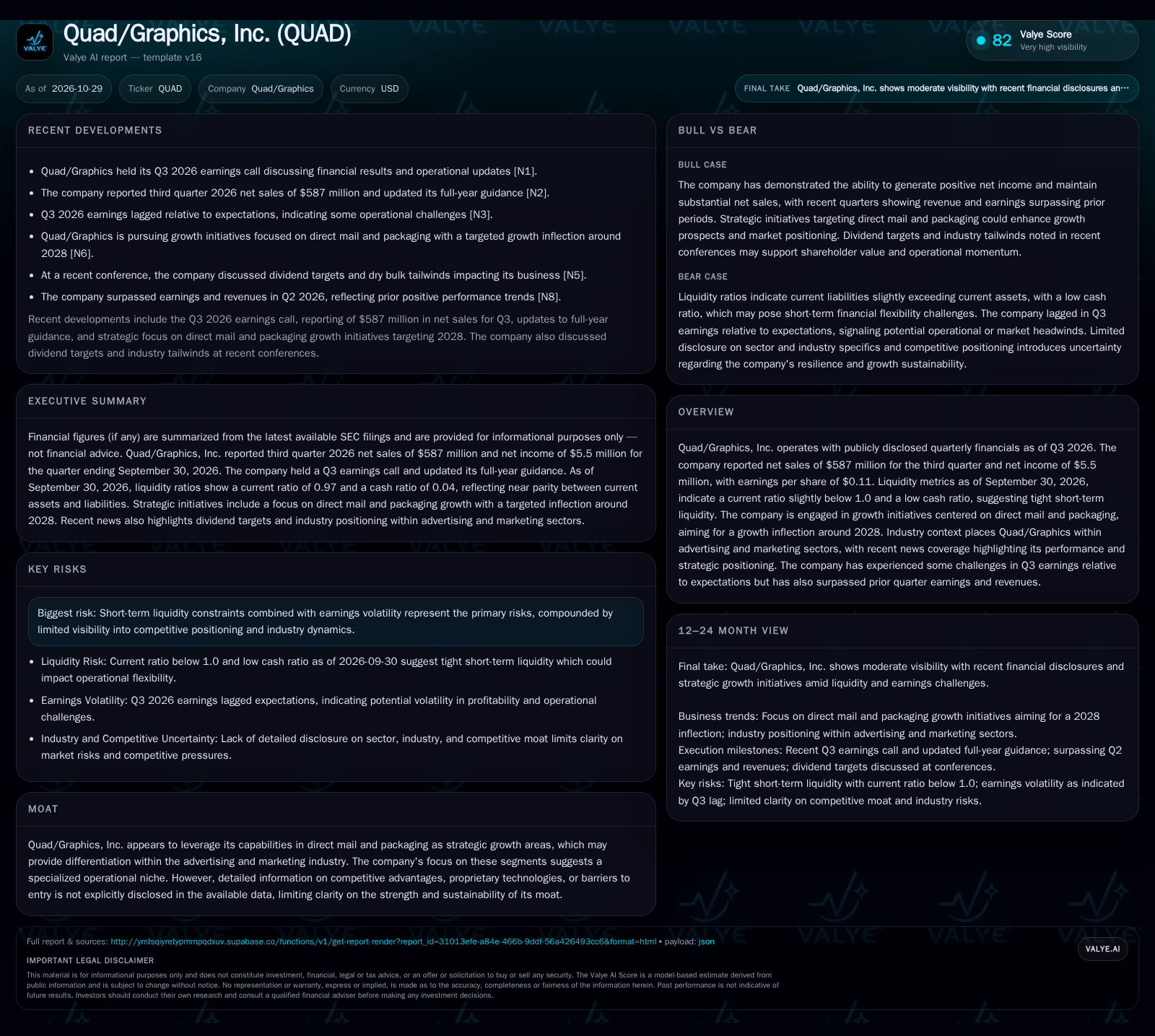
Quad/Graphics, Inc. is navigating a challenging print and marketing environment by pivoting toward direct mail and packaging, aiming for a growth inflection in 2028.
Q3 2026 earnings lagged expectations, underscoring ongoing margin and demand pressures. Success will depend on execution in higher-value segments and the company's ability to manage potential financial flexibility through a period of industry transition. [S2] [N2] [N3] [N6]
Quad/Graphics, Inc. stands at a strategic crossroads as print and traditional marketing services face secular headwinds. The company’s Q3 2026 results underscore both its ongoing relevance—with $587 million in net sales and a positive, if modest, net income—and its exposure to tight liquidity and margin compression. Management’s explicit focus on direct mail and packaging as future growth engines, with an inflection targeted for 2028, signals a necessary pivot to higher-value services. However, the combination of reported cash balance, near-parity between current assets and liabilities, and recent earnings volatility raises the stakes for execution and financial discipline over the next several years. [S2] [N2] [N3] [N6]
Revenue Stability Contrasts with Liquidity Challenges in Latest Results
As of September 30, 2026, Quad/Graphics reported net sales of $587 million for the third quarter and net income of $5.5 million, with basic and diluted EPS of $0.11. The company’s current assets of $574 million versus current liabilities of $590.4 million result in a current ratio of 0.97, while cash and cash equivalents stand at $22.8 million, yielding a cash ratio of just 0.04. The company reported cash and liquidity metrics for the period; these figures do not by themselves establish operating runway, investment capacity, financial flexibility, or financing capacity. Q3 earnings lagged expectations, contrasting with a stronger Q2 performance. The company held an earnings call and updated its full-year guidance, emphasizing the need to manage through current headwinds while pivoting strategically. [S2] [N2] [N3] [N8]
In such a context, the company's ability to optimize working capital becomes critical; efficient inventory management, receivables collection, and payables timing could provide incremental liquidity relief without external funding. Moreover, the timing and scale of capital expenditures must be carefully calibrated to avoid exacerbating cash constraints.
Economic Shifts in Direct Mail and Packaging Reshape Revenue Composition
Quad/Graphics has historically operated in capital-intensive print and marketing services, where fixed costs (facilities, presses, logistics) are high and margins are pressured by secular print declines. The company’s strategic emphasis on direct mail and packaging reflects a pivot to segments where print retains value due to personalization, regulatory requirements, and e-commerce tailwinds. Direct mail can command higher unit economics when integrated with data-driven marketing and omnichannel campaigns, while packaging benefits from defensible demand as consumer goods and e-commerce require physical containers.
However, the transition is not frictionless. Investments in new capabilities, potential retooling, and customer acquisition for these segments require capital and operational flexibility. Given the company’s current liquidity constraints, funding this shift may depend on internally generated cash flow, working capital discipline, or asset optimization. Operating leverage could improve if higher-margin segments grow as a share of revenue, but the risk is that legacy print declines outpace new business gains, intensifying margin pressure and straining the balance sheet.
The shift toward direct mail and packaging also introduces complexity in cost structure and operational execution. Packaging typically requires specialized equipment, materials sourcing, and compliance with safety or environmental standards, which may elevate fixed and variable costs initially. Direct mail, while benefiting from personalization and data integration, demands sophisticated customer analytics and fulfillment capabilities. These requirements imply that success hinges not only on market demand but also on the company's ability to integrate new technologies and processes efficiently. If the company can leverage scale economies and streamline supply chains in these segments, it may partially offset the capital intensity and reduce the risk of margin erosion during the transition.
Quad/Graphics Navigates Industry Challenges Through Targeted Market Segments
Quad/Graphics competes in a print and marketing ecosystem marked by price competition, digital substitution, and consolidation. Its focus on direct mail and packaging could offer some insulation from pure-play digital competitors, as these services are less easily replaced by online channels and can be integrated with digital marketing for enhanced impact. However, these segments remain fragmented and competitive, with both large diversified marketing firms and specialized packaging providers vying for share.
Quad/Graphics’ ability to differentiate may hinge on its scale, operational integration, and capability to deliver cross-channel campaigns. If it can leverage data analytics, workflow automation, and supply chain efficiency in direct mail and packaging, it could defend margins and customer relationships. The absence of disclosed proprietary technology or explicit switching costs suggests barriers to entry are moderate at best—meaning persistent pressure from both legacy and upstart rivals.
Competitive dynamics in direct mail and packaging are influenced by the convergence of traditional print providers with digital marketing firms and logistics specialists. Quad/Graphics’ established infrastructure may offer advantages in volume handling and geographic reach, but competitors with more agile digital platforms or niche packaging innovations could capture premium segments or faster-growing markets. The extent to which Quad/Graphics can develop proprietary data integration capabilities or establish exclusive partnerships will be a key determinant of differentiation. Additionally, the company’s ability to respond to evolving customer demands for sustainability and customization could influence its competitive positioning, as these factors increasingly drive purchasing decisions in packaging and direct marketing.
Direct Mail and Packaging Catalyze Potential Margin Improvement
If Quad/Graphics successfully executes its pivot, the direct mail and packaging businesses could outpace legacy print declines by 2028. This would likely require the company to secure key client wins in regulated verticals (healthcare, financial services), expand value-added offerings (personalized mail, smart packaging), and improve operational efficiency. Margin expansion could follow as higher-value segments represent a greater share of the revenue mix, enabling better pricing discipline and utilization of fixed assets.
Confirmation of this scenario would come from sustained growth in direct mail and packaging revenues, improved gross and operating margins, and evidence of new multi-year client contracts or partnerships. Additional signals would include increased capital expenditures directed at automation or packaging capabilities and a stabilization or improvement in liquidity metrics, suggesting internally funded growth.
Ongoing Margin Pressures Temper Steady Operational Advances
The most plausible outcome is that Quad/Graphics manages a gradual shift toward higher-value segments, but legacy print declines continue to offset much of the progress through at least 2028. Revenue may remain flat or experience modest growth, with periodic earnings volatility as the company navigates cost pressures and competitive pricing. Liquidity remains tight, requiring ongoing working capital management and possibly asset sales or refinancing to fund growth initiatives.
This scenario would be confirmed by stable or slightly growing direct mail and packaging revenues, but with overall margins remaining compressed and no meaningful improvement in current or cash ratios. Disclosures of incremental wins in target segments, but without step-change growth, would reinforce this view.
Growth Setbacks Could Prompt Strategic Retrenchment for Quad/Graphics
A negative outcome would see legacy print revenues erode faster than Quad/Graphics can ramp up direct mail and packaging, leading to declining total sales and persistent margin compression. Tight liquidity could become acute, forcing the company to curtail investments, divest assets, or seek external financing under unfavorable terms. Operational disruptions or loss of key clients could amplify the risk.
Missed guidance and increased earnings volatility would also signal deeper structural challenges.
Factors Influencing Quad/Graphics’ Financial and Strategic Outlook
Quarterly trends in direct mail and packaging revenue, if disclosed, would help gauge the pace and scale of the company’s strategic pivot.
Gross and operating margin trajectories, especially as new business segments scale, will clarify whether higher-value services are offsetting legacy declines.
Updates on client wins, multi-year contracts, or partnerships in target verticals would indicate market traction in growth initiatives.
Capital expenditure disclosures, particularly for automation and packaging, would signal the company’s commitment and ability to invest in transformation.
Changes in current and cash ratios, as well as operating cash flow, will provide early warning on liquidity risk or improvement.
Management commentary on cost structure optimization and asset utilization would help test whether operational efficiency gains are materializing.
Announcements of asset sales, refinancing, or restructuring would be red flags for intensified financial stress.
Disclaimer: This is research-only, informational analysis and not investment advice. It may include AI-generated interpretation and general industry context. Always verify important details using primary sources.

Comments