
Builders FirstSource: Scale, Integration, and Margin Pressure in a Shifting Housing Market
Despite a broad national footprint and ongoing expansion into value-added products, Builders FirstSource faces margin compression and profit declines amid a softening housing market. The company’s ability to leverage recent acquisitions and digital solutions for operational efficiency will be pivotal as cyclical and structural headwinds persist.
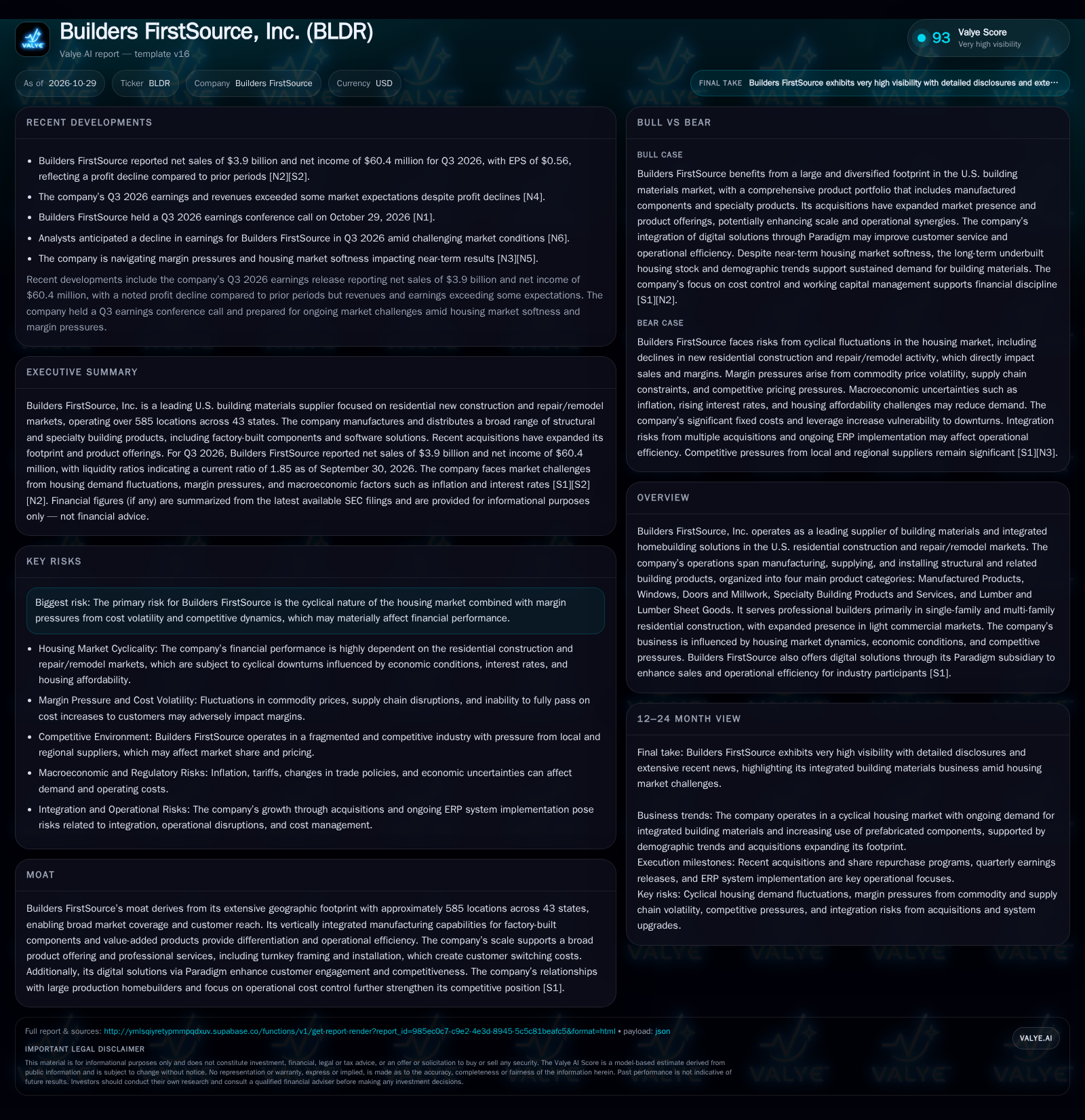
Builders FirstSource remains the largest U.S. supplier of building materials to professional builders, operating over 585 locations and expanding through acquisitions. Q3 2026 showed $3.9 billion in net sales but declining profits, as the company contends with margin pressures and housing market volatility. Its future hinges on extracting synergies from recent deals and using digital tools to offset cyclical risks and competitive threats. [S1] [S2] [N2] [N3]
Builders FirstSource, the nation’s dominant supplier of building materials to professional homebuilders, is navigating a complex environment shaped by cyclical housing demand, cost inflation, and intensifying competition. While its Q3 2026 revenue and earnings exceeded some expectations, profit declined on margin pressure, underscoring the company’s acute exposure to macroeconomic headwinds. Recent acquisitions and a growing digital solutions portfolio offer pathways for operational improvement, but execution risks and industry cyclicality continue to weigh heavily on near-term performance and strategic positioning. The question is whether scale and integration can outpace the structural challenges facing the broader U.S. housing and construction sector.
Q3 2026 Results Highlight Margin Compression and Strategic Expansion
Builders FirstSource reported $3.9 billion in net sales and $60.4 million in net income for Q3 2026, translating to basic and diluted EPS of $0.56. This marks a notable profit decline versus prior periods, attributed to ongoing margin pressures despite exceeding some market expectations on the top line. The company’s liquidity position as of September 30, 2026, included $55 million in cash and a current ratio of 1.85, but a reported cash ratio of 0.03. Since 2025, Builders FirstSource completed several acquisitions—Alpine Lumber, O. C. Cluss Lumber, Truckee Tahoe Lumber, and others—broadening its footprint and value-added product mix. The business remains acutely sensitive to housing market dynamics, commodity price swings, and competitive forces. [S1] [S2] [N2] [N3]
Integrated Product Portfolio and Cost Structure: Where Profits Are Made and Lost
Builders FirstSource generates revenue through manufacturing, supplying, and installing a wide array of building materials—ranging from commodity lumber to factory-built trusses, wall panels, windows, and turnkey installation services. The company’s scale enables bulk purchasing and efficient distribution, but exposes it to commodity price cycles, especially for lumber and sheet goods. While value-added components and services (such as engineered wood, millwork, and turnkey framing) typically offer higher margins and recurring demand, the company’s overall profitability remains tightly coupled to housing starts and repair/remodel activity.
Recent acquisitions are intended to increase exposure to higher-margin, prefabricated, and specialty products, which can generate more stable cash flows compared to pure commodity sales. However, the integration of these businesses introduces fixed costs and operational complexity, potentially offsetting near-term margin gains if synergies are delayed or market conditions deteriorate. Operating leverage is considerable: fixed distribution, manufacturing, and administrative expenses mean that volume declines (as seen in Q3 2026) can quickly erode profitability. The company’s capital structure—with a $750 million senior notes issuance and a $2.2 billion revolving facility—provides funding flexibility, but interest expense and leverage amplify downside risk in a cyclical downturn. [S1] [S2]
Scale, Service Breadth, and Digital Tools as Differentiators—But Local Competition Remains Fierce
Builders FirstSource’s competitive moat is built on its extensive national footprint (over 585 locations in 43 states), vertically integrated manufacturing, and ability to offer turnkey solutions—attributes that appeal to large production homebuilders seeking reliability and breadth. Its digital platform (Paradigm) provides tools for drafting, estimating, and virtual design, which may embed the company more deeply in customer workflows and could increase switching costs if adoption is broad.
Despite these advantages, the industry remains fragmented, with regional and local suppliers competing aggressively on price, service, and relationships. These smaller players can be more nimble in responding to local demand swings and may undercut pricing, especially in soft markets. The threat of substitution from alternative construction methods (e.g., steel framing, panelized systems from other vendors) is moderate but could rise if labor shortages or cost pressures persist. Ultimately, Builders FirstSource’s advantage hinges on its ability to deliver value-added products, maintain service levels, and leverage technology to reduce friction for customers.
If Synergies and Digital Adoption Accelerate, Margin Expansion Could Outpace the Cycle
A favorable outcome for Builders FirstSource would see its recent acquisitions fully integrated, with operational synergies realized through better procurement, manufacturing efficiency, and cross-selling of higher-margin products. If the Paradigm digital platform achieves broad industry adoption, it could lock in customers via workflow integration and data-driven services, reducing churn and enabling premium pricing. A stabilization or rebound in housing starts—driven by demographic tailwinds or improved affordability—would further support volume growth and operating leverage.
Evidence to confirm this scenario would include: sustained improvement in gross and operating margins despite volatile commodity prices; accelerating revenue from manufactured, value-added, and digital products; customer retention or expansion among large production builders; and public disclosures of digital platform adoption rates and cost savings from integration.
Navigating Cyclicality with Incremental Gains from Acquisitions and Product Mix
The most plausible trajectory is for Builders FirstSource to weather ongoing housing market softness, with modest growth from recent acquisitions and gradual improvement in the mix of value-added products. Margins may remain compressed as commodity price volatility and competitive pricing offset efficiency gains. The digital solutions business is likely to contribute incrementally, but not enough in the near term to materially alter the company’s margin profile.
This scenario would be confirmed by relatively stable revenue and earnings, with periodic margin volatility tied to commodity swings and housing activity. Watch for incremental margin improvement and steady contributions from new business lines, but not a step-change in profitability unless end-market demand improves or digital adoption accelerates. Delays or cost overruns in integrating acquisitions or rolling out new technology would be a sign that upside is capped, at least temporarily.
Prolonged Housing Weakness and Integration Missteps Could Trigger Margin Erosion
A negative scenario unfolds if U.S. housing starts and repair/remodel activity decline further or remain depressed, driving down volumes and amplifying the impact of fixed costs. Margin compression could accelerate if commodity prices remain volatile or the company is forced to lower prices to defend share against local competitors. Integration challenges—whether from operational disruptions, cultural misalignments, or delayed synergy realization—could further erode profitability.
This scenario would be confirmed by continued declines in net income, negative operating leverage, increased restructuring or impairment charges, and missed synergy targets from recent acquisitions. Additional warning signs would include rising interest expense outpacing earnings, deteriorating working capital metrics, and loss of key customer relationships to nimbler local or regional players.
Testing Builders FirstSource’s Thesis: What Will Determine Strategic and Financial Outcomes?
Gross and operating margin trends, especially in relation to commodity price volatility and product mix, will indicate whether value-added expansion is offsetting cyclical headwinds.
Revenue growth in manufactured and specialty product categories—if disclosed—would signal success in shifting the mix away from low-margin commodity sales.
Adoption rates and revenue contribution from Paradigm digital solutions, if disclosed, would help assess the platform’s potential for customer lock-in and margin improvement.
Integration milestones for recent acquisitions, including cost synergies and operational alignment, are critical for realizing expected benefits.
Working capital efficiency and inventory management, especially during periods of demand volatility, will affect both cash flow and profitability.
Customer concentration and retention rates among large production builders—if disclosed—would test the company’s ability to defend share against local competitors.
Interest expense trends and leverage ratios will reveal balance sheet risk in a cyclical downturn.
Disclaimer: This is research-only, informational analysis and not investment advice. It may include AI-generated interpretation and general industry context. Always verify important details using primary sources.

Comments